
If you’re following the Autoimmune Protocol, your snack options can feel painfully small. No nuts, no seeds, no grains. No dairy. And just when you think you’ve found something that might work, you flip the label and discover a non-compliant ingredient hiding in the fine print.
That’s exactly why so many people in the AIP community keep asking the same question: are tiger nuts actually okay to eat on the Autoimmune Protocol?
The short answer is yes, AIP tiger nuts are fully compliant with the elimination phase of the AIP diet. Despite the name, tiger nuts aren’t nuts at all. They’re small, naturally sweet tubers, and they may be one of the most gut-friendly foods you can add to an AIP lifestyle.
In this complete guide, you’ll discover what tiger nuts (also known as chufa) really are, why AIP tiger nuts support digestion, how they solve the biggest frustrations of the AIP diet, from boring snacks to seemingly impossible baking, and the easiest ways to enjoy them, whether you make them at home or buy them ready-made.
In this guide:
- What Are Tiger Nuts? Chufa, the Ancient Tuber
- Are Tiger Nuts AIP Compliant?
- Why Gut Health Is the Heart of the AIP Diet
- 5 Ways Tiger Nuts Support Digestion
- Solving Real AIP Diet Problems with Tiger Nuts
- 6 Easy Ways to Use Tiger Nuts on AIP
- Homemade vs. Store-Bought: What’s Better on AIP?
- Tips for Sensitive Stomachs
- Final Thoughts
- Frequently Asked Questions
What Are Tiger Nuts? Chufa, the Ancient Tuber Everyone Mistakes for a Nut
Let’s clear up the biggest misunderstanding first: tiger nuts have nothing to do with tigers, and nothing to do with nuts.
Tiger nuts are the small, wrinkled tubers of Cyperus esculentus, a grass-like plant also known as chufa. They grow underground, like tiny sweet potatoes. Humans have been eating them for thousands of years; traces of tiger nuts have been found in ancient Egyptian tombs, and in Spain they’ve been pressed into horchata de chufa, a creamy traditional drink, for centuries.
So why should anyone on the Autoimmune Protocol care about an ancient African and Spanish staple? Because AIP tiger nuts check nearly every box the elimination phase demands: they’re naturally grain-free, gluten-free, dairy-free, and, crucially, free of the nut proteins that make tree nuts off-limits on AIP.
Nutritionally, these little tubers punch well above their weight:
- Prebiotic fiber, a significant dietary source of resistant starch, the type of fiber that feeds beneficial gut bacteria
- Monounsaturated fats, similar heart-friendly profile to olive oil
- Iron, magnesium, potassium, and zinc, minerals many people on restrictive diets struggle to get enough of
- Vitamin E, an antioxidant that supports immune balance
- Natural sweetness, with a mild, slightly nutty flavor that satisfies cravings without any added sugar
Think of them as “nut-free nuts”: all the satisfying crunch, creaminess, and versatility of nuts, with none of the immune-triggering proteins. That’s precisely what makes AIP tiger nuts such a breakthrough ingredient for people who miss nut butters, baked goods, and crunchy snacks.
Benefit hook: Imagine spreading creamy “nut butter” on a snack, baking soft cookies, or pouring a glass of sweet, creamy “milk”, all 100% compliant with the strictest phase of the AIP diet. That’s what tiger nuts make possible.
Are Tiger Nuts AIP Compliant?

This is the question that stops most people before they ever try tiger nuts: are tigernuts AIP? After all, the Autoimmune Protocol eliminates nuts, and anything with “nut” in the name sounds suspicious.
Here’s the reassuring truth: AIP tiger nuts are compliant even during the strict elimination phase, the hardest part of the protocol. Here’s why:
1. They’re tubers, not tree nuts.
The AIP diet eliminates tree nuts (almonds, walnuts, cashews) and peanuts because their proteins can trigger immune responses in sensitive individuals. Tiger nuts are root vegetables. They contain no nut proteins whatsoever, so the entire reason nuts are excluded simply doesn’t apply.
2. They’re naturally free of every major AIP exclusion.
No grains, no gluten, no dairy, no eggs, no nightshades, no seeds. No legumes. Tiger nuts in their whole, natural form sail through the elimination checklist untouched.
3. They fit the “nutrient density” principle.
The AIP diet isn’t just about what you remove; it’s about what you add. The protocol emphasizes nutrient-dense foods that support immune regulation and gut repair. With their prebiotic fiber, minerals, and healthy fats, AIP tiger nuts actively contribute to the healing goals of the diet rather than just “being allowed.”
A note on tiger nut allergy: true tiger nut allergy is considered rare, but it can occur, just as with any food. Because tiger nuts are not tree nuts, most people with tree nut allergies tolerate them; however, anyone with a history of severe food allergies should introduce them cautiously and consult their healthcare provider first. Also check labels on flavored products: plain tiger nut products are the safest starting point during elimination.
The bottom line? If you’ve been avoiding tiger nuts because the name scared you off, you’ve been missing out on one of the most versatile compliant foods available. AIP tiger nuts don’t just “pass” the AIP rules; they help you thrive within them.
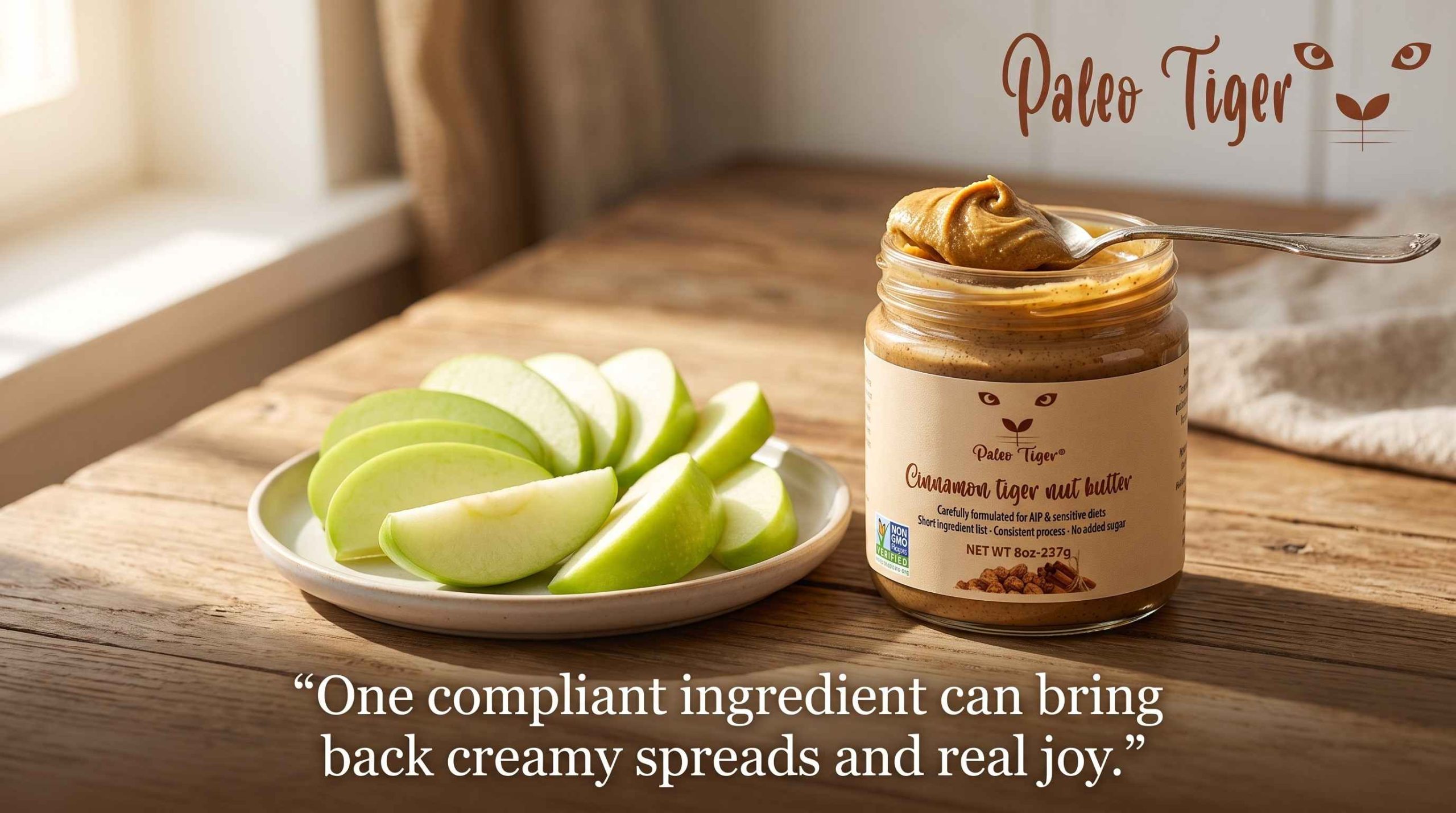
Benefit hook: The elimination phase doesn’t have to mean deprivation. One compliant ingredient can bring back creamy spreads, crunchy snacks, and real baked goods.
Why Gut Health Is the Heart of the AIP Diet
To understand why tiger nuts matter so much on the Autoimmune Protocol, you need to understand what the protocol is actually trying to fix: the gut.
The AIP diet is built on a well-supported idea in functional medicine: that increased intestinal permeability (“leaky gut”), gut dysbiosis, and chronic inflammation are deeply connected to autoimmune activity. The elimination phase removes potentially inflammatory foods while flooding the body with the nutrients needed to repair the gut lining, rebalance the microbiome, and calm the immune system.
That’s why the protocol places such emphasis on:
- Bone broth and collagen-rich foods to supply the building blocks of the gut lining
- Fermented foods (where tolerated) to introduce beneficial bacteria
- Prebiotic fibers to feed those beneficial bacteria so they can thrive and produce healing compounds
- Anti-inflammatory fats and antioxidants to reduce gut inflammation
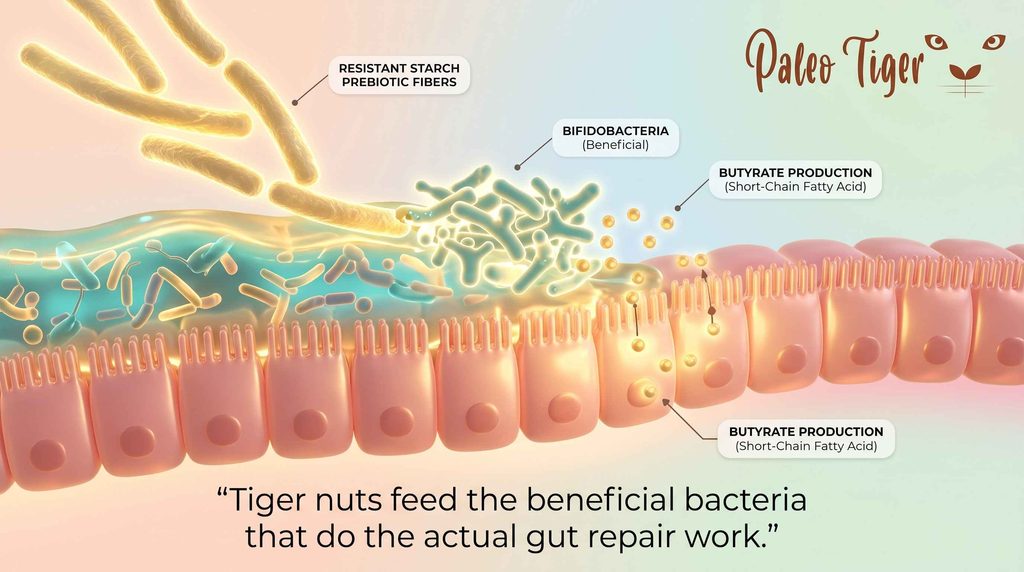
This is exactly where AIP tiger nuts earn their place. They’re one of the few AIP-compliant foods that deliver meaningful amounts of prebiotic fiber, the fuel your good gut bacteria need to produce short-chain fatty acids like butyrate, which nourish colon cells and help maintain the integrity of the gut barrier.
Most AIP elimination snacks are pure protein or fat (think meat sticks and coconut). Fiber is the missing piece, and it’s the piece your microbiome is starving for. Adding AIP tiger nuts to your routine fills that gap deliciously.
Benefit hook: You can’t heal a gut you’re starving. Tiger nuts feed the beneficial bacteria that do the actual repair work.
5 Ways Tiger Nuts Support Digestion
1. Rich in Resistant Starch That Feeds Good Bacteria
Tiger nuts are a significant dietary source of resistant starch, a type of carbohydrate that resists digestion in the small intestine and travels intact to the colon. There, beneficial gut bacteria ferment it, supporting the production of short-chain fatty acids, most notably butyrate. Butyrate is the preferred fuel source for the cells lining your colon and plays a key role in maintaining a strong gut barrier, a central goal of the AIP diet.
2. Promotes Regularity Without Harsh Effects
The combination of soluble and insoluble fiber in tiger nuts adds gentle bulk to stool and supports healthy transit time. Unlike harsh fiber supplements, the fiber in AIP tiger nuts comes packaged with natural fats and moisture, making it easier to tolerate, an important consideration when your digestive system is already sensitive.
3. Naturally Soothing and Easy to Digest (When Prepared Right)
Soaked tiger nuts, tiger nut milk, and finely ground tiger nut flour are all soft, low-residue formats that are gentle on irritated digestive tracts. Traditional cultures didn’t just eat tiger nuts for calories; preparations like chufa horchata were valued as soothing, nourishing drinks, a hint that these tubers have long been considered stomach-friendly.
4. Helps Crowd Out Less Desirable Gut Microbes
A well-fed beneficial microbiome is your best defense against dysbiosis. By selectively feeding butyrate-producing bacteria, the prebiotic fiber in tiger nuts helps create a gut environment where beneficial microbes thrive, supporting the microbial balance the AIP diet aims to restore.
5. Supports Nutrient Absorption
A healthier gut lining with a balanced microbiome absorbs nutrients more efficiently, and people on elimination diets need every bit of absorption they can get. The minerals in tiger nuts (iron, magnesium, zinc, potassium) become more bioavailable as gut function improves, creating a virtuous cycle. This is one reason AIP tiger nuts are more than just “allowed”; they’re actively supportive of the protocol’s healing mission.
Benefit hook: Most AIP foods avoid harming your gut. Tiger nuts actively help it, feeding the bacteria that repair the gut lining from the inside out.
Solving Real AIP Diet Problems with Tiger Nuts
Knowing tiger nuts are compliant is one thing. Understanding how they fix the daily frustrations of the AIP diet is what turns knowledge into action. Here are the problems AIP tiger nuts solve:
Problem 1: “I miss crunchy snacks.”
Elimination-phase snacking is notoriously boring. Soaked and dehydrated tiger nuts deliver a genuinely satisfying crunch, sweet, chewy-crisp, and endlessly snackable. Keep a jar at your desk or in your bag for true AIP elimination snacks that don’t feel like a compromise.
Problem 2: “Baking without grains, nuts, or eggs feels impossible.”
Tiger nut flour behaves remarkably like almond flour in baking, with natural sweetness and a tender crumb, but it’s completely nut-free. Cookies, pancakes, flatbreads, and muffins are back on the menu. Pair it with PaleoTiger’s Extra Fine Tiger Nuts Flour for the smoothest, most consistent results.
Problem 3: “I can’t have nut butter anymore.”
This is the big one. For many people, losing almond and cashew butter is the hardest part of AIP. Stone-ground tiger nut butters recreate that creamy, spoonable experience, and flavored versions like cinnamon and carob turn it into a genuine treat. Try the Original Tiger Nut Butter for everyday spreading, or the Carob Tiger Nut Butter when chocolate cravings hit (carob is a popular chocolate alternative in the AIP community).
Problem 4: “I need grab-and-go options.”
Not everything can be homemade. A ready-made Tiger Nuts Granola gives you a compliant breakfast or topping with zero prep, something the AIP diet desperately lacks in the convenience category.
Problem 5: “My gut needs fiber, but high-fiber foods upset my stomach.”
Because tiger nut fiber comes with natural fats and can be prepared in gentle formats (soaked, milked, finely milled), it offers a “soft landing” for fiber reintroduction. Start with butters and milk, then work up to whole soaked tiger nuts as tolerance improves.
Benefit hook: Tiger nuts don’t just fill nutritional gaps; they fill the emotional gaps of AIP: the crunch you crave, the baking you miss, the butter you thought was gone forever.
6 Easy Ways to Use Tiger Nuts on AIP

1. Soaked Whole Tiger Nuts, The Simplest Snack
Cover whole tiger nuts with filtered water, add a pinch of sea salt, and soak for 12–24 hours. They’ll plump up, soften, and become easier to digest; soaking is the traditional preparation that makes dried tiger nuts gentler on sensitive stomachs. Drain, rinse, and snack as-is, or dehydrate them at low temperature for a crunchier texture. This is the purest way to enjoy AIP tiger nuts: one ingredient, nothing hidden.
2. Creamy Tiger Nut Milk, Your New Dairy Alternative
Blend 1 cup of soaked tiger nuts with 3–4 cups of filtered water, then strain through a nut milk bag or cheesecloth. The result is naturally sweet, creamy, and completely dairy-free, perfect over granola, in smoothies, or simply chilled in a glass. Unlike many store-bought plant milks, homemade tiger nut milk has no gums, no additives, and no seed oils.
3. Baking with Tiger Nut Flour, Cookies, Pancakes & Flatbreads
This is where tiger nuts truly shine on AIP. The extra-fine grind of Tiger Nut Flour gives you a soft, workable flour for AIP cookies, pancakes, tortillas, and muffins. Its natural sweetness means you can reduce or skip added sweeteners entirely. Pro tip: because tiger nut flour is thirstier than grain flours, increase liquids slightly and let batters rest 5–10 minutes before baking.
4. Tiger Nut Butter, Straight from the Spoon
If you’ve been mourning nut butter, this is your homecoming. Ready-made tiger nut butters are stone-ground for a silky texture that’s nearly impossible to achieve with a home food processor. Keep it simple with the Original Tiger Nut Butter, add warmth with the Cinnamon Tiger Nut Butter, satisfy chocolate cravings with the Carob Tiger Nut Butter, or go for texture with the Crunchy Tiger Nut Butter. Spread on sliced fruit, swirl into porridge, or eat by the spoonful, no judgment.
5. Tiger Nut Porridge, A Comforting AIP Breakfast
Simmer ¼ cup of tiger nut flour (or finely ground soaked tiger nuts) with 1 cup of coconut milk, a dash of vanilla, cinnamon, and a pinch of sea salt until thick and creamy. Top with a spoonful of Macaroon Tiger Nut Butter for a coconut-kissed finish. It’s warm, filling, and gentle, the AIP answer to oatmeal, and honestly, many people prefer it.
6. No-Bake Energy Balls, The Ultimate AIP Elimination Snack
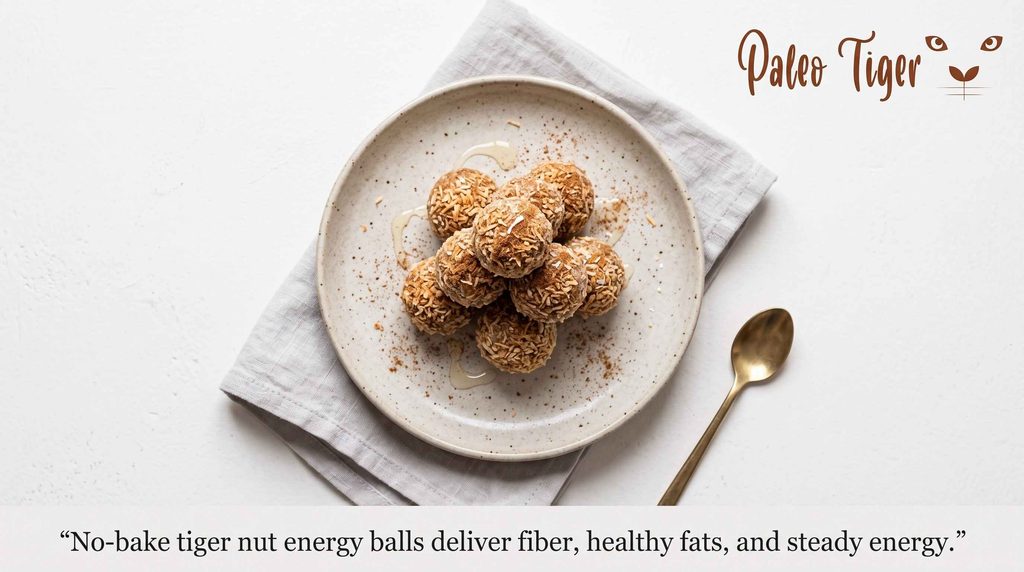
Mix 1 cup tiger nut flour, ¼ cup melted coconut oil, ¼ cup shredded coconut, 1 tablespoon of your favorite tiger nut butter, cinnamon, and a pinch of salt. Roll into balls and chill. These keep for a week in the fridge and deliver fiber, healthy fats, and steady energy, proof that AIP tiger nuts can anchor genuinely satisfying snacks, not just side dishes.
🛒 Stock your AIP pantry: Shop all PaleoTiger tiger nut products, butters, flour, granola, oil, and whole tiger nuts, all crafted to be AIP-friendly.
Homemade vs. Store-Bought: What’s Better on AIP?
One of the most common dilemmas: should you make tiger nut products at home, or buy them ready-made? Honest answer: it depends on the product.
| Homemade | Store-Bought | |
| Tiger nut milk | Winner, fresh, no additives, pennies per glass | Fine for convenience, but check labels for gums and seed oils |
| Soaked tiger nuts | Winner, just water, salt, and time | Rarely sold pre-soaked; whole dried nuts are the store-bought version |
| Tiger nut flour | Possible, but home grinders produce coarse, uneven flour | Winner, commercial stone-milling gives the extra-fine texture baking needs |
| Tiger nut butter | Possible, but home processors struggle to get it silky; easy to burn out motors | Winner, professional stone-grinding creates true creamy butter |
| Granola | Great if you enjoy baking and controlling clusters | Winner for convenience, quality AIP granola is hard to find |
The AIP safety angle matters too. During the elimination phase, cross-contamination is a real concern. Reputable AIP-focused brands produce in controlled environments and formulate specifically for the protocol, something a bulk-bin tiger nut of unknown origin can’t guarantee. When your gut is healing, that certainty has value.
The smart strategy: make what’s easy and fresh at home (milk, soaked nuts, energy balls), and buy what requires professional equipment or strict compliance control (flour, butters, granola). Many people do both: homemade milk for daily use, and a jar of Crunchy Tiger Nut Butter for when life gets busy. There’s no purity prize for doing everything from scratch; the best AIP diet is the one you can actually sustain.
Benefit hook: You don’t have to choose a camp. Homemade for freshness, store-bought for texture and convenience, AIP tiger nuts work both ways beautifully.
Tips for Sensitive Stomachs
If you’re new to high-fiber foods or dealing with active digestive symptoms, ease in; even gut-friendly foods need a proper introduction. The good news is that AIP tiger nuts are among the gentlest ways to reintroduce fiber:
- Start small. Begin with 1–2 tablespoons per day (a spoonful of butter or a splash of tiger nut milk) and increase gradually over 1–2 weeks.
- Always soak whole tiger nuts. Soaking softens them dramatically and reduces the compounds most likely to cause bloating. Never eat them dry and unsoaked if your digestion is sensitive.
- Choose gentle formats first. Butters, milk, and extra-fine flour are easier to tolerate than whole tiger nuts. Work your way up the texture ladder.
- Drink plenty of water. Fiber needs water to move smoothly through your system; increase both together.
- Eat them with fat. The natural fats in AIP tiger nuts already help, but pairing them with coconut oil or avocado can further ease digestion.
- Listen to your body. Mild adjustment bloating for a few days is normal when increasing fiber; sharp pain or persistent symptoms are not. Scale back and consult your practitioner.
Final Thoughts
Tiger nuts may be small, but they solve outsized problems on the Autoimmune Protocol: the fiber gap, the snack gap, the baking gap, and the “I miss nut butter” gap, all while actively supporting the gut healing the diet is designed for.
Whether you’re blending fresh tiger nut milk, baking with extra-fine flour, or simply eating a spoonful of creamy butter straight from the jar, AIP tiger nuts turn the elimination phase from an exercise in deprivation into something genuinely enjoyable.
Your gut does the hard work of healing. Give it the fuel it deserves, and give yourself food you actually look forward to. Explore the full range of AIP tiger nut products at PaleoTiger and taste what compliant comfort food feels like.
Why trust this guide? This article was written by the PaleoTiger editorial team. PaleoTiger specializes exclusively in tiger nut foods crafted for paleo and AIP lifestyle,; every product we make is formulated without grains, gluten, dairy, nuts, or seeds. We work with these ingredients daily, and this guide reflects hands-on experience plus current understanding of the Autoimmune Protocol framework developed by Dr. Sarah Ballantyne.
Medical disclaimer: This content is for informational purposes only and is not medical advice. The AIP diet is a therapeutic dietary approach; consult your healthcare provider or a qualified practitioner before making significant dietary changes, especially if you have a diagnosed autoimmune condition or food allergies.
Sources & further reading: USDA FoodData Central (tiger nut nutritional composition) · Dr. Sarah Ballantyne, The Paleo Approach (Autoimmune Protocol framework) · Tiger nut nutrition, resistant starch and gut-health review · Tiger nut drink and intestinal beneficial bacteria (Nutrients, 2022) · Tiger nuts, epithelial barrier protection and Lactobacillus growth (Nutrients, 2021) · Tiger nut starch: composition and properties (Royal Society of Chemistry) · EFSA safety assessment: tiger nut allergenicity
Frequently Asked Questions
Are tiger nuts AIP compliant?
Yes, AIP tiger nuts are compliant during the elimination phase. They’re tubers (not tree nuts), naturally free of grains, gluten, dairy, eggs, seeds, legumes, and nightshades.
Are tigernuts AIP during the elimination phase, or only during reintroduction?
During the elimination phase itself. Because they contain no nut proteins and none of the excluded food groups, there’s no protocol-based reason to wait until reintroduction.
I have a tree nut allergy. Are tiger nuts safe for me?
Tiger nuts are not tree nuts, and most people with tree nut allergies tolerate them. That said, tiger nut allergy, while rare, does exist, and flavored products may be made in shared facilities. Introduce cautiously and talk to your allergist first if your allergy is severe.
Can tiger nuts cause bloating?
They can, especially if you jump in with large amounts or eat unsoaked whole tiger nuts. Soaking, starting with small servings, and choosing gentle formats (butter, milk, fine flour) usually prevents issues.
Is tiger nut flour the same as ground tiger nuts?
Not exactly. Commercial tiger nut flour is milled extra-fine for baking, giving a smoother, more consistent texture than anything a home grinder produces. Ground tiger nuts from a food processor tend to be coarser and work better in porridges and energy balls.
How often should I eat tiger nuts for gut health?
There is no official recommended amount, but many people enjoy tiger nuts several times per week as part of a varied AIP diet. Consistency matters more than quantity; regular small servings feed your beneficial bacteria better than occasional large ones.
Can I eat tiger nuts during an autoimmune flare?
Many people tolerate them well during flares because they’re gentle and easy to digest, but flares are highly individual. During a severe flare, stick to the gentlest formats (butter, milk) and follow your practitioner’s guidance.
What’s the difference between homemade and store-bought tiger nut butter?
Texture and effort. Professional stone-grinding produces a silky butter that’s very hard to replicate at home, where food processors often yield a gritty paste. If you make it at home, expect a rustic result, delicious, but different.
Is chufa the same as tiger nuts?
Yes. Chufa is the Spanish name for tiger nuts (Cyperus esculentus), the same tuber, famously used to make horchata de chufa.
Where can I buy AIP-compliant tiger nut products?
Look for brands that formulate specifically for the Autoimmune Protocol with no hidden non-compliant ingredients. PaleoTiger’s shop carries butters, flour, granola, oil, and whole tiger nuts, all crafted to be AIP-friendly.