

Yes, tiger nut granola is generally considered AIP-friendly. Tiger nuts aren’t nuts at all. They’re small, naturally sweet tubers (a root vegetable), which means they sidestep the entire reason the Autoimmune Protocol eliminates tree nuts and peanuts. That said, not every product labeled “granola” is equal: whether a specific tiger nut granola fits the AIP diet depends on its full ingredient list. A clean recipe, like our Tiger Nuts Granola, made with just tiger nuts, avocado oil, and cinnamon, checks every AIP box. In this guide, we’ll explain what tiger nuts are, why the AIP confusion exists, the real health benefits, and how to choose (or make) a granola that truly supports your autoimmune protocol.
In this article
- What Are Tiger Nuts?
- Are Tiger Nuts Actually Nuts?
- What Is the AIP Diet?
- Why People Think Tiger Nuts Don’t Fit the AIP Diet
- Is Tiger Nut AIP? What the Evidence Says
- What’s Inside Tiger Nut Granola?
- 9 Science-Backed Benefits of Tiger Nut Granola
- Tiger Nut Granola vs. Regular Granola
- Homemade vs. Store-Bought Tiger Nut Granola
- How to Enjoy Tiger Nut Granola on AIP
- What to Look for When Buying Tiger Nut Granola
- FAQs
- References
What Are Tiger Nuts?
Tiger nuts (Cyperus esculentus), also known as chufa, yellow nutsedge, or earth almonds, are small, wrinkled, marble-sized tubers that grow underground on the roots of a sedge plant. Despite the striped-sounding name, they have nothing to do with tigers; the name likely comes from their stripy, textured skin.
Tiger nuts are one of humanity’s oldest cultivated foods. They were a staple in ancient Egypt thousands of years ago, and in Spain they’ve been enjoyed for centuries as horchata de chufa, a creamy, naturally sweet plant-based milk. Today, they’re prized as a nut-free tuber that delivers the crunch and flavor people love about nuts, without being a nut at all.
You’ll find tiger nuts in several forms:
- Whole tiger nuts, chewy, naturally sweet, eaten as a snack (Whole Tiger Nuts)
- Tiger nut flour, a grain-free, gluten-free baking flour (Tiger Nuts Flour Extra Fine)
- Tiger nut butter, a creamy, AIP-friendly spread (Tiger Nut Butter – Original)
- Tiger nut oil, cold-pressed oil rich in monounsaturated fats (100% Cold-Pressed Tiger Nuts Oil)
- Tiger nut granola, baked clusters for breakfast and snacking (Tiger Nuts Granola)
Are Tiger Nuts Actually Nuts?
No, and this single fact is the key to the entire AIP question.
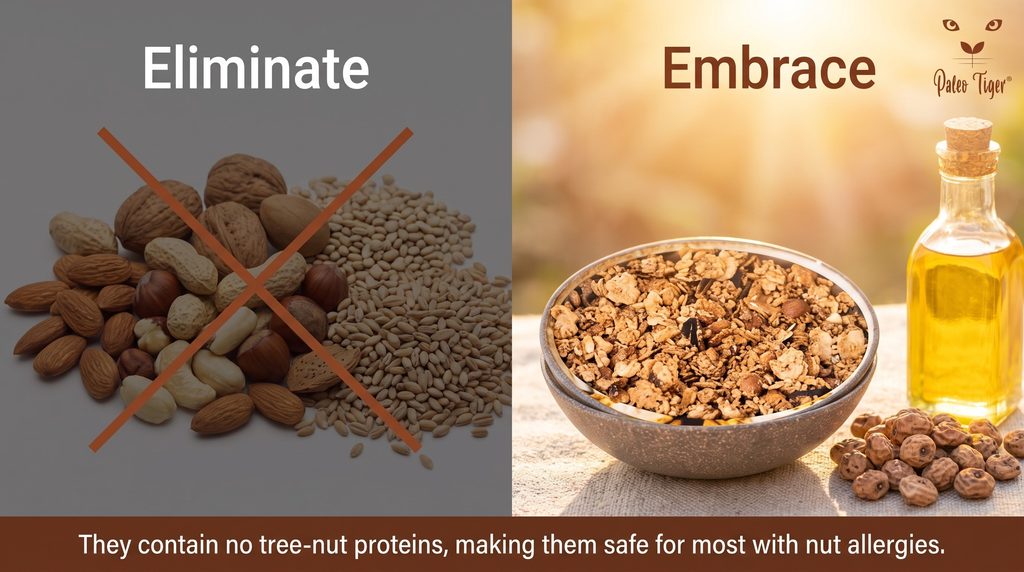
Tiger nuts are not nuts. They are tubers, underground storage organs of a plant, in the same broad category as sweet potatoes and cassava. They contain no tree-nut proteins, which is why they’re considered safe for most people with nut allergies (though anyone with a severe allergy should always check with their allergist first, as cross-contamination during processing is possible with any packaged food).
The name is simply a historical accident. “Are tigernuts nuts?” is one of the most searched questions about this food, and the answer unlocks everything else: because tiger nuts aren’t nuts, they are not subject to the AIP diet’s elimination of nuts and seeds. For more background, see our guide: Tiger Nuts: The Superfood You Need on the AIP Diet.
What Is the AIP Diet?
The Autoimmune Protocol (AIP) diet, sometimes called the autoimmune protocol, is an elimination-and-reintroduction diet designed to reduce inflammation, support gut health, and help manage autoimmune symptoms through food and lifestyle changes. It was developed from a paleo framework and expanded by researchers including biophysicist Dr. Sarah Ballantyne.
The AIP diet works in phases:
- Elimination phase: For several weeks, you remove foods thought to potentially increase intestinal permeability or drive inflammation. This includes grains, legumes, dairy, eggs, nightshade vegetables, nuts and seeds, alcohol, refined sugar, seed oils, and food additives.
- Reintroduction phase: Foods are reintroduced one at a time to identify personal triggers.
The reason nuts are eliminated during the AIP elimination phase is that certain compounds in nuts and seeds may irritate the gut lining, a particular concern for people with systemic inflammation. But remember: tiger nuts aren’t nuts, so the rationale for eliminating them doesn’t apply.
Foods generally welcomed on AIP include vegetables (except nightshades), fruits, quality meats and seafood, fermented foods, healthy fats like olive oil, coconut oil, and avocado, and alternative flours made from vegetables or fruit, including tigernut, cassava, and coconut.
Important: The AIP diet is a therapeutic protocol. This article is for informational purposes only and isn’t medical advice. If you’re managing an autoimmune condition, work with a qualified healthcare practitioner before making dietary changes.
Why People Think Tiger Nuts Don’t Fit the AIP Diet?
If tiger nuts are so clearly AIP-compatible, why does the confusion persist? We’ve seen this question come up repeatedly, and it usually traces back to four things:
1. The name. “Tiger nut” sounds like a tree nut. On a diet that eliminates all nuts, the name alone is enough to make cautious eaters skip it. It’s the number-one source of the myth.
2. They’re missing from older AIP food lists. Early AIP resources were written before tiger nuts became widely available in Western health-food markets, so many older “yes/no” lists simply don’t mention them. Absence from a list gets misread as a “no.”
3. Not all tiger nut products are equal. Some commercial “tiger nut” snacks and granolas add ingredients that genuinely aren’t AIP elimination-phase compliant: seeds, chocolate, non-compliant oils, or added sugars. People see one non-compliant product and assume the ingredient itself is the problem.
4. General caution around “new” foods. Anyone in the AIP elimination phase is (rightly) careful. When a food is unfamiliar, the safest-feeling choice is to avoid it, even when the evidence supports it.
The bottom line: the concern is about the name and about formulations, not about the tuber itself. Once you separate those, the picture gets much clearer.
Is Tiger Nut AIP? What the Evidence Says
So, is tigernut AIP? Let’s look at what AIP authorities and resources actually say:
- Tiger nut flour is listed among AIP-allowed alternative flours. Clinical and educational summaries of the AIP diet name tigernut alongside cassava, green banana, and coconut as compliant flour alternatives during the elimination phase.
- AIP recipe creators treat tiger nuts as fully compliant. AIP-focused cooks routinely use tiger nuts in elimination-phase recipes, including tigernut granola, specifically because they’re a tuber, not a nut or seed.
- Every AIP “avoid” category misses tiger nuts. The elimination phase removes grains, legumes, dairy, eggs, nightshades, nuts, seeds, alcohol, and additives. Tiger nuts are none of these. They’re a root vegetable, a category AIP encourages.
There is one honest caveat worth stating: AIP is an individual protocol. The diet’s reintroduction phase exists precisely because triggers vary from person to person. Tiger nuts are high in fiber, so anyone with significant digestive sensitivity should introduce them gradually (more on that below). And if you’re working with a practitioner, it’s always worth mentioning new foods. But as a category, tiger nuts are considered AIP-friendly by the AIP community, which is why you’ll find them in products explicitly formulated for the autoimmune protocol, like our Tiger Nuts Granola.
AIP-compliant nuts? There aren’t any; that’s the point of tiger nuts.
A common related search is “AIP compliant nuts.” Here’s the straight answer: during the AIP elimination phase, there are no compliant tree nuts or peanuts; almonds, walnuts, cashews, and pecans are all out. Tiger nuts fill exactly this gap. They deliver the crunchy, nutty, satisfying experience of nuts while remaining a nut-free tuber that’s welcome on the protocol. That’s why tiger nut granola, tiger nut butter, and tiger nut flour have become staples in AIP pantries.
What’s Inside Tiger Nut Granola?
A traditional oat granola is built on rolled oats, tree nuts, seeds, sweetener, and oil. Tiger nut granola rebuilds the concept from the ground up for people who can’t do grains, gluten, or nuts.
Our Tiger Nuts Granola keeps it radically simple: three ingredients:
- Tiger nuts, the crunchy, naturally sweet base
- Avocado oil, rich in monounsaturated fats; an AIP-approved cooking fat
- Cinnamon, a bark spice (AIP allows spices derived from leaves, bark, flowers, or pods), adding warmth and natural sweetness
That’s it. No added sugar, no preservatives, no artificial colors or flavors. No grains, no gluten, no dairy, no nuts, no seeds. It’s suitable for vegans and vegetarians, and it’s specifically formulated to be AIP-compliant.
Compare that to a typical store-bought oat granola label: oats (a grain, out on AIP), almonds or cashews (nuts, out on AIP), sunflower or canola oil (seed oils, out on AIP), brown sugar or glucose syrup (refined sugar, out on AIP), plus “natural flavors” and preservatives (additives, out on AIP). The difference isn’t subtle; it’s the difference between a food built for the autoimmune protocol and one built against it.
9 Science-Backed Benefits of Tiger Nut Granola
Tiger nuts aren’t just AIP-compatible; they’re genuinely nutrient-dense. Here’s what the research and nutritional data show:
1. Exceptional prebiotic fiber for gut health
Tiger nuts are roughly 8–15% dietary fiber by dry weight, and much of it is resistant starch, a type of fiber that passes through the small intestine undigested and feeds beneficial bacteria in the large intestine. A clinical intervention with natural tiger nut beverage confirmed selective enrichment of butyrate-producing gut bacteria. Since gut health is a central pillar of the autoimmune protocol, this prebiotic effect is arguably tiger nuts’ standout benefit. (Note: because the fiber content is high, introduce tiger nut granola gradually if your digestion is sensitive: a small serving first, then build up.)
2. Rich in iron for energy
Tiger nuts are a good source of iron, a mineral that supports oxygen transport and energy metabolism, and fatigue is one of the most common complaints among people managing autoimmune conditions. An iron-containing, naturally sweet snack is a practical way to support daily intake. (Published analyses vary on exact mineral amounts, so take any specific %DV figures you see online with a grain of salt.)
3. Magnesium for muscles and calm
Tiger nuts are a good source of magnesium, a mineral involved in hundreds of enzymatic processes, including muscle function and the body’s stress response. Magnesium is frequently under-consumed in modern diets.
4. Potassium for healthy blood pressure
Tiger nuts are a good source of potassium, alongside phosphorus and calcium. Potassium helps balance sodium’s effects and supports normal blood pressure and muscle function.
5. Heart-healthy monounsaturated fats
Tiger nuts are 22–45% lipids by dry weight, and the standout is oleic acid, the same monounsaturated fat that makes olive oil famous, accounting for roughly 70–76% of tiger nut oil’s fatty acids. A 28-day human intervention in adults with elevated cholesterol found that tiger nut consumption reduced serum cholesterol, though hematological markers were unchanged, and the evidence base overall is short-term and small-scale. Combined with avocado oil in the granola, you’re getting a genuinely heart-friendly fat profile.
6. Antioxidant protection from vitamin E and polyphenols
Tiger nuts contain vitamin E, vitamin C, polyphenols, and flavonoids, antioxidant compounds that help protect cells from oxidative damage. Research shows that germinating tiger nuts can increase their antioxidant content, while germinating or roasting reduces antinutrients (like phytates and oxalates) that can interfere with mineral absorption. Baking helps on the antinutrient side, but the antioxidant boost is tied specifically to germinating, so don’t assume a baked granola automatically inherits every benefit of the raw tuber.
7. Blood sugar–friendly energy
Tiger nuts have a low glycemic impact relative to their carbohydrate content, thanks to the fiber matrix slowing digestion. In one human trial, acute tiger nut consumption led to a statistically significant decrease in insulin levels, though blood glucose reduction was not significant, suggesting a possible improvement in insulin sensitivity rather than a proven glucose-lowering effect. And a note on wording: “no added sugar” doesn’t mean “no glycemic response”; tiger nuts are still 23–48% carbohydrate, so the fiber slows the rise rather than eliminating it. What you avoid is the sharp spike from syrups or refined sweeteners.
8. Naturally sweet with no added sugar
Tiger nuts are naturally sweet, genuinely. Our granola contains no added sugar at all, which is rare in the granola aisle, where even “healthy” brands often pack 10–16g of added sugar per serving. For AIP followers avoiding refined sugar entirely, this matters enormously.
9. Satiety that actually lasts
The combination of fiber, resistant starch, and healthy fats slows gastric emptying and steadies energy, meaning a small bowl of tiger nut granola keeps you full far longer than an equivalent serving of puffed, sugary cereal. For anyone using food as a tool for stable energy through a demanding day (or a demanding healing protocol), satiety is a feature, not a footnote.
For a deeper dive into tiger nuts’ nutritional profile, including benefits specific to women’s health, read Tiger Nut Benefits for Women.
Tiger Nut Granola vs. Regular Granola

| Tiger Nut Granola (ours) | Regular Oat Granola | |
| Base ingredient | Tiger nuts (tuber) | Rolled oats (grain) |
| Nuts | None, nut-free | Usually almonds, cashews, or walnuts |
| Gluten | Naturally gluten-free | Often cross-contaminated; oats themselves are a grain |
| AIP elimination-phase friendly | Yes | No (grains + nuts + seed oils + sugar) |
| Added sugar | None | Typically 10–16g per serving |
| Oils | Avocado oil | Often sunflower, canola, or soybean oil |
| Prebiotic resistant starch | Yes, naturally rich | Minimal |
| Suitable for nut allergies | Yes (nut-free tuber) | No |
The comparison makes the positioning obvious: regular granola is built on exactly the ingredients AIP eliminates. Tiger nut granola was built for the people regular granola leaves out.
Homemade vs. Store-Bought Tiger Nut Granola
One of the most common questions we hear: should I make tiger nut granola at home or buy it? Here’s an honest breakdown.
Making it at home
Pros:
- Total control over ingredients; you choose the oil, the spice level, and the bake
- Can be cheaper per serving if you buy tiger nuts in bulk
- Fun to customize (add coconut flakes, carob, or dried fruit, checking each against your protocol phase)
Cons:
- Getting the crunch right takes practice; tiger nuts bake differently than oats
- Time-consuming: soaking, chopping, mixing, low-and-slow baking, cooling
- Sourcing quality tiger nuts and getting consistent results batch to batch
A basic homemade version: roughly chop soaked whole tiger nuts, toss with a compliant fat like avocado oil or coconut oil, add cinnamon, spread thin on a baking sheet, and bake low (around 300°F / 150°C), stirring occasionally until golden. Cool completely; that’s when the clusters crisp up.
Buying it ready-made
Pros:
- Consistency, professionally developed recipes nail texture and flavor
- Convenience, no prep, no baking, no cleanup
- Formulated for compliance, a product like our Tiger Nuts Granola was specifically designed around AIP rules, so you don’t have to double-check every ingredient
Cons:
- Higher cost per serving than bulk homemade
- Less customization (though you can always add your own compliant toppings)
Our take: If you enjoy baking and have the time, homemade tiger nut granola is a great project. But if you want guaranteed AIP compliance without the guesswork, especially during the strict elimination phase, when one wrong ingredient can set you back, a purpose-built product removes the risk. Many of our customers do both: keep a bag of ready-made granola for busy mornings and bake their own on weekends.
How to Enjoy Tiger Nut Granola on AIP?
Tiger nut granola is versatile. Here are AIP-friendly ways to enjoy it (all compliant with the elimination phase):
- With coconut yogurt, the classic parfait: coconut yogurt, tiger nut granola, and fresh berries
- As a cereal, with coconut milk or homemade tiger nut milk (blend soaked tiger nuts with water and strain)
- Smoothie bowl topper, adds crunch to any blended fruit-and-greens bowl
- Straight from the bag, the simplest AIP-compliant snack there is
- Baked fruit crumble topping, sprinkle over baked apples or pears with cinnamon
- Trail mix, combine with coconut flakes and dried mango or raisins (unsweetened, no additives)
- Dessert garnish, over AIP-friendly nice cream (frozen banana blended smooth)
One serving note: because tiger nuts are fiber-dense, start with a modest portion (around ¼ cup) and see how you feel before working up to a full bowl, especially if your gut is currently sensitive.
What to Look for When Buying Tiger Nut Granola?

Not every “tiger nut” product deserves a place in an AIP pantry. Use this checklist:
- Short ingredient list. Three to five recognizable ingredients is ideal. Our granola has three: tiger nuts, avocado oil, and cinnamon.
- No added sugar. Watch for honey, maple syrup, coconut sugar, brown rice syrup, or “evaporated cane juice.” (Note: honey and maple syrup are technically AIP-compliant in moderation, but a no-added-sugar product gives you full control.)
- Compliant fat only. Avocado oil, coconut oil, olive oil, or palm shortening. Avoid sunflower, safflower, canola, and soybean oils.
- No seeds or chocolate. Chia, flax, pumpkin seeds, and cacao are out during AIP elimination; some “paleo” granolas include them.
- No “natural flavors,” preservatives, or emulsifiers. Additives are excluded on AIP.
- Certified gluten-free facility if celiac disease or severe sensitivity is in the picture, to rule out cross-contamination.
- Transparent sourcing. Brands that tell you where their tiger nuts come from and how they’re processed are brands you can trust.
Ready to Try It?
If you’ve been missing granola on the autoimmune protocol, you don’t have to anymore. Our Tiger Nuts Granola is specifically formulated to be AIP-friendly: just tiger nuts, avocado oil, and cinnamon, no added sugar, no preservatives, no grains, no nuts, no seeds.
Explore the full tiger nut pantry:
- Tiger Nuts Granola, the AIP-friendly crunch
- Whole Tiger Nuts, for snacking, soaking, and homemade milk
- Tiger Nuts Flour – Extra Fine, grain-free baking
- Tiger Nut Butter – Original (AIP-Friendly), creamy, nut-free spread
- 100% Cold-Pressed Tiger Nuts Oil, for cooking and dressings
- Shop all products
FAQs
Is tiger nut granola AIP-friendly?
Yes, tiger nut granola is generally considered AIP-friendly, provided its ingredients are. Tiger nuts are tubers, not nuts, so they aren’t subject to the AIP elimination of nuts and seeds. Check the full label: a compliant granola uses AIP-approved fats (like avocado or coconut oil), compliant spices, and no added seeds, chocolate, refined sugar, or additives. Our Tiger Nuts Granola (tiger nuts, avocado oil, cinnamon) meets these criteria.
Is tigernut AIP compliant during the elimination phase?
Yes. The AIP elimination phase removes grains, legumes, dairy, eggs, nightshades, nuts, seeds, alcohol, refined sugar, seed oils, and additives. Tiger nuts fall into none of these categories; they’re a root vegetable, and AIP resources list tigernut among the allowed alternative flours and foods. As with any food, individual tolerance varies, so introduce new foods thoughtfully and consult your practitioner.
Are tigernuts nuts? Can I eat them with a nut allergy?
Tiger nuts are not nuts; they’re small tubers (Cyperus esculentus), botanically unrelated to tree nuts and peanuts. That makes them a popular nut-free tuber alternative for people with nut allergies. However, if you have a diagnosed nut allergy, check that the product is made in a nut-free facility and confirm with your allergist before trying.
What are AIP-compliant “nuts”?
Strictly speaking, there are no AIP-compliant tree nuts during the elimination phase; almonds, walnuts, cashews, pecans, pistachios, and peanuts are all eliminated. Tiger nuts are the closest compliant alternative: they deliver a nutty crunch and flavor while remaining a tuber. (Some nuts may be reintroduced later, depending on individual tolerance.)
What is tiger nut granola made of?
It depends on the brand. Ours is made of just three ingredients: tiger nuts, avocado oil, and cinnamon, with no added sugar, preservatives, or artificial anything. Always read the label, because some commercial versions add seeds, sweeteners, or chocolate that aren’t AIP elimination-phase compliant.
Does tiger nut granola contain gluten or grains?
No. Tiger nuts are naturally gluten-free and grain-free; they’re a tuber, not a cereal grain. This makes tiger nut granola suitable for gluten-free, grain-free, paleo, and AIP diets (always verify the manufacturing facility if celiac-level cross-contamination is a concern).
How is tiger nut granola different from regular granola?
Regular granola is built on rolled oats (a grain), tree nuts, seeds, sweeteners, and often seed oils, nearly every one of which is eliminated on AIP. Tiger nut granola replaces the entire base with a nut-free, grain-free tuber, uses compliant fats, and (in our case) adds no sugar at all.
Can I eat tiger nut granola every day on AIP?
For most people, yes, it’s made from whole-food, AIP-compliant ingredients. Start with a smaller serving to assess your digestive tolerance (tiger nuts are very high in fiber), drink plenty of water, and keep portions reasonable. If you’re in the strict elimination phase, confirm with your practitioner as part of your overall plan.
Is tiger nut granola good for gut health?
Tiger nuts are rich in resistant starch, a prebiotic fiber that feeds beneficial gut bacteria; research has confirmed enrichment of butyrate-producing bacteria with tiger nut consumption. Since gut health is central to the autoimmune protocol, this is one of tiger nut granola’s most relevant benefits. Introduce it gradually if your digestion is sensitive.
Where can I buy AIP-friendly tiger nut granola?
Right here, our Tiger Nuts Granola is formulated specifically for the autoimmune protocol. You can also browse the full range of AIP-friendly tiger nut foods in our shop.
References
- Healthline, “Tiger Nuts: What Are They and Are They Good for You?” Nutritional composition, fiber, resistant starch, and antinutrient notes.
- News-Medical, “Health Benefits of Tiger Nuts: Nutrition, Uses & Side Effects.” Lipid profile, oleic acid content, prebiotic effects, cholesterol and blood-sugar research.
- PaleoZone Nutrition, “What Is the Effect of the Autoimmune Protocol (AIP) Diet in Rheumatoid Arthritis?” AIP elimination inclusions/exclusions, including tigernut as an allowed alternative flour.
- Backcountry Paleo, “Easy Lemon Ginger Tigernut Granola (AIP, Paleo).” Tiger nuts as AIP-compliant tubers in elimination-phase cooking.
- Paleo Tiger, “Tiger Nuts: The Superfood You Need on the AIP Diet.”
- Paleo Tiger, “Tiger Nut Benefits for Women.”