
Most carob guides do the lazy thing: they declare one powder “the best” and move on. That is not what this is. If you have ever bought a bag of carob powder, baked it once, and quietly shelved it, the answer is almost always the roast, not the recipe. Terrasoul’s lightly roasted carob powder and the broader family of Mediterranean carob powders look alike in the bag. They do not taste alike in the cake.
This guide breaks down exactly what separates the:, roast level, flavor, sweetness, and best uses, and then answers the question almost nobody asks, but everyone on a healing diet eventually lands on: what is the simplest everyday way to actually eat carob? For many people following the Autoimmune Protocol, the fastest answer is an AIP carob butter: a ready-made spread that skips the measuring, the baking experiments, and the label-reading fatigue.
What is the difference between Terrasoul and Mediterranean carob powder?
Terrasoul’s lightly roasted carob powder is mild, sweet, and caramel-like, while Mediterranean carob powders are typically roasted darker for a deeper color and more intense, slightly bitter flavor. For everyday eating, an AIP carob butter made from tiger nuts and carob is the simplest way to enjoy carob without baking.
Terrasoul = light roast: sweeter, milder, caramel-like. Mediterranean = usually darker roast: deeper color, more intense, slightly bitter.
Roast level changes the carob’s flavor more than the brand name on the bag.
Carob powder is naturally caffeine-free and high in fiber, but it is an ingredient, not a snack.
A finished AIP carob butter is the practical shortcut: carob’s chocolate-like appeal in a spreadable, no-bake form.
Carob’s AIP status has real nuance (it is in the legume family), so this guide gives you the honest version.
Disclosure: Paleo Tiger makes tiger-nut products, including the carob butter featured below. We recommend what we would eat ourselves, and we flag the limitations too, including the ones on our own jar.
How was this comparison researched?
We built this guide from primary sources: the Terrasoul product listing for its “lightly roasted” processing claim, Healthline’s carob overview for botanical and nutritional facts, a roasting guide for the raw/light/dark distinctions, producer descriptions for the Mediterranean flavor profile, and Paleo Tiger’s own live product page (checked September 30, 2026) for every product fact, name, price, ingredients, and exact compatibility wording. Where evidence is thin or contested (carob’s AIP status, Mediterranean bitterness), we say so instead of smoothing it over.
| Terrasoul (Lightly Roasted) | Mediterranean Carob Powder | |
| Roast level | Light roast | Usually medium to dark roast |
| Color | Light to medium brown | Dark brown |
| Flavor | Mild, sweet, caramel-like | Intense, earthy, slightly bitter |
| Best for | Smoothies, frostings, kid-friendly baking | Dark cakes, brownies, cocoa-style desserts |
| Everyday shortcut | AIP carob butter | AIP carob butter |
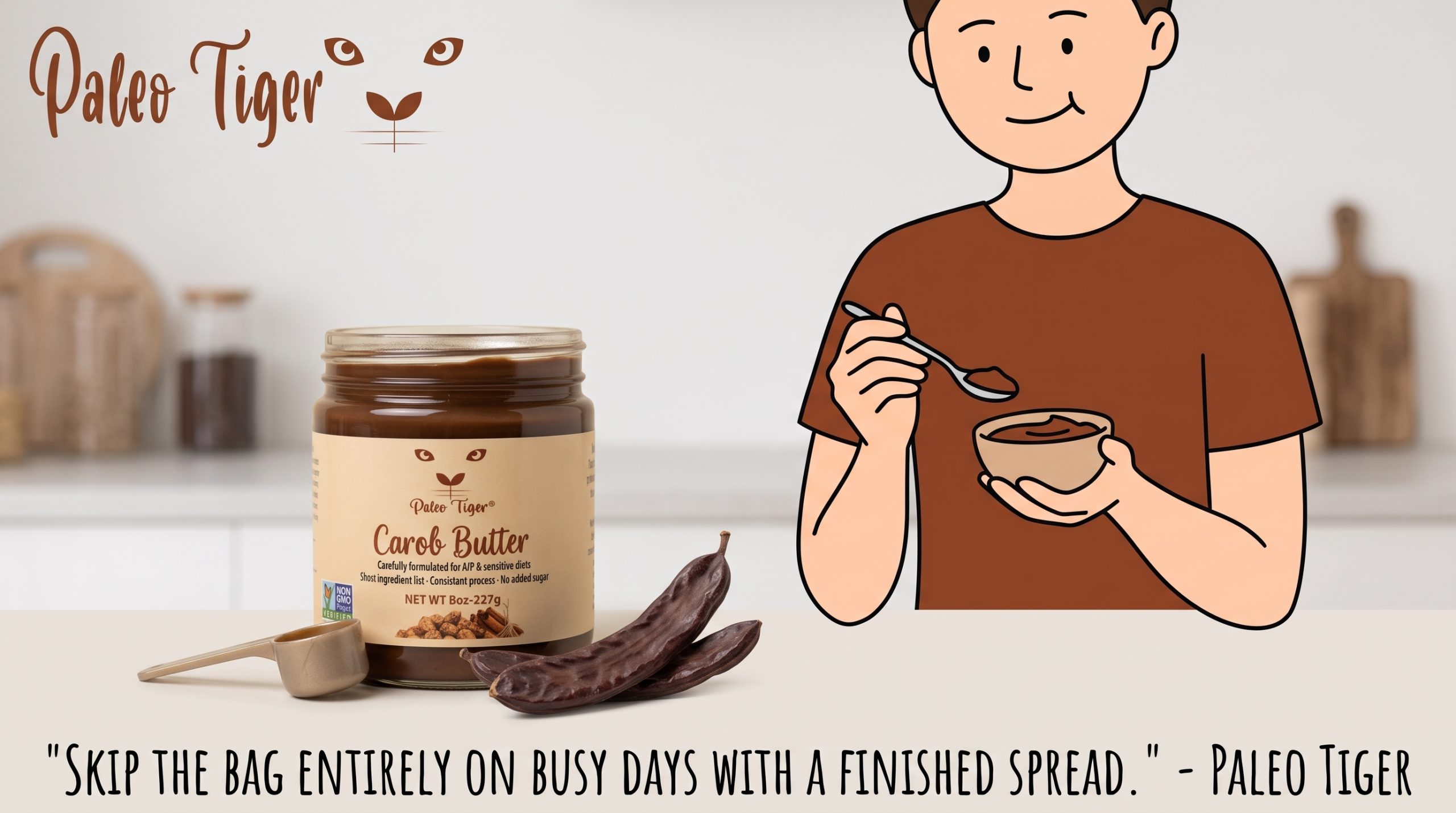
Takeaway: pick the powder by roast character, then skip the bag entirely on busy days with a finished spread.
What Is Carob Powder, and Why Is It a Popular Chocolate Substitute?
Carob powder is ground, dried carob pod pulp, naturally sweet, caffeine-free, and high in fiber, used as a chocolate substitute for people avoiding stimulants.
Carob powder comes from the pods of the carob tree (Ceratonia siliqua), a hardy tree native to the Mediterranean region. The long, dark brown pods are harvested, dried, and ground; the sweet pulp surrounding the hard seeds is what becomes the powder you bake with. Healthline describes carob as high in fiber and commonly used as a caffeine-free alternative to chocolate, noting that roasted carob powder resembles cocoa in taste while being naturally sweet and low in fat (Healthline on carob).
That natural sweetness is carob’s signature: unlike cacao, which needs sugar to become palatable, carob pulp is mild and caramel-like on its own. It is also naturally caffeine-free and theobromine-free, which is why it has become a staple chocolate substitute for people who avoid stimulants, including kids, pregnant women, and anyone whose sleep or digestion suffers from chocolate.
But not all carob powders taste the same. Where the pods grow matters less than how they are roasted, and that is where the Terrasoul vs Mediterranean question begins. If you want the full botanical backstory on the tuber that pairs so well with carob in AIP kitchens, see our guide on what tiger nuts are.
Quick Summary: In short, carob powder is sweet, caffeine-free pod pulp, a genuine chocolate substitute, not a chocolate copy. Roast level decides its flavor far more than origin does.
That leads directly to the comparison everyone is actually searching for.
Terrasoul Lightly Roasted vs Mediterranean Carob Powder, What’s the Difference?

Terrasoul’s powder is lightly roasted for maximum sweetness and mildness; Mediterranean carob powders are typically roasted darker for deeper color and a more intense, cocoa-adjacent flavor.
Terrasoul Superfoods’ Organic Carob Powder is one of the most widely available carob powders online, commonly sold in 1-pound bags. According to its product listing, it is certified organic, non-GMO, gluten-free, and vegan, and the detail that matters most here: it is lightly roasted to enhance its sweet chocolate flavor (Terrasoul listing).
Light roasting is deliberate: heavy roasting pushes carob toward bitterness for a darker color, while light roasting preserves the pod’s natural sugars and keeps the flavor mild, sweet, and caramel-like. The brand positions it as a direct cocoa-powder replacement, “used to replace cocoa powder or chocolate in your recipes for a no-fat, caffeine-free option”, and highlights its high fiber content.
Mediterranean carob powder is less a single brand and more a category:
Carob grown and processed around the Mediterranean basin, Spain, Italy, Cyprus, and Greece, where the carob tree is native and has been cultivated for centuries. Cyprus famously produced carob syrup for generations, long before carob lattes existed.
Mediterranean powders are typically roasted darker, giving a deeper brown color and a more intense, slightly bitter flavor closer to cacao, preferred by some bakers for rich chocolate-style cakes and brownies. The trade-off, as one Australian producer puts it, is that Mediterranean-style powders can carry “the strong bitter taste normally associated with European/Mediterranean carob powders,” while lighter-processed carob tastes sweeter (Australian Carob Co.). That is a producer’s marketing claim, not a lab result, but it matches what most home bakers report: Mediterranean carob tastes more “serious,” Terrasoul tastes more “sweet.”
| Feature | Terrasoul (Lightly Roasted) | Mediterranean Carob Powder |
| Roast level | Light roast | Usually medium to dark roast |
| Color | Light to medium brown | Dark brown |
| Flavor | Mild, sweet, caramel-like | Intense, earthy, slightly bitter |
| Sweetness | Higher perceived sweetness | Lower; often needs added sweetener |
| Caffeine | None | None |
| Fiber | High | High |
| Best for | Smoothies, frostings, kid-friendly baking, energy balls | Dark cakes, brownies, cocoa-style desserts |
| Availability | Widely available online, 1-lb bags | Specialty stores, Mediterranean import shops |
Takeaway: neither is objectively better; they are tools for different jobs. Match the roast to the recipe.
For the AIP cook, the deeper story is why tiger nuts and carob keep showing up together; our guide to tiger nuts on the AIP diet walks through the tuber side of that pairing.
Quick Summary: So the bottom line is: buy Terrasoul’s lightly roasted carob powder for sweetness and mildness, Mediterranean-style powder for depth and intensity.
But here is the practical verdict most people reach after buying both bags: whichever powder wins your taste test, powders are for baking projects. The everyday shortcut is a finished spread you can use in ten seconds, no recipe required. That is where this guide turns from powder comparison to pantry reality.
Why Does Roast Level Matter More Than the Brand on the Bag?
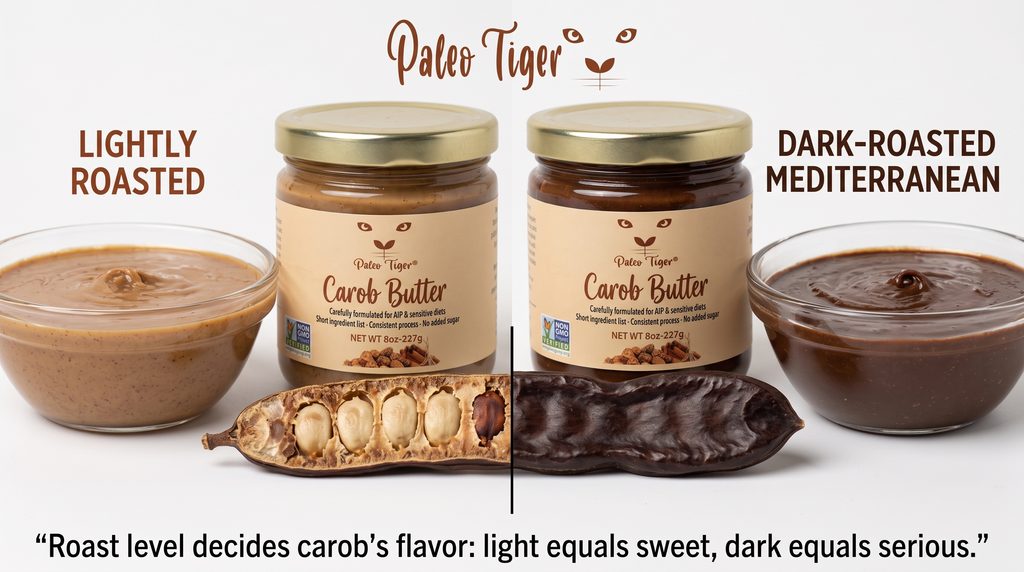
Roast level decides carob’s flavor: raw is subtly sweet, lightly roasted is the sweetest style, and dark-roasted turns bitter-edged and cocoa-like.
Beyond the Terrasoul vs Mediterranean question, it helps to understand the three roast levels, because “lightly roasted” is doing a lot of work in that product name (roasting guide):
| Roast level | Heat | Color | Flavor |
| Raw carob powder | Dried with no heat (under ~118°F) | Light brown | Subtly sweet, almost caramel-like, zero bitterness |
| Lightly roasted carob powder | Heated to ~200°F | Light to medium brown | The sweetest style, gentle heat deepens flavor without burning off natural sugars. Terrasoul sits here. |
| Dark-roasted carob powder | High heat, up to ~400°F | Dark brown | Bitter-edged, closest visual and flavor match to cacao. Most Mediterranean-style powders sit here. |
Takeaway: if you tried carob once and thought “this tastes burnt,” you almost certainly tried a dark roast.
When a label says “lightly roasted carob,” it is telling you the flavor, not just the process. That phrase predicts sweetness better than brand, origin, or price: Mediterranean carob describes where it comes from; roasted carob describes what it will taste like.
Quick Summary: In short, light roast equals sweet, dark roast equals serious. Learn the roast levels once, and you will never buy the wrong bag again.
Quick Take: Choosing between Terrasoul and Mediterranean carob powder? Decide by dessert: light, sweet bakes (frostings, smoothies, kid treats) favor lightly roasted carob; dark, rich bakes (brownies, chocolate-style cakes) favor darker Mediterranean-style roast. Either way, keep a finished carob spread in the pantry for the days you do not feel like baking.
That covers powders. Now the honest comparison everyone asks about next.
Carob vs Cacao, Which Is Better for an AIP Kitchen?
Micro-answer: Carob is caffeine-free, naturally sweet, and very high in fiber; cacao has more antioxidants and fat but contains stimulants that many AIP followers avoid.
Carob is usually compared to chocolate, so let us put it next to cacao, the raw material of chocolate, and keep the claims honest and sourced:
| Carob powder | Cacao powder | |
| Stimulants | None, no caffeine, no theobromine | Contains caffeine and theobromine |
| Fat | Very low in fat | Relatively high in fat |
| Sweetness | Naturally sweet, caramel-like | Bitter; needs added sugar |
| Antioxidants | Contains polyphenols, at modest levels | Rich in flavonoids, cacao wins here |
| Fiber | Very high in fiber, carob wins here | Lower in fiber |
Takeaway: carob’s single biggest advantage is what it lacks, stimulants. Cacao’s is what it has: flavonoid antioxidants.
One distinction matters: the table describes carob powder. A carob spread, carob blended with tiger nuts and oils, is a different food with a different nutrition profile. Powder is low-fat; butter made with tiger nuts and oils is not, and it is not trying to be.
Quick Summary: In short, choose carob when you want sweet, stimulant-free, and gut-friendly; choose cacao when antioxidants are the priority and stimulants are not a concern.
And that powder-vs-spread distinction is exactly where the most useful product in this guide enters.
What Is AIP Carob Butter?
An AIP carob butter is a spread of carob powder blended into AIP-friendly fats like tiger nuts and coconut or avocado oil, with no cocoa, caffeine, nuts, dairy, or added sugar.
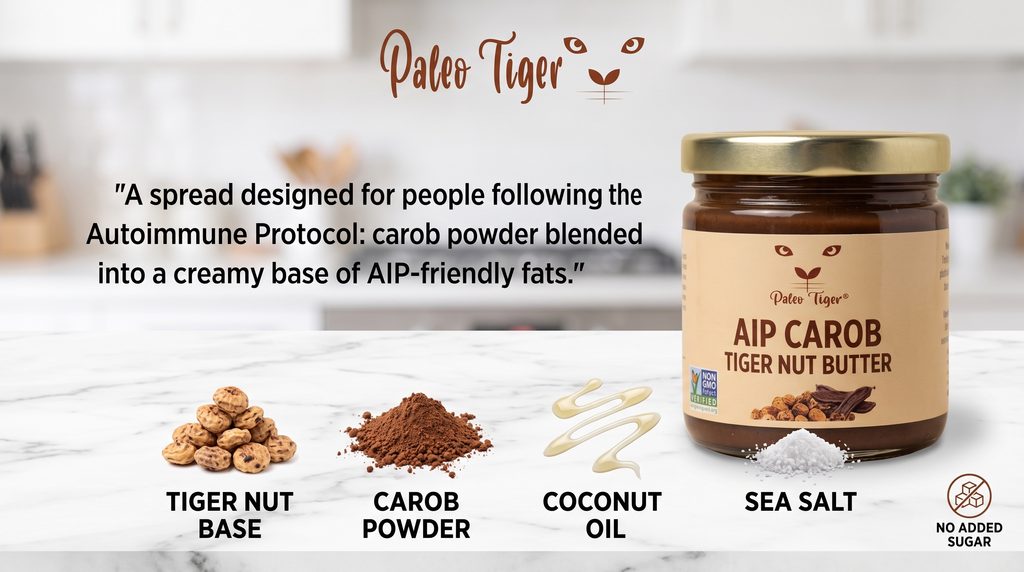
An AIP carob butter is a spread designed for people following the Autoimmune Protocol: carob powder blended into a creamy base of AIP-friendly fats, with no chocolate, no caffeine, no nuts, no dairy, and no added sugar. Unlike most chocolate spreads on the shelf, built on cocoa, palm oil, and sugar, often with “may contain nuts” warnings, a true AIP carob butter is built the other way around: start with what a sensitive diet allows, then make it taste like a treat.
The idea solves a real daily problem. Baking with carob powder is a project; you need the right roast, the right recipe, and a free afternoon. A finished spread is the project already done: open the jar, spread, done. That convenience is exactly why the AIP carob butter concept has grown alongside the powder market: powders are ingredients, butters are foods.
The AIP question, answered honestly.
Most carob articles skip this section. It is the one that matters most on a healing diet, so here are the two doubts, answered straight.
Doubt #1: “Tiger nuts don’t sound like AI; they have ‘nut’ in the name.” Tiger nuts are not nuts at all. They are small tubers, underground root vegetables from the Cyperus esculentus plant, closer to potatoes and yams than to almonds or peanuts. Not grains, legumes, nightshades, or tree nuts, which is precisely why they fit an elimination diet. When a carob butter is built on a tiger-nut base, the “nut-free” claim is botany, not marketing wordplay.
Doubt #2: “Isn’t carob a legume? AIP eliminates legumes.” This one deserves honesty. The carob tree (Ceratonia siliqua) does belong to the legume family, Fabaceae. Strictly speaking, that puts carob in the same botanical family as foods AIP eliminates. However, carob powder comes from the sweet pulp of the pod, not the seed, and the pod pulp does not contain the seed compounds that make legumes problematic on AIP.
Many AIP practitioners treat carob as acceptable; others prefer to treat it as a careful reintroduction. Notice the careful language on serious product pages; Paleo Tiger describes its spread as “AIP and Paleo-compatible” rather than claiming blanket compliance. That wording is deliberate and worth respecting.
Product spotlight
Tiger Nut Butter (Carob) AIP Friendly-8oz
Why use: The ready-to-eat answer to this entire guide, carob’s chocolate-like appeal in a spreadable, no-bake form.
Pricing: $16.99 for 8 oz (verified live September 30, 2026).
This is where the comparison meets the shelf. Paleo Tiger’s Tiger Nut Butter (Carob) AIP Friendly-8oz is the brand’s ready-to-eat AIP carob butter: a spread built for people who want the carob experience without the baking project.
Why it earns its place: caffeine-free mornings (the chocolate ritual without the stimulant), lunchbox-safe by botany rather than “may contain” luck, and a four-ingredient label that suits elimination-phase shopping.
Honest limitation: This AIP carob butter is not a low-fat food; tiger nuts and oils see to that, and it is not trying to be. The roast character is the house blend; if you want to choose Terrasoul-style sweetness vs Mediterranean-style intensity yourself, the homemade recipe below is your lane. At roughly $2.12 per oz, it also costs more than stirring up your own.
Verdict: For busy weeks, lunchboxes, and anyone who wants carob in their day without a project, this is the easiest AIP carob butter to fit into a real day. Bakers who want control should make the DIY version instead.
You can find it in the Paleo Tiger shop alongside the rest of the range. If carob is not your flavor, the same AIP-compatible tiger-nut base comes in other varieties; check the shop page for the current lineup.
Mid-article CTA: Shop the carob butter, 4 ingredients, $16.99
Quick Take: AIP carob butter in one line: carob powder meets tiger-nut butter, no caffeine, no nuts, no dairy, no added sugar. Buy the jar for busy days; make the recipe below when you want to control the roast.
That covers the why. Next is the how.
How Do You Make AIP Carob Butter at Home?
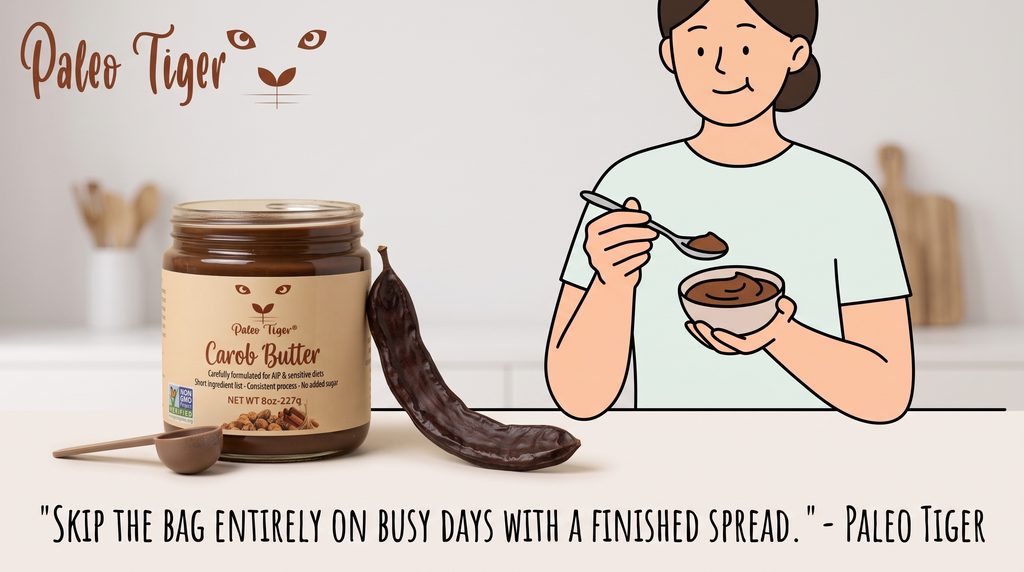
You can make AIP carob butter at home in about 15 minutes by stirring carob powder and coconut oil into plain tiger nut butter, no grinding required.
If you enjoy kitchen projects, or you already have a bag of carob powder from the comparison above, here is a simple homemade carob butter recipe. It uses store-bought tiger nut butter as its base, which keeps the recipe genuinely AIP-compatible without requiring you to grind tiger nuts from scratch.
Homemade carob butter (makes about 1½ cups)
- 1 cup plain tiger nut butter (tiger nuts, avocado oil, coconut oil, the plain base)
- 3–4 tablespoons carob powder (lightly roasted if you want it sweeter, Mediterranean-style if you want it darker)
- 2 tablespoons coconut oil, gently melted
- 1 pinch of sea salt
Method: Warm the jar in a bowl of warm water for 5 minutes so it stirs easily, then add the carob powder one tablespoon at a time, stirring thoroughly; it clumps if you rush it. Stir in the melted coconut oil and salt until glossy.
Taste and adjust: want it sweeter?
Add another tablespoon of lightly roasted carob rather than any sweetener. Pour into a clean jar and let it set at room temperature for an hour.
This homemade batch keeps for 2–3 weeks in a cool pantry (oil separation is natural, just stir). It will never be quite as silky as the stone-ground commercial version, but it lets you control the roast character:
Terrasoul-style powder for a mild, sweet spread, Mediterranean-style for a darker, more intense one. That is the real payoff of understanding the powder comparison: your spread tastes like your preference, not a committee’s.
A baker’s tip: this carob butter recipe also works as a frosting. Chill it for 30 minutes and it firms up enough to spread on carob cupcakes made with extra-fine tiger nut flour.
| Homemade | Store-Bought (Paleo Tiger) | |
| Ingredients | 4 (you control them) | 4 (listed on the page) |
| Time | 15 minutes + setting | 0 minutes |
| Texture | Rustic, slightly grainy | Smooth, stone-ground |
| Roast choice | Yours, Terrasoul or Mediterranean powder | Fixed house blend |
| Cost per jar | Lower, if you own the powder | $16.99 for 8 oz |
| Best for | Bakers, tinkerers, big batches | Busy weeks, lunchboxes, gifting |
Takeaway: make the DIY version when you want control over the roast; buy the jar when you want breakfast. Many households do both.
Original Tiger Nut Butter
Why use: The plain base that makes the homemade recipe above possible, no grinding tiger nuts from scratch.
The homemade carob butter recipe needs a plain, unsweetened starting point, and Original Tiger Nut Butter is exactly that: the brand’s unflavored tiger-nut base. We use it here the way a baker uses plain flour, a neutral foundation that takes on whatever you stir into it.
Honest limitation: Availability. The shop listing showed this one as “Sold out” when we last checked, so confirm it is back in stock before planning a batch around it. It is also the plainest-tasting jar in the range by design; do not expect it to excite anyone on its own.
Verdict: Buy it as an ingredient, not a snack. If it is in stock, one jar covers multiple batches of homemade carob butter.
Quick Summary: In short, the homemade route takes 15 minutes and hands you roast control; the jar takes zero minutes and hands you breakfast. There is no wrong answer.
Big-batch tip: double the recipe and pour half into a second jar with a darker-roast powder. Two roasts side by side is the fastest education in what “lightly roasted” actually tastes like.
What Else Belongs in a Carob Lover’s AIP Pantry?
A carob-friendly AIP pantry stocks tiger-nut staples, granola, flour, and oil that turn one jar of carob butter into breakfasts, bakes, and snacks.
Once an AIP carob butter lives in your pantry, a few companion staples turn it from a single spread into a whole rotation:
| Staple | Why it pairs with carob butter | Best use |
| Tiger Nuts Granola | Crunchy, grain-free base under a spoonful of carob butter | Breakfast bowls, yogurt-style parfaits |
| Tiger Nut Flour (Extra Fine) | The flour for carob cupcakes and frostings | AIP baking projects |
| Cold-Pressed Tiger Nuts Oil | Neutral AIP cooking fat for roasting and drizzling | Everyday cooking alongside sweet staples |
Takeaway: one spread plus three staples covers breakfast, baking, and cooking without leaving AIP.
Tiger Nuts Granola
Why use: The crunch your carob butter breakfast bowl is missing, grain-free, nut-free, and built for AIP mornings.
Paleo Tiger’s tiger nuts granola is the breakfast anchor of the range: clusters of tiger nuts, coconut, and tiger nut flour with avocado oil and cinnamon, and no added sugar. Crumble it into a bowl, add a spoonful of carob butter, and you have a chocolate-style breakfast with zero baking and zero stimulants.
Honest limitation: We are not quoting a price or pack size here because the store currently shows conflicting details on both; check the live listing before you buy. Like any granola, it is a calorie-dense food; the “healthy” framing does not make it a free-for-all.
Verdict: The fastest AIP breakfast in this guide: granola plus carob butter, done in sixty seconds.
Tiger Nut Flour (Extra Fine)
Why use: The flour behind every carob baked in this guide, cupcakes, frostings, and energy balls that stay grain-free.
Pricing: $12.99 (verified live September 30, 2026).
Extra-fine tiger nut flour is the baking workhorse: finely milled tiger nuts that behave like a light alternative flour in AIP recipes. It is the flour we reach for in the carob cupcake idea above and in the frosting version of the homemade recipe.
Honest limitation: It does not behave exactly like wheat flour or even almond flour; expect a denser crumb and adjust liquids. It is also the priciest way to buy tiger nuts per ounce, so save it for baking, not smoothies.
Verdict: Essential if you bake AIP; skip it if your carob life is spreads-only.
100% Cold-Pressed Tiger Nuts Oil
Why use: A neutral, AIP-friendly cooking fat that keeps your whole pantry in one ingredient family.
Pricing: $12.99 (verified live September 30, 2026).
Cold-pressed tiger nut oil is the quiet utility player: a mild oil for roasting vegetables, drizzling over roasted carob-spiced snacks, or anywhere you want a neutral fat that keeps the whole meal AIP-compatible. It shares the jar’s ingredient family, which simplifies label-reading to nearly nothing.
Honest limitation: It is a finishing and light-cooking oil, not a high-heat workhorse; do not treat it like avocado oil for searing. And at this price, it is a pantry upgrade, not a budget staple.
Verdict: Worth it once your AIP kitchen is established; not the first jar to buy.
Quick Summary: So the bottom line is: carob butter is the star, and granola, flour, and oil are the supporting cast that turns one jar into a full AIP rotation.
Final Takeaway
Powders are ingredients for projects; a finished AIP carob butter is food for real life. Choose Terrasoul lightly roasted carob powder for sweetness and mildness, Mediterranean carob powder for depth and intensity; roast level matters more than brand. But if your goal is simply to have something chocolate-like in the house that a caffeine-sensitive kid, an AIP follower, or a nut-free household can all eat, the spread beats the bag. Keep the powder for baking weekends; keep an AIP carob butter in the pantry for everything else.
Medical disclaimer: This article is for informational purposes only and is not medical advice. The Autoimmune Protocol is a dietary framework, not a treatment. Talk to your healthcare practitioner before making dietary changes, especially during the elimination phase or if you have a diagnosed condition or severe allergy.
Sources
- Healthline, “What Are the Benefits of Carob?” (botanical origin, fiber, caffeine-free use as chocolate substitute)
- Terrasoul Superfoods Organic Carob Powder product listing (lightly roasted, organic/non-GMO/gluten-free/vegan)
- Nutriplanet, “Carob Benefits, Uses and Carob vs Cocoa” (raw vs lightly roasted vs dark-roasted distinctions)
- The Australian Carob Co. (producer description of Mediterranean carob powder flavor)
- Paleo Tiger, “What Are Tiger Nuts?”
- Paleo Tiger, product page, Tiger Nut Butter (Carob) AIP Friendly-8oz
FAQs
What is AIP carob butter?
An AIP carob butter is a spread made for the Autoimmune Protocol: carob powder blended with AIP-friendly fats like tiger nuts and coconut or avocado oil, with no cocoa, caffeine, nuts, dairy, or added sugar. People use it as a chocolate-spread alternative during elimination and beyond.
Is carob AIP compliant?
The honest answer has nuance. The carob tree belongs to the legume family, but carob powder comes from the pod pulp, not the seed. Many practitioners consider it acceptable, while others treat it as a reintroduction. Brands that take AIP seriously describe carob products as “AIP-compatible” rather than claiming blanket compliance. During strict elimination, ask your practitioner.
Can I substitute carob powder for cocoa powder 1:1?
In most baking recipes, yes, start with a 1:1 swap. Expect differences: carob is naturally sweeter and lower in fat than cocoa, so you may want less added sugar and slightly more fat in the recipe. Lightly roasted carob needs the least adjustment; dark-roasted Mediterranean-style carob behaves the most like cocoa.
I tried carob once, and it tasted burned. What did I do wrong?
You almost certainly tried a dark roast. Dark-roasted carob is roasted at high heat for a cocoa-like color, and it carries a bitter edge that surprises first-timers. Try a lightly roasted carob powder instead; it tastes mild, sweet, and caramel-like. Roast level, not the brand, was the problem.
Is carob butter actually healthy, or just candy with better marketing?
It depends on the jar. A real carob butter, tiger nuts, oils, carob powder, nothing added, is a simple whole-food spread, not candy. But “carob” on a label does not guarantee simplicity; some spreads add sugar and palm oil. Read the ingredient list: short and recognizable wins, whatever the marketing says.
Is Paleo Tiger’s carob butter really nut-free?
The formulation is nut-free by botany: tiger nuts are tubers (root vegetables), not tree nuts or peanuts, and the jar contains no nuts, dairy, or gluten ingredients. That said, “nut-free ingredients” and “nut-free facility” are different claims; anyone with a severe allergy should check manufacturing practices and consult their allergist.
Where can I buy AIP carob butter?
You can buy AIP carob butter through the Paleo Tiger shop, which sells Tiger Nut Butter (Carob) AIP Friendly-8oz for $16.99. When comparing brands, check that the ingredient list is short, the nut-free claim refers to the formulation, and the page does not promise medical outcomes.