
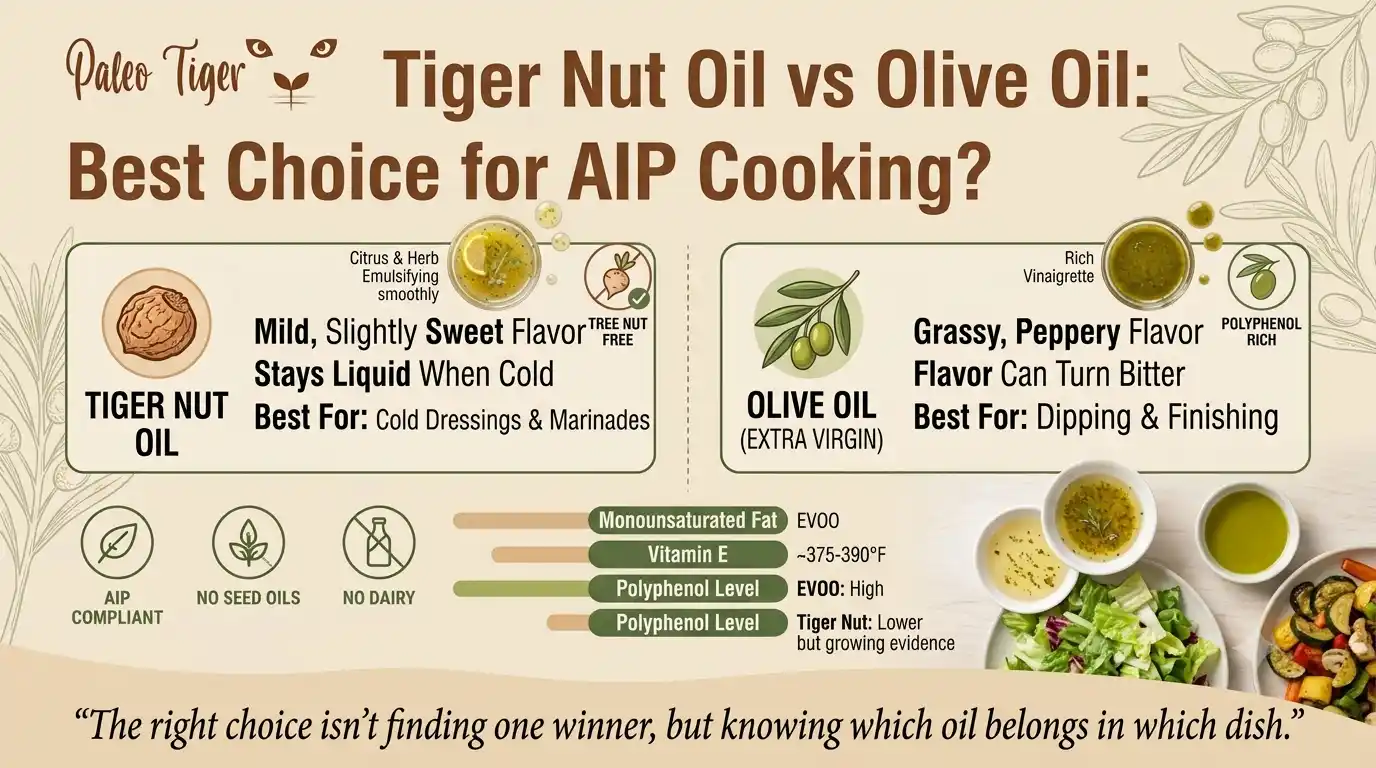
Tiger Nut Oil vs Olive Oil is a common comparison for anyone following the Autoimmune Protocol (AIP). Oil choices matter more than most people expect. The wrong oil can knock you out of compliance in one meal. Two of the most discussed AIP-friendly options are tiger nut oil and olive oil. Both are allowed on AIP. Both are widely available. However, they behave very differently in the kitchen, and each oil performs best for different cooking tasks.
This guide breaks down the real differences between tiger nut oil vs olive oil, flavor, fat profile, smoke point, AIP compliance, and everyday use, so you can stock your pantry with confidence. And if you want to go straight to using tiger nut oil in real recipes, our AIP-friendly oils guide covers exactly that.
What Is Tiger Nut Oil and Why Does It Matter on AIP?
Manufacturers produce tiger nut oil by cold-pressing tiger nuts, a small root vegetable rather than a tree nut. That distinction is important. Many people on AIP also have tree-nut sensitivities or allergies. Tiger nut oil sidesteps that concern entirely.
The oil has a mild, slightly sweet, faintly nutty flavor. It stays liquid at room temperature and emulsifies cleanly with citrus or vinegar. These two qualities make it especially useful in cold dressings and marinades, where coconut oil would solidify, and olive oil can turn bitter.
Paleo Tiger’s 100% cold-pressed tiger nut oil is one of the cleanest options on the market, single-ingredient, cold-pressed, and fully AIP elimination-phase compliant. If you want an oil that works across dressings, light sautéing, and everyday cooking without any compliance guesswork, this is the one to keep stocked.
Quick Comparison: Tiger Nut Oil vs Olive Oil
| Feature | Tiger Nut Oil | Olive Oil (Extra Virgin) |
| Source | Tiger nut (root vegetable/tuber) | Olive fruit |
| AIP Compliant | Yes | Yes |
| Tree Nut Free | Yes | Yes |
| Flavor Profile | Mild, slightly sweet, faintly nutty | Grassy, fruity, can be bitter |
| Smoke Point | ~390°F (199°C) | ~375°F (191°C) |
| Solid at Room Temp? | No, stays liquid | No, stays liquid |
| Best For | Dressings, marinades, light cooking | Roasting, dressings, dipping |
| Emulsifies in Cold Dressings | Excellent | Good, but flavor dominates |
| Vitamin E Content | Present naturally | Present naturally |
| Primary Fat Type | Monounsaturated (oleic acid) | Monounsaturated (oleic acid) |
AIP Compliance: Are Both Oils Actually Safe?
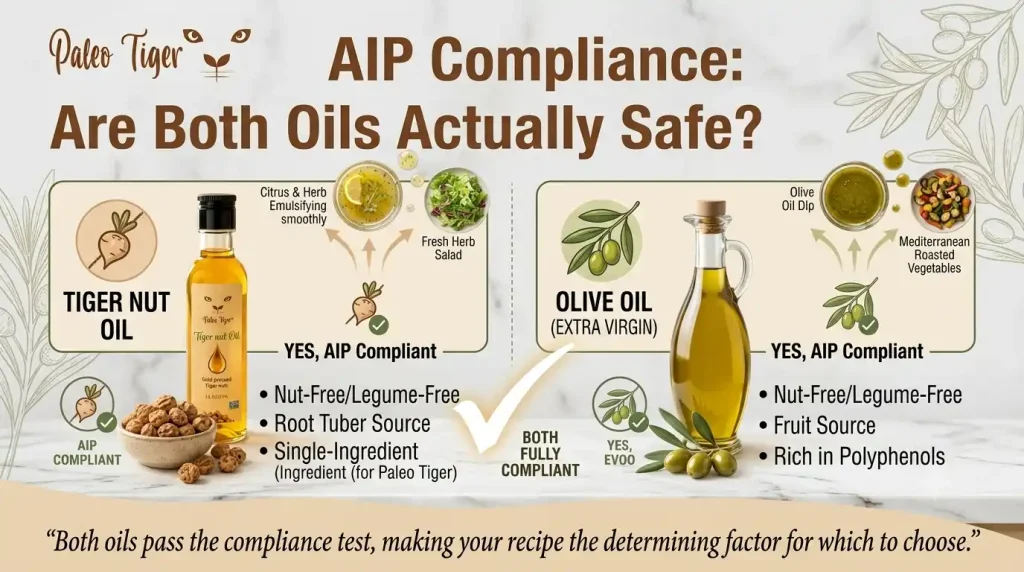
Yes, both tiger nut oil and olive oil are AIP elimination-phase compliant. Neither comes from a seed, grain, or legume, which are the main oil sources excluded on AIP. But compliance alone doesn’t decide which oil is right for a given task.
The more important question is: which oil causes the fewest practical problems on AIP? Here, tiger nut oil has a clear edge for anyone also managing a tree-nut allergy alongside their autoimmune protocol. Because tiger nuts are a tuber, the oil is naturally nut-free, shareable across a household with mixed dietary needs without cooking two separate versions of every meal.
For a deeper look at all AIP-friendly fat options and how they compare, our guide to what is the AIP diet covers this in full context.
Flavor Profile: The Biggest Practical Difference
This is where most home cooks notice the difference fastest. Extra virgin olive oil has a distinctive flavor, grassy, peppery, and sometimes bitter, especially in high-quality varieties. That’s a feature, not a flaw, in a Greek-style vinaigrette or drizzled over roasted vegetables. But it becomes a problem in delicate dressings built around fresh dill, mint, or parsley, where the olive oil’s flavor fights the herbs rather than carrying them.
Tiger nut oil is much more neutral. It has a mild, faintly sweet quality that doesn’t compete with other flavors. That makes it the better choice for light herb dressings, citrus marinades, and recipes where you want the other ingredients to shine.
Flavor Use Case Guide
| Use Case | Best Oil | Why |
| Greek-style vinaigrette | Olive oil | Flavor is intentional and expected |
| Lemon-herb dressing | Tiger nut oil | Neutral base lets herbs lead |
| Roasting root vegetables | Either | Both handle moderate heat well |
| Creamy avocado dressing | Tiger nut oil | Emulsifies cleanly, no bitterness |
| Drizzling over carpaccio | Olive oil (EVOO) | Flavor is the point |
| Carrot-ginger dressing | Tiger nut oil | Doesn’t compete with ginger’s heat |
| Dipping oil with herbs | Olive oil | Bold flavor suits the format |
| Light sauté (medium heat) | Tiger nut oil | Higher smoke point, neutral flavor |
Fat Profile and Nutritional Value: How Do They Compare?
Both oils are predominantly monounsaturated fat, the same type of fat associated with heart health that makes olive oil a commonly recommended dietary choice. The dominant fatty acid in both is oleic acid. This is an important similarity: people who switch from olive oil to tiger nut oil for AIP reasons are not making a nutritional downgrade.
Tiger nut oil also contains natural vitamin E, an antioxidant that becomes harder to get in adequate amounts on AIP, since several common vitamin E sources (almonds, sunflower seeds, wheat germ) are excluded during elimination. Olive oil also contains vitamin E, so both oils support this nutrient gap to some degree.
Nutritional Comparison (per 1 tbsp / 14g, approximate)
| Nutrient | Tiger Nut Oil | Extra Virgin Olive Oil |
| Calories | ~120 kcal | ~119 kcal |
| Total Fat | 14g | 14g |
| Monounsaturated Fat | ~10g (70–75%) | ~10g (70–80%) |
| Polyunsaturated Fat | ~2g | ~1.5g |
| Saturated Fat | ~2g | ~2g |
| Vitamin E | Present | Present (~1.9 mg) |
| Antioxidant Compounds | Yes (oleic acid) | Yes (polyphenols, oleocanthal) |
| Omega-6:Omega-3 Ratio | Moderate | Moderate (favorable) |
One area where olive oil, especially high-quality extra virgin varieties, has more research behind it is polyphenol content. Polyphenols are plant compounds with anti-inflammatory properties, and EVOO is one of the richest dietary sources. This is a genuine advantage of olive oil for people focused on managing inflammation as part of their autoimmune protocol. Tiger nut oil doesn’t match this specific benefit, but it compensates with its neutral flavor and nut-free profile.
Smoke Point: Which Oil Is Better for Cooking?
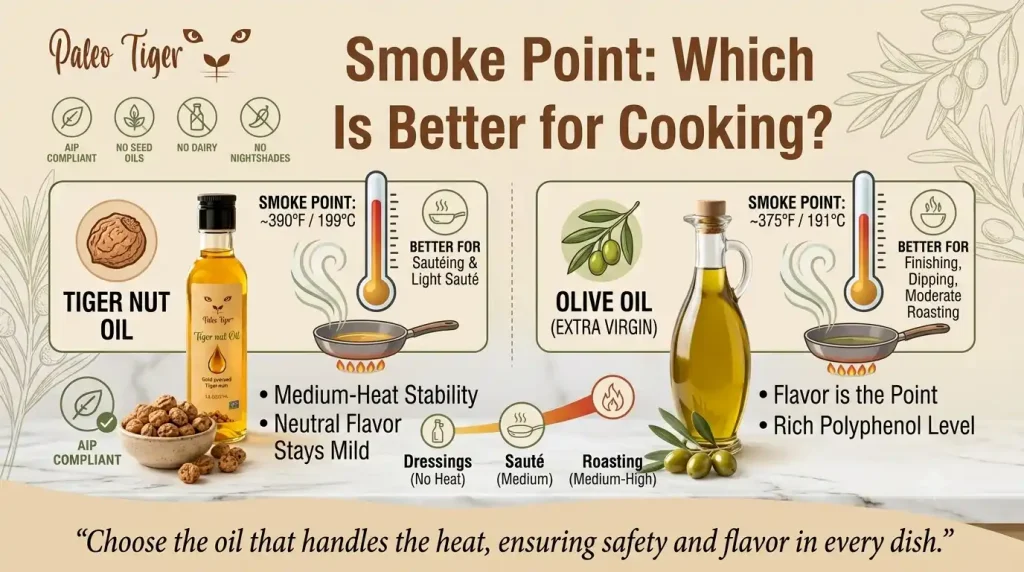
Smoke point matters because heating oil above its smoke point degrades the fat and can produce harmful compounds. In AIP cooking, which often involves plenty of roasting and sautéing, knowing where each oil reaches its limit is useful.
• Tiger nut oil: approximately 390°F (199°C)
• Extra virgin olive oil: approximately 375°F (191°C)
• Light/refined olive oil: approximately 465°F (240°C), but refined versions lose many of the health compounds
When it comes to most AIP cooking, including roasting vegetables, light sautéing, and making dressings, both tiger nut oil and EVOO work within safe limits. Neither is the right choice for very high-heat cooking like deep frying. Instead, coconut oil or avocado oil is better suited.
The practical takeaway is that tiger nut oil has a slight edge for medium-heat cooking and is noticeably better for cold applications where you don’t want the oil’s flavor to interfere. Olive oil remains the standard for situations where its flavor is part of the dish.
Everyday Use: Where Each Oil Actually Belongs in Your Kitchen
The comparison between tiger nut oil vs olive oil isn’t really about which one is universally better. It’s about which one belongs in which situation. Here’s how to think about stocking both, or choosing one if budget is a factor.
Best Uses for Tiger Nut Oil
Choose tiger nut oil for salad dressings where a neutral base is needed.
Make AIP-compliant vinaigrettes without mustard.
Prepare herb-forward dressings like lemon-dill or parsley-citrus.
Blend creamy dressings with avocado or coconut cream.
Use it for medium-heat sautéing of vegetables or proteins.
Ideal for households managing tree-nut allergies alongside AIP.
Perfect for carrot-ginger or Asian-inspired dressings where a neutral oil won’t compete with ginger or coconut aminos.
Best Uses for Olive Oil
Choose Greek-style or Mediterranean vinaigrettes where the olive oil flavor is the highlight.
Drizzle over finished dishes to add richness and depth.
Serve as a dipping oil with AIP-compliant herbs.
Roast vegetables where a subtle olive flavor enhances the dish.
Best for recipes where polyphenol content is a priority.
If you can only stock one, tiger nut oil is more versatile on AIP specifically, because its neutral flavor doesn’t limit the type of dressings or dishes you can make. Olive oil’s strong character is an asset in some recipes and a problem in others.
Paleo Tiger stocks cold-pressed tiger nut oil alongside whole tiger nuts, tiger nut flour, and tiger nut butter, so building out an AIP pantry around tiger nut products doesn’t require sourcing from multiple places.
Pros and Cons: Tiger Nut Oil vs Olive Oil on AIP
| Tiger Nut Oil | Olive Oil (EVOO) | |
| Pros | Neutral flavor, doesn’t compete with herbs or spices. Liquid at room temp, pours well in cold dressings. Tree-nut and legume free, shareable across dietary needs. Emulsifies without mustard. Higher smoke point than EVOO. Mild sweetness adds depth without extra ingredients | Rich polyphenol content, well-researched anti-inflammatory benefits. Bold flavor, a feature in Mediterranean dishes. Widely available and often cheaper per ounce. Strong evidence base for heart health. Versatile for cooking and finishing |
| Cons | Less research on polyphenol content specifically Slightly higher price point in some markets Less familiar to most home cooks | Bitter/grassy flavor can overpower delicate dressings Flavor limits recipe versatility on AIP Lower smoke point than tiger nut oil Not tree-nut free (though not a tree nut, cross-perception can occur in branding) |
Cost and Availability: A Practical Look
Olive oil is typically the more affordable option when comparing standard grocery store prices. Extra virgin olive oil from well-known brands is easy to find at most supermarkets and warehouse stores. Tiger nut oil is more of a specialty product and is primarily found through dedicated AIP and paleo brands like Paleo Tiger.
That said, a bottle of tiger nut oil goes a long way in dressings; a standard bottle covers dozens of servings. The slightly higher unit cost is offset by the fact that you’re getting an oil specifically optimized for the tasks where it excels: cold dressings, herb-forward vinaigrettes, and situations where olive oil’s bold flavor would get in the way.
For AIP households that are already buying specialty ingredients- cassava flour, coconut aminos, tiger nut butter- adding tiger nut oil to the pantry is a straightforward addition. You can browse the full lineup, including tiger nut oil, at the Paleo Tiger shop.
What the Research Actually Says?
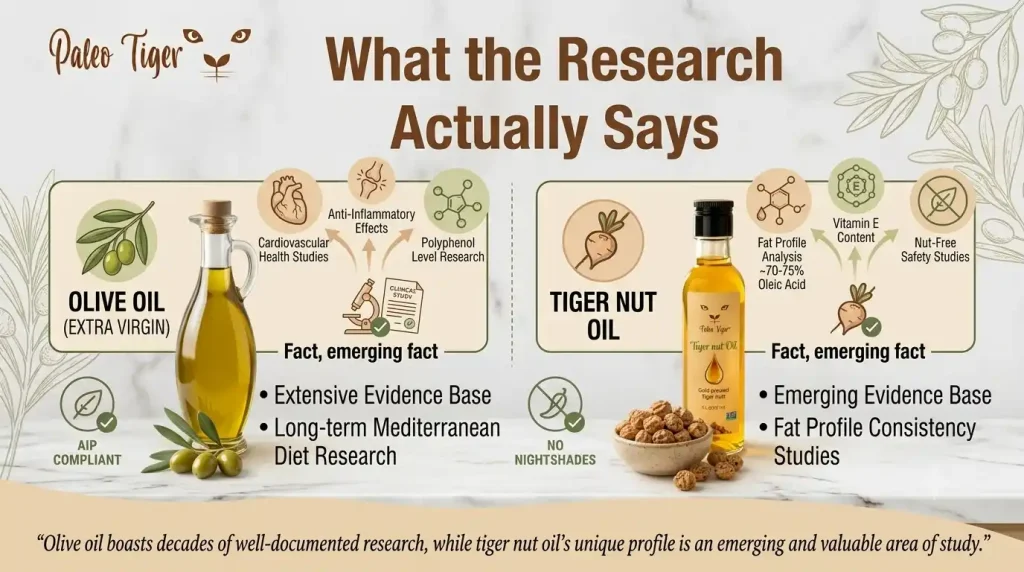
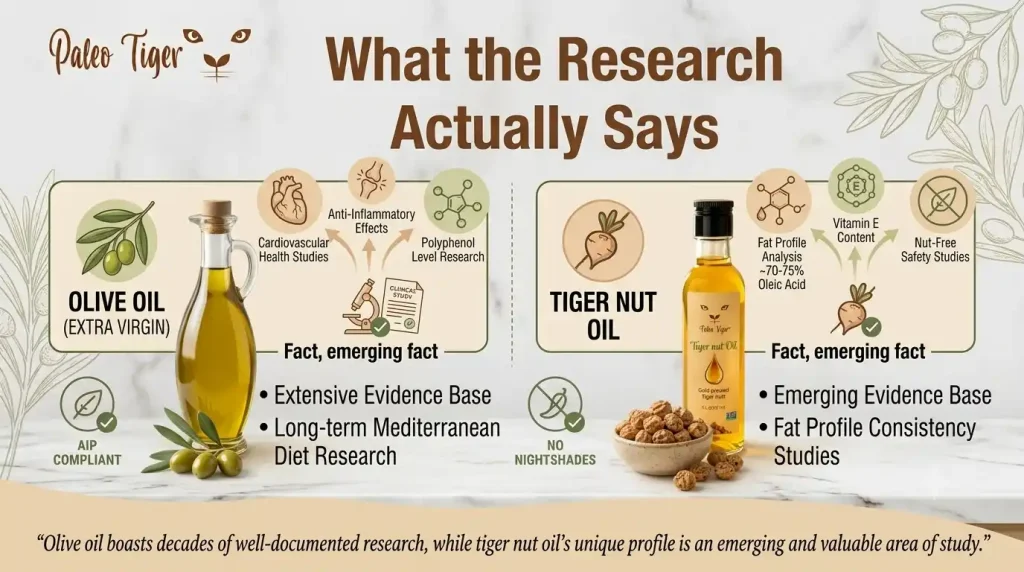
Olive oil has the stronger research record, decades of Mediterranean diet studies, clinical trials on cardiovascular outcomes, and extensive work on the anti-inflammatory effects of its polyphenol compounds (oleocanthal in particular). This is well-established and worth taking seriously.
Tiger nut oil is newer to the conversation in Western markets, but research on its fat profile is consistent: it’s predominantly oleic acid (the same monounsaturated fat in olive oil), with a small polyunsaturated fraction and natural vitamin E. Studies on tiger nuts as a food source also suggest benefits for gut health, since the whole nut contains prebiotic resistant starch, though this applies to the whole nut and flour more than the oil.
The honest summary: if polyphenol content is your primary concern, olive oil has a stronger evidence base. If versatility and neutrality on AIP are your priorities, especially for cold dressings and herb-forward cooking, tiger nut oil is the better tool.
For more on how tiger nuts work specifically within AIP guidelines, our tiger nuts and the AIP diet guide explains the full picture.
How to Use Tiger Nut Oil and Olive Oil Together
The best approach for most AIP kitchens isn’t choosing between tiger nut oil vs olive oil; it’s understanding when to reach for each one.
Here’s a simple framework:
Choose tiger nut oil for cold dressings, light herb vinaigrettes, or any recipe where a neutral flavor is needed.
Reach for olive oil when you want its bold flavor to enhance dishes, dipping oils, drizzles, or Mediterranean recipes.
Either oil works well for medium-heat sautéing, as both stay within the smoke point range required for most AIP cooking.
Default to tiger nut oil if someone at the table has a tree-nut allergy, since its nut-free profile makes it a universally safe choice.
This two-oil approach covers almost every AIP cooking scenario without needing to stock additional oils like avocado oil or coconut oil for everyday use (though those are useful for high-heat cooking and baking, respectively).
If you’re just getting started with tiger nut products on AIP, our essential foods for starting the AIP diet guide covers where tiger nut oil fits into a full elimination-phase pantry.
Why Paleo Tiger’s Tiger Nut Oil Stands Out
Not all tiger nut oil products are created equal. Paleo Tiger’s cold-pressed tiger nut oil is made from a single ingredient, pressed without chemical processing, and designed specifically for AIP and paleo households. That means no fillers, no blended oils, and no ambiguity about what’s in the bottle.
Paleo Tiger was built around the idea that AIP cooking shouldn’t require constant label-checking or ingredient sourcing from six different places. Having a trusted source for tiger nut oil, alongside tiger nut butter, tiger nut flour, and whole tiger nuts, makes the day-to-day reality of elimination eating genuinely easier. The pantry builds on itself.
That’s the practical advantage of choosing Paleo Tiger products: they’re designed to work together. The tiger nut butter pairs with tiger nut flour for AIP baking. The whole tiger nuts add crunch to salads topped with tiger nut oil dressing. Every product in the lineup stays within AIP boundaries without requiring you to verify it separately.
Key Statistics and Facts at a Glance
| Stat / Fact | Detail |
| Oleic acid content in tiger nut oil | ~70–75% monounsaturated fat |
| Oleic acid content in extra virgin olive oil | ~70–80% monounsaturated fat |
| Smoke point, tiger nut oil | ~390°F / 199°C |
| Smoke point, EVOO | ~375°F / 191°C |
| AIP compliance, both oils | Fully compliant in elimination phase |
| Tree-nut free | Tiger nut oil: Yes | Olive oil: Yes (not from nuts) |
| Vitamin E present | Both oils contain natural vitamin E |
| Emulsifies without mustard (AIP vinaigrettes) | Tiger nut oil: Yes | Olive oil: Yes, but flavor dominates |
| Polyphenol research depth | Olive oil: Extensive | Tiger nut oil: Emerging |
| Best cold dressing oil on AIP | Tiger nut oil (neutral flavor, clean emulsification) |
Final Thoughts
The tiger nut oil vs olive oil debate doesn’t have a single winner. It depends entirely on what you’re cooking.
Olive oil is a well-researched fat with a distinctive flavor that works beautifully in the right dishes. Tiger nut oil is a neutral, AIP-compliant oil that outperforms olive oil in cold dressings, herb-forward vinaigrettes, and any recipe where you need the oil to carry flavor without contributing its own. It’s also the better option for nut-allergy households and anyone who finds olive oil’s bitterness too strong in lighter preparations.
For most AIP kitchens, the answer is to use both, and to know when each one belongs. Start with tiger nut oil for dressings and light cooking, keep olive oil for Mediterranean-style dishes and finishing, and you’ll cover almost every scenario the elimination phase asks for.
Paleo Tiger’s cold-pressed tiger nut oil is the cleanest, most reliable way to add this oil to your AIP pantry: single-ingredient, cold-pressed, and built for exactly this kind of everyday use.
Frequently Asked Questions
1. Is tiger nut oil better than olive oil for AIP?
Tiger nut oil is better for cold dressings and neutral-flavor cooking on AIP. Olive oil is better when its bold flavor suits the dish. Both are fully AIP elimination-phase compliant.
2. Can I substitute tiger nut oil for olive oil in AIP recipes?
Yes, tiger nut oil works as a 1:1 substitute for olive oil in most cold applications. Its milder flavor makes it especially good in herb dressings where olive oil can taste bitter or overpowering.
3. Does tiger nut oil have the same health benefits as olive oil?
Both oils are high in monounsaturated fat and contain vitamin E. Olive oil has more polyphenol research behind it. Tiger nut oil matches olive oil’s fat profile closely and adds the benefit of a completely nut-free source.
4. What is the smoke point of tiger nut oil compared to olive oil?
Tiger nut oil has a smoke point of approximately 390°F (199°C). Extra virgin olive oil sits at around 375°F (191°C). Both are suitable for medium-heat AIP cooking like sautéing and roasting.
5. Where can I buy cold-pressed tiger nut oil for AIP cooking?
Paleo Tiger offers 100% cold-pressed tiger nut oil that is fully AIP compliant, single-ingredient, and designed for everyday AIP cooking, available directly through the Paleo Tiger shop.