
Pick up almost any box in the cereal aisle. You will see the word fiber everywhere. Granola brands love it. Bar brands love it even more.
But nobody answers the real question clearly: is granola fiber? Or does granola just contain some fiber?
The answer matters. Most adults fall far short of daily fiber targets. And most “high fiber” snacks fail people on paleo or AIP diets. They rely on oats, nuts, and seeds. Those ingredients are off the table.
This guide fixes that. You will learn what dietary fiber does, where granola fiber really comes from, and how to spot healthy granola bars that are actually good for you. You will also meet a different kind of high-fiber granola. It is grain-free; it is nut-free. It fits the AIP diet. And it turns into some of the easiest AIP snacks you can make at home.
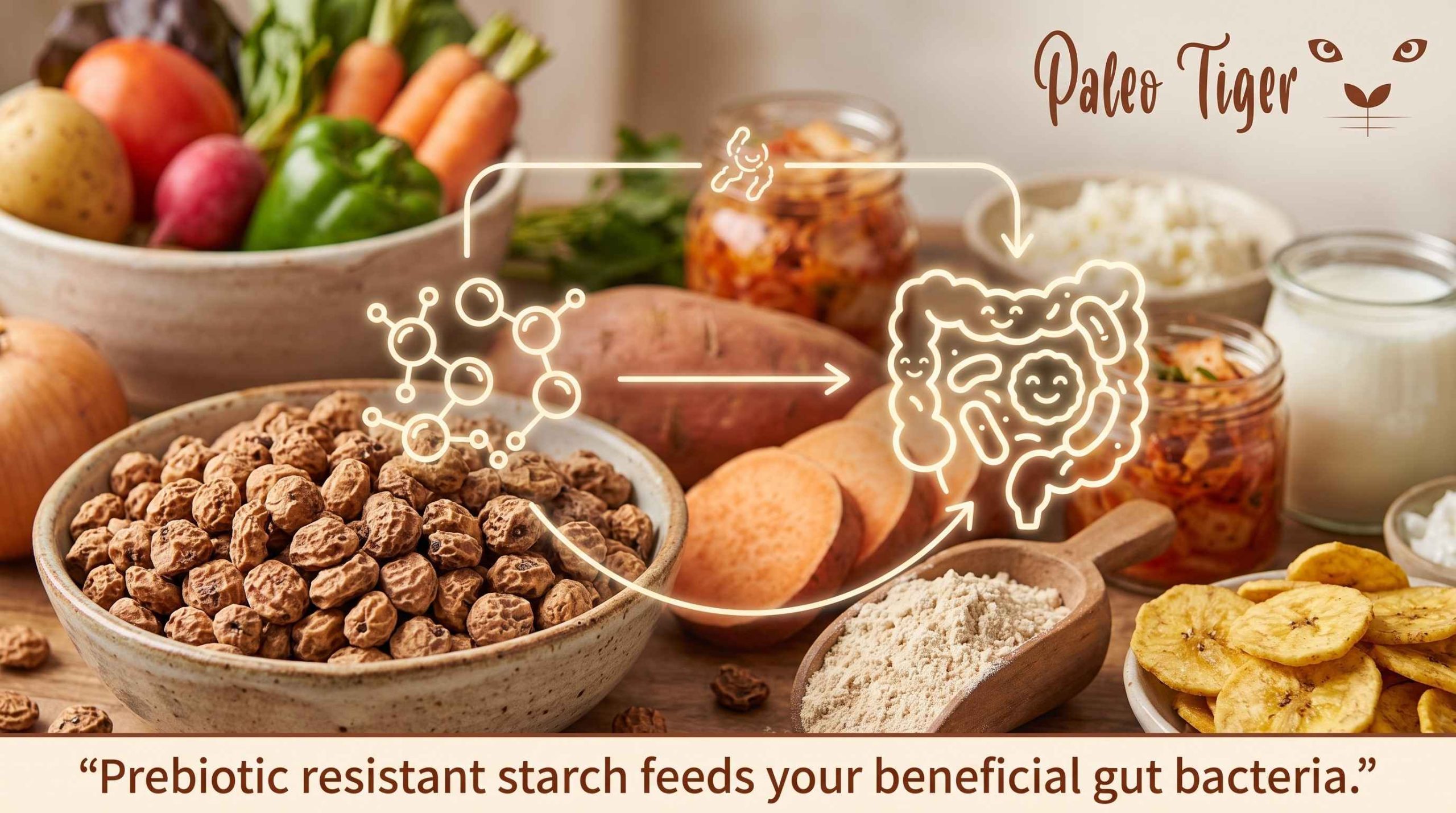
PaleoTiger makes it from tiger nuts. Tiger nuts are small tubers, not nuts. They pack serious fiber, including prebiotic types that feed good gut bacteria. If you want AIP snacks with real fiber, start here. The data might surprise you.
Is Granola Fiber? The Short Answer
Short answer: granola is not fiber. Granola is a food that can contain fiber.
Think of it like this. An orange is not vitamin C. It contains vitamin C. Granola works the same way. Its fiber content depends 100% on its ingredients.
A granola made from oats, honey, and almonds carries oat fiber. A granola made from tiger nuts, avocado oil, and cinnamon carries tigernut fiber. Same word on the package. Very different nutrition inside.
So when someone asks “is granola fiber,” the honest answer is: check the ingredients. Then check the fiber grams per serving. Then check what else comes along for the ride, like added sugar.
This matters more than most people think. The USDA sets daily fiber targets at 25 grams for women and 38 grams for men. National surveys put average intake at only about 15 grams a day. Analyses of national nutrition data estimate that only around 1 in 20 American adults meets the target. That gap is huge.
For people on the AIP diet, the gap is even harder to close. The usual high fiber heroes, oats, wheat bran, chia, flax, are all eliminated on the AIP diet. You need fiber from sources that play by AIP rules. That is where this guide goes next.
What Dietary Fiber Actually Does for You?
Fiber is the part of plant food your body cannot digest. That sounds useless. It is the opposite. Here is what fiber does, in plain terms:
- It adds bulk. This keeps digestion moving and supports regularity.
- It slows digestion. This helps you feel full longer after a meal.
- It steadies blood sugar. Fiber slows how fast your body absorbs carbohydrates.
- It feeds gut bacteria. Certain fibers, called prebiotics, feed beneficial microbes in your colon.
- It supports heart health. Research links higher fiber intake with healthy cholesterol levels already in the normal range.
Two main types exist. Insoluble fiber adds bulk. You find it in vegetable skins and whole tubers. Soluble fiber forms a gel in your gut. You find it in oats and beans. Most plant foods contain both. The ratio differs.
Tiger nuts, for example, run mostly insoluble. One peer-reviewed analysis measured 99.8% insoluble fiber in the tuber (MDPI, 2019). That profile makes them strong supporters of digestive regularity.
| Fiber type | What it does | AIP-friendly sources |
| Insoluble | Adds bulk, supports regularity | Tiger nuts, vegetables, coconut |
| Soluble | Slows digestion, supports healthy cholesterol | Sweet potato, plantain, carrots |
| Prebiotic/resistant starch | Feeds beneficial gut bacteria | Tiger nuts, green plantain |
Quick math: at 15 grams a day, you need 10 more grams to hit the women’s target and 23 more to hit the men’s target. One high fiber snack will not close that gap alone. But smart AIP snacks, chosen daily, add up fast.
Fiber in Granola, What the Numbers Say
Numbers beat adjectives. Here is how common fiber sources stack up per typical serving.
| Food (typical serving) | Fiber (approx.) | Share of a 25 g daily target |
| Medium apple | ~4.4 g | ~18% |
| 1 oz almonds | ~3.5 g | ~14% |
| 1 cup cooked oatmeal | ~4 g | ~16% |
| 1 oz chia seeds | ~10 g | ~40% |
| Tigernut granola (per serving) | Check the label | Varies by product |
Three takeaways:
Single foods do not close the gap alone. Even chia, the fiber leader here, covers less than half the daily target. You need fiber at every meal and snack.
Serving size tricks you. A bar with 3 grams of fiber per 40-gram bar looks fine. It covers about 10% of your day. The target is 25 to 38 grams.
AIP removes the easy buttons. Oats, almonds, and chia are all out during AIP elimination. The remaining high fiber players are vegetables, fruits, and tiger nuts. That trio is the backbone of smart AIP snacks.
Now the sugar side of the ledger. Fiber means little if it arrives with a sugar load. Many commercial granola bars list 8 to 12 grams of added sugar per serving. The American Heart Association suggests limiting added sugar to 25 grams a day for women and 36 for men. One bar can eat half that budget.
Do the full-day math. A breakfast bar (10 g sugar) plus an afternoon “healthy” bar (9 g sugar) equals 19 grams of added sugar before dinner. That is 76% of the suggested daily limit for women, from two snacks marketed as healthy.
This is the quiet scandal of the granola aisle. Products sell fiber on the front and sugar on the back. The fix is simple: choose high-fiber granola with no added sugar, and build your AIP snacks around it. One ingredient swap changes both columns of the ledger. That is the standard your AIP snacks should meet.
Granola Fiber, Where Does It Usually Come From?
Open a typical granola ingredient list. You will almost always see oats first. Oats are the engine of conventional granola fiber. Rolled oats carry around 10 grams of fiber per 100 grams (USDA FoodData Central).
Oats work fine for the general population.
They fail three big groups:
- Grain-free eaters. Oats are grains. Paleo excludes them.
- Nut-free eaters. Most oat granolas add almonds, walnuts, or pecans.
- AIP followers. The AIP diet eliminates grains, nuts, and seeds during the elimination phase.
So the standard “healthy granola” formula, oats plus nuts plus honey, breaks all three rules at once.
Tigernuts change the formula. They are tubers, not grains and not nuts; they grow underground like tiny potatoes. They are naturally gluten-free, grain-free, and nut-free.
How does their fiber compare? Published values vary by variety and drying. They range from about 9 to 33 grams of fiber per 100 grams. A peer-reviewed analysis measured 8.81 grams per 100 grams in fresh tuber. That is far above other tubers, which sit at 0.66 to 2.55 grams (MDPI, 2019). Dried-tuber nutrition analyses report values up to about 33 grams per 100 grams.
Here is the head-to-head:
| Fiber source (per 100 g, approx.) | Dietary fiber | Grain free? | Nut free? | AIP elimination? |
| Rolled oats | ~10 g | No | Yes | No |
| Almonds | ~12 g | Yes | No | No |
| Chia seeds | ~34 g | Yes | Yes | No |
| Tiger nuts | ~9–33 g | Yes | Yes | Yes |
Read that last row again. Tiger nuts are the only high-fiber option here that clears every filter. Chia wins on raw fiber grams, but chia is a seed. Seeds are out on AIP elimination. Almonds are out because they are nuts. Oats are out because they are grains.
That makes tigernuts a standout base for AIP snacks with real fiber. No other common granola ingredient can say the same.
Tigernut Fiber and Prebiotics, Food for Your Gut Bugs
Not all fiber just passes through. Some of it feeds you indirectly. It feeds your gut bacteria. Scientists call this fiber “prebiotic.”
The International Scientific Association for Probiotics and Prebiotics (ISAPP) defines a prebiotic as “a substrate that is selectively utilized by host microorganisms conferring a health benefit.” In plain English: it feeds the good bugs, and you benefit.
Tiger nuts contain resistant starch. Resistant starch resists digestion in the small intestine. It travels to the colon intact. There, gut bacteria ferment it. Nutrition analyses describe this resistant starch as acting like a prebiotic, promoting the growth of beneficial gut bacteria.
Why does this matter for your snack choice?
Most granola bars give you bulk fiber from oats. Few give you prebiotic resistant starch without grains. Tigernut granola does both jobs at once.
That is the idea behind PaleoTiger Tiger Nuts Granola. It starts with tiger nuts, it adds avocado oil and cinnamon, and it contains no added sugar. Every crunchy cluster delivers tigernut fiber in a form your gut bacteria can use. For anyone building a rotation of high-fiber AIP snacks, this is the easiest upgrade in the pantry. Smart snacking does more than fill a gap. It feeds the whole system.
New to tiger nuts? Read What Are Tiger Nuts? for the full backstory, from ancient Egyptian snack to modern paleo staple.
High Fiber Granola: How to Read the Label Like an Expert?
Brands throw around “high fiber” freely. Your job: verify. Here is a five-point label check.
Find fiber grams per serving. Compare products per serving, not per 100 grams. Higher is better, but context matters.
Read the ingredient order. Ingredients appear by weight. Fiber should come from the first ingredients, not from added powders at the end.
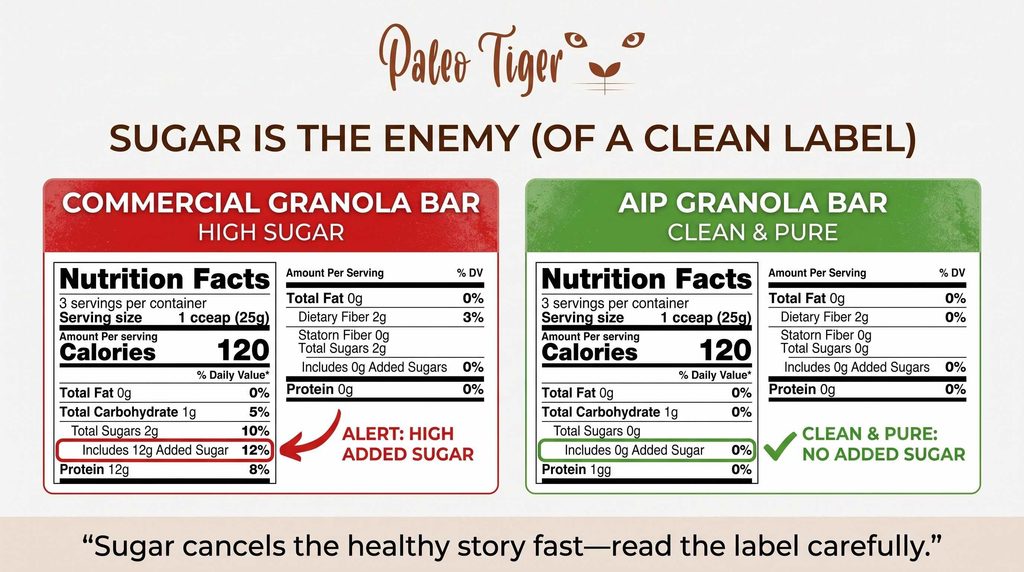
Count added sugars. Many commercial granola bars list 8 or more grams of added sugar per serving. Some pack as much sugar as a candy bar. Sugar cancels the “healthy” story fast.
Scan for your deal-breakers. Oats, wheat, almonds, peanuts, chia, flax, soy protein, whey. All common in bars. All problems on AIP.
Check the fat source. Look for simple fats like avocado oil or coconut oil. Skip bars with vague “vegetable oil” blends.
Run any contender through this table:
| 🚩 Red flag | ✅ Green flag |
| Oats or wheat as first ingredient | Tigernuts as the first ingredient |
| 8 g+ added sugar per serving | No added sugar |
| Almonds, peanuts, or cashews | Nut-free recipe |
| Chia, flax, or other seeds | Seed-free recipe |
| Soy or whey protein isolate | Whole-food ingredients only |
| “Natural flavors” with no detail | Short, readable ingredient list |
Most “healthy granola bars” fail by row three. The winners tend to be grain-free granola products built for restricted diets. That is exactly the AIP snacks category. When a product is designed for AIP from the start, you do not have to play detective.
Healthy Granola Bars vs. Grain Free Granola, Pros and Cons
Should you buy bars or build your own from granola? Here is the honest breakdown.
| Store-bought “healthy” bars | Homemade bars from grain-free granola | |
| Pros | Portable; no prep; portioned | You control every ingredient; AIP-compliant; no added sugar; cheaper per serving over time |
| Cons | Often high in added sugar; usually contain oats, nuts, or seeds; fail AIP and paleo rules; “natural flavors” hide details.s | Needs 10 minutes of prep; shorter shelf life; you need a good base granola |
The analytics are simple. If you eat paleo or AIP, store-bought bars rarely qualify. One scan of the ingredient list usually ends the debate.
Homemade wins on every metric that matters: ingredient control, diet compliance, and sugar. The only cost is ten minutes. And the base, a high-fiber grain-free granola, does most of the work for you.
That is why the smartest AIP snacks strategy is not hunting for the perfect bar. It is keeping a great granola on hand and assembling bars yourself. You get the portability of a bar with the ingredient list of a whole food.
Why Is PaleoTiger Granola Built for AIP Snacks?
Most granola starts with a grain. PaleoTiger starts with a tuber.
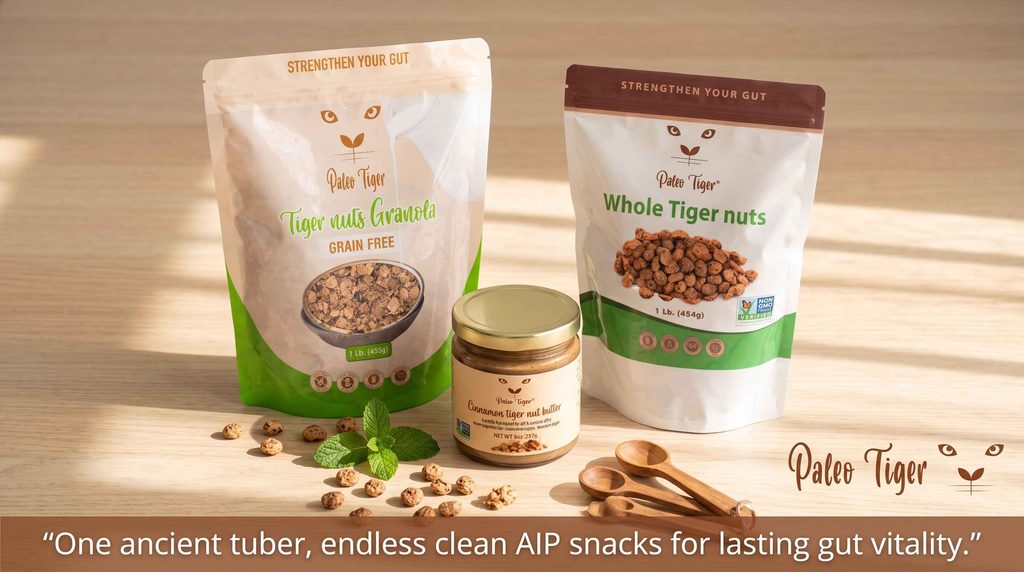
Tiger Nuts Granola blends tiger nuts with avocado oil and cinnamon. That is the whole idea. Simple ingredients. Serious crunch. No added sugar, no grains, no nuts. No seeds and no dairy.
Benefit hooks, straight up:
- Fiber first. Tigernut fiber, including prebiotic resistant starch, in every serving. This is granola fiber that works two jobs: bulk and bacterial fuel.
- Steady energy. Fiber plus healthy fats from avocado oil slow digestion. No added sugar means no spike-and-crash cycle.
- AIP and paleo fit. Grain-free, nut-free, and dairy-free by design, not by workaround.
- Real crunch. Clusters that hold up in coconut yogurt, in smoothie bowls, or straight from the bag.
Pair it. Drizzle Tiger Nut Butter (Carob) over a bowl for a cocoa-free, caffeine-free chocolate-style treat with nothing added for sweetness. Or stir in Whole Tiger Nuts for extra chew and extra fiber.
Want the full lineup? Browse the shop and compare labels yourself. For AIP snacks that actually deliver fiber, this granola is the foundation everything else builds on. This is the upgrade your pantry has been missing.
No-Bake AIP Snacks Bars, The 4-Ingredient Recipe
You do not need oats to make a great bar. You need a binder, a crunch, and a flavor boost. This recipe uses all three.
Ingredients (makes 8 bars)
- 2 cups Tiger Nuts Granola, the fiber base
- 3/4 cup Tiger Nut Butter (Cinnamon), warm spice binder, no added sugar needed
- 1/4 cup chopped Whole Tiger Nuts, extra fiber and chew
- 2 tbsp melted Tiger Nut Butter (Carob), for the drizzle
Steps
- Line an 8×8 pan with parchment.
- Warm the cinnamon butter until pourable. Stir until smooth.
- Fold in the granola and chopped tiger nuts. Mix well.
- Press firmly into the pan. Flatten the top with a spatula.
- Drizzle with melted carob butter.
- Chill for 1 hour. Cut into 8 bars.
Each bar carries tigernut fiber from two sources: the granola and the whole nuts. No grains, no nuts, no seeds. No added sugar. These are AIP snacks you can trust because you made them yourself.
Homemade vs. store-bought, by the numbers:
| Factor | These homemade bars | Typical store-bought bar |
| Added sugar | 0 g | Often 8–12 g |
| Grains | None | Usually oats |
| Nuts/seeds | None | Usually present |
| AIP compliant | Yes | Rarely |
| Prep time | 10 min + chill | 0 min |
| Cost per bar | Lower over time | Higher per bar |
For more pairing ideas, see Plantains: Nutrition, Recipes, and Tiger Nut Pairings. Plantains bring their own resistant starch to the party.
More AIP Snacks From the Tiger Nut Pantry
Granola is the start. The rest of the pantry pulls weight too.
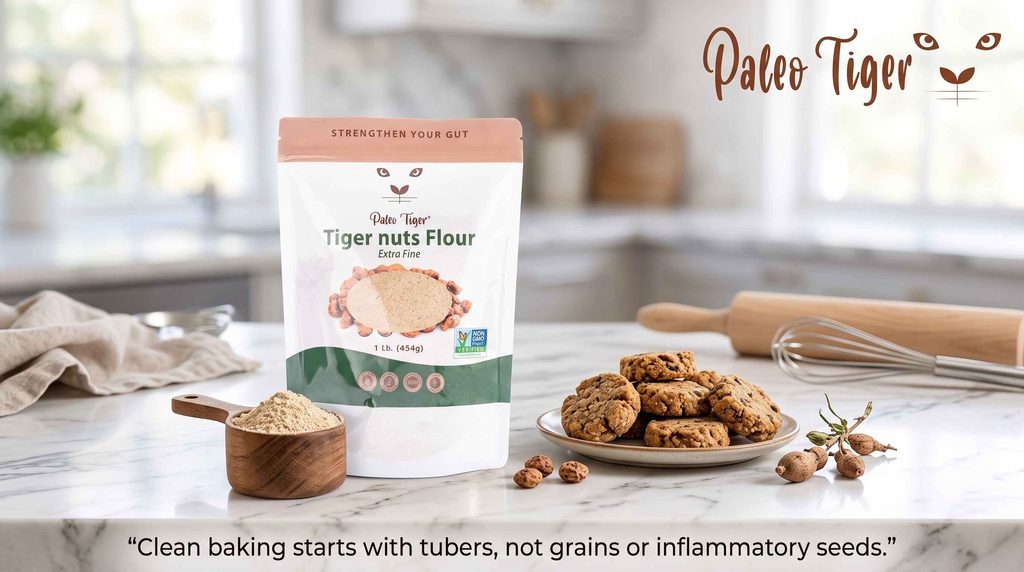
- Tiger Nut Flour (Extra Fine), Bake grain-free muffins, crackers, and bar bases. Fine texture. Mild natural sweetness. Zero grains involved.
- 100% Cold-Pressed Tiger Nuts Oil, Drizzle over roasted vegetables or whisk into dressings. A clean, simple fat for everyday AIP meals.
- Whole Tiger Nuts, the original high-fiber snack. Chewy, naturally sweet, endlessly portable. Toss a handful in your bag.
- The butter lineup: Original, Cinnamon, Carob, Crunchy, Macaroon. Spread them, drizzle them, or eat them by the spoonful. Five flavors, one simple tuber base.
Mix and match. Flour for baking days. Oil for savory days. Butters for the 3 p.m. slump. Together they cover every craving that AIP snacks need to cover. That is what a real AIP snacks pantry looks like: one ingredient family, endless combinations.
AIP Snacks and Fiber on the AIP Diet
The AIP diet heals by removing. Grains go. Nuts go. Seeds go. Dairy, eggs, and nightshades go too during the elimination phase.
That is a lot of fiber sources gone in one move. Oats? Gone. Almond flour crackers? Gone. Chia pudding? Gone.
This is why fiber becomes a project on AIP. You must rebuild it from what remains: vegetables, fruits, and tubers.
Tiger nuts are tubers. They survived the cut. They are one of the few crunchy, snackable, high-fiber foods that fit the elimination phase without modification.
Read Tiger Nuts: The Superfood You Need on the AIP Diet for the deeper dive. Then stock your pantry like someone who plans to stay on track. Good AIP snacks make the diet sustainable. Fiber-rich ones make it work.
The Bottom Line
So, is granola fiber? No. But the right granola is one of the easiest fiber upgrades you can make.
Skip the oat bars with 10 grams of added sugar. Skip the “healthy” labels that hide nuts and seeds. Choose a grain-free granola built on tigernut fiber, with prebiotic resistant starch and no added sugar. Then turn it into bars, bowls, and breakfasts that fit your life.
PaleoTiger makes that choice simple. One tuber. Nine products. Endless AIP snacks with real fiber. Your gut will notice the difference.
Data Sources and Disclaimer
Sources: USDA Dietary Guidelines for Americans (fiber targets), USDA FoodData Central (oat fiber values), MDPI 2019, “Nutritional and Microbiological Quality of Tiger Nut Tubers” (fiber content, 99.8% insoluble), ISAPP consensus statement (prebiotic definition), Cleveland Clinic and Healthline (fiber benefits, label-reading guidance), NCCIH (general digestive health information).
Quick notes on the choices: the DGA link goes to the official 2020-2025 guidelines PDF, the FoodData Central link goes to the USDA’s own oat entry (FDC ID 169705, the one behind the ~10g fiber figure), and the Cleveland Clinic link is their “Why Fiber Is Crucial for Your Diet” piece since it covers both benefits and label reading.
Methodology note: Product facts in this article reflect PaleoTiger’s live product pages as checked in September 2026. Fiber values for tiger nuts are reported as published ranges because they vary by variety, growing region, and drying method. No price or pack-size claims are made.
Medical disclaimer: This article is for general information only and is not medical advice. Fiber needs vary by individual. If you have a digestive condition or follow a therapeutic diet, consult your healthcare provider before making changes.
Frequently Asked Questions
Is granola considered fiber?
No. Granola is a food that can contain fiber. Its fiber content depends entirely on its ingredients. A tigernut-based granola delivers tigernut fiber. An oat-based granola delivers oat fiber. Always check the label.
Is granola fiber the same as fiber from oats?
Not always. Oat fiber is rich in soluble beta-glucan. Tigernut fiber is mostly insoluble, plus prebiotic resistant starch. Both support digestion. They work through different mechanisms.
How much fiber is in granola?
It varies widely. Conventional oat granolas often list 3–5 grams per serving. Tigernut fiber content in the raw tuber ranges from about 9 to 33 grams per 100 grams depending on variety and drying (MDPI, 2019; nutrition analyses). Check your product’s nutrition panel for exact numbers.
Are granola bars good for you?
Some are. Most commercial bars carry 8 or more grams of added sugar per serving plus oats, nuts, or seeds. Those fail paleo and AIP standards. Bars you make at home from grain-free granola give you full control.
What are the best AIP snacks for fiber?
Tiger nut-based AIP snacks top the list. The granola, whole tiger nuts, and tiger nut butters all deliver fiber without grains, nuts, seeds, or dairy. Vegetables like sweet potato and plantain add more.