
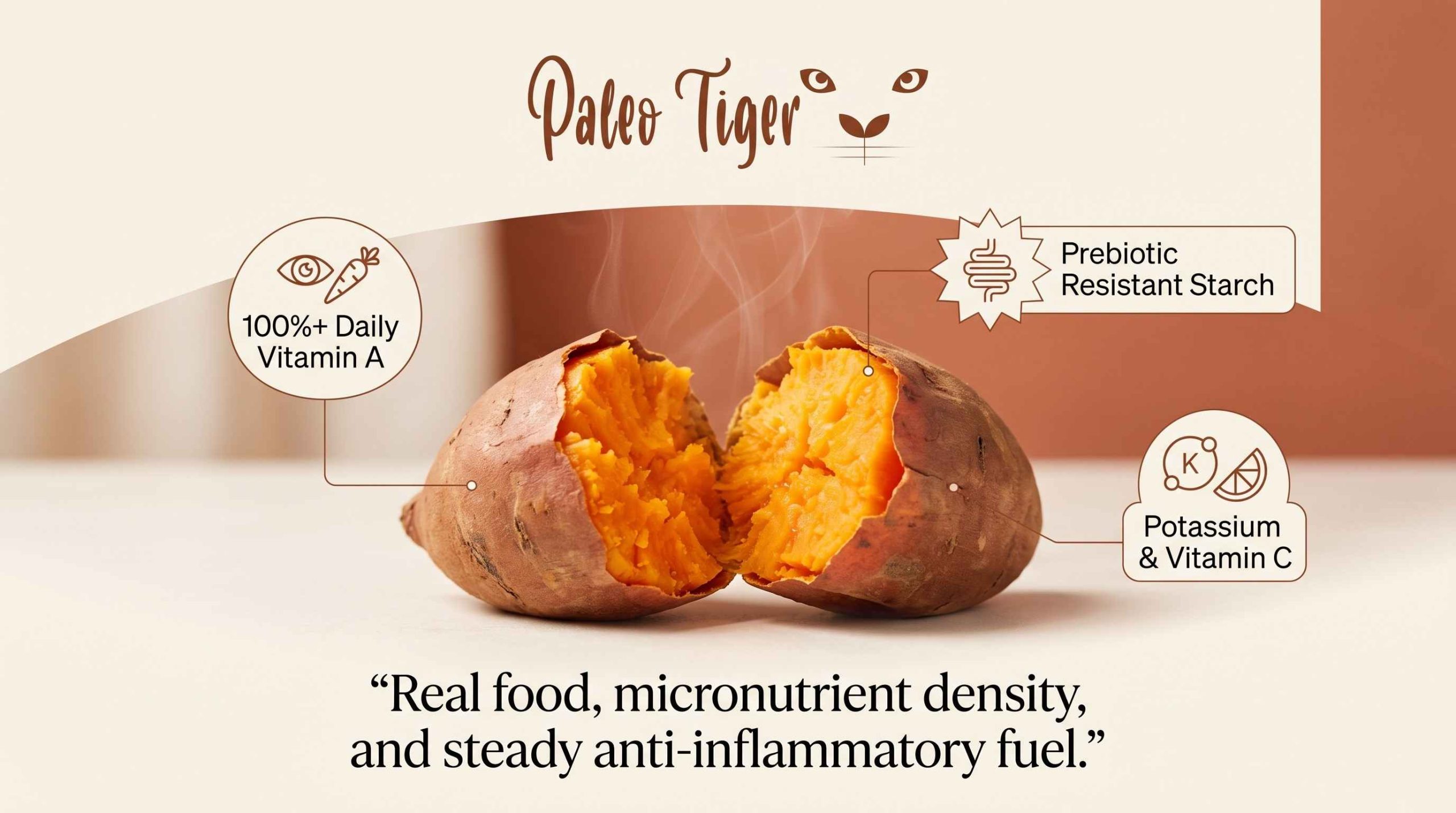
If you have ever typed “AIP sweet potato” into a search bar at 11 p.m., wondering whether this humble root vegetable is actually allowed on your healing protocol, you are not alone. Sweet potatoes sit at one of the most confusing intersections in ancestral eating: beloved by paleo eaters, feared by nightshade worriers, constantly mixed up with yams and white potatoes.
Most guides on sweet potatoes and the AIP diet do the lazy thing. They confirm the tuber is compliant, then wave vaguely at “healthy fats and nuts” for toppings. That is not what this is. Nuts and seeds are both eliminated on the AIP diet, so that advice fails the exact reader it claims to help. Instead, this guide pairs every preparation with a real, verifiable PaleoTiger product: oil, butters, flour, granola, with ingredient lists and prices checked against live pages on September 30, 2026.
Is an AIP sweet potato actually compliant?
An AIP sweet potato is simply a sweet potato prepared the AIP way: no dairy, grains, nuts, seeds, nightshades, or refined sugar in the cooking or toppings. The tuber itself is compliant on both the Paleo diet and the AIP diet. It is a non-nightshade root vegetable in the morning glory family, not a grain, legume, or true potato.
An AIP sweet potato is compliant on the AIP diet and the Paleo diet: it is a morning-glory-family tuber, not a nightshade.
On sweet potato nutrition, one medium potato delivers over 100% of daily vitamin A plus meaningful fiber, vitamin C, and potassium.
Sweet potato carbs are gentler when boiled, and pairing any preparation with fat flattens the blood sugar curve.
The compliance risk is never the potato. It is the oil you roast in, the topping you mash in, and the flour you bake with.
Five tiger-nut products cover every job: roasting, mashing sweet, mashing savory, baking, and breakfast bowls, with verified AIP-friendly ingredients.
Disclosure: PaleoTiger makes the tiger-nut products recommended in this guide. We recommend them because we make them to AIP standards, we checked every label ourselves, and we flag their limitations honestly below.
Compliance snapshot
| Food | Plant family | AIP elimination phase | Paleo diet |
| Sweet potato | Convolvulaceae (morning glory) | Compliant | Yes |
| White potato | Solanaceae (nightshade) | Eliminated | Generally no |
| True yam (Dioscorea) | Dioscoreaceae | Generally compliant | Generally yes |
What Is an AIP Sweet Potato?
An AIP sweet potato is an ordinary sweet potato prepared with zero AIP-eliminated ingredients anywhere in the cooking or toppings.
Any AIP sweet potato you buy at the store is already compliant before you do a thing to it. Sweet potatoes (Ipomoea batatas) are root vegetables, not nightshades, not grains, not legumes. The compliance question is never about the tuber. It is about everything around it: the oil you roast it in, the topping you mash into it, and the flour you bake it with.
That distinction is the whole game on the AIP diet. The elimination phase removes grains, dairy, eggs, nuts, seeds, nightshades, and legumes, then reintroduces them systematically, while non-nightshade tubers are deliberately retained for fermentable fiber and steady energy.
So the AIP sweet potato earns its place not as a loophole but as a cornerstone: paleo carbs that keep you fed while the rest of the plate stays strict.
One clarification before we go deeper. “AIP sweet potato” describes the food in an AIP context, not a special variety. There is no separate cultivar. Orange, purple, white, and Japanese sweet potatoes are all equally AIP-friendly. They differ in color, flavor, and antioxidant profile, not compliance.
Quick Summary: In short, an AIP sweet potato is just a sweet potato cooked the AIP way. The tuber needs no modification; your oil, toppings, and flour do the compliance work.
With the definition set, the next question is where sweet potatoes sit on the broader Paleo diet.
Are Sweet Potatoes Paleo?
Yes. Sweet potatoes are one of the most widely accepted carbohydrate sources on the Paleo diet, and they have been since the earliest Paleo food lists.
The Paleo diet excludes grains, legumes, dairy, and refined sugar, and favors whole, unprocessed foods. A starchy tuber fits that template cleanly.
The AIP sweet potato question and the Paleo question share an answer for the same reason: sweet potatoes are not grains and not legumes. On both frameworks, they are not merely tolerated; they are recommended as a primary energy source, especially for active people who need Paleo carbs to replace the grains they gave up.
Where people get tripped up is the potato-family confusion, covered in its own section below.
The practical point: if you are pairing an AIP sweet potato with tiger-nut products, you are stacking two ancestral foods. Tigernuts are tubers too, the edible underground organs of Cyperus esculentus, closer botanically to potatoes and yams than to any actual nut. Two tubers, zero grains, zero nuts, full compliance. That is the thesis of this guide.
Insight: We built this guide from a failure we kept seeing: articles confirm sweet potatoes are compliant, then suggest almond butter or tahini, both of which break AIP. We replaced every such suggestion with a PaleoTiger product whose label we personally verified on September 30, 2026.
Honest limitation: We are the brand, so treat our picks as a starting point and check any label yourself mid-elimination.
Quick Summary: So the bottom line is, sweet potatoes are firmly paleo, and the stricter AIP diet keeps them too. The only thing to watch is the company they keep on the plate.
That brings us to the confusion that drives the most searches: nightshades.
Is Sweet Potato a Nightshade?
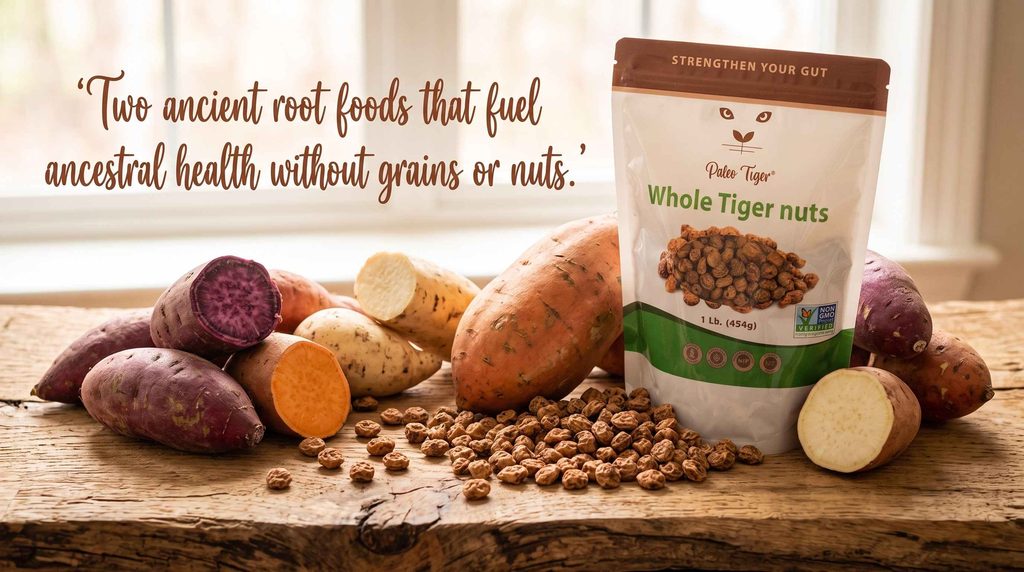
No. An AIP sweet potato is not a nightshade; sweet potatoes are in the morning glory family, while nightshades are in the Solanaceae family.
This is the single most important botanical fact in this article. Nightshades include white potatoes, tomatoes, eggplant, and peppers. The two families are not close relatives. The confusion exists for one reason only: the English word “potato” got applied to both.
It matters because nightshades are eliminated during the AIP elimination phase, and many people hear “potato” and assume guilt by association, which is exactly why the search phrase “sweet potato nightshade” exists. But elimination is about plant families and their compounds, not shared syllables. White potatoes contain glycoalkaloids like solanine; the AIP sweet potato is not a nightshade and contains no such alkaloids, just beta-carotene, anthocyanins in purple varieties, and fiber.
So when “sweet potato nightshade” comes up in AIP forums, the answer is: no relation. An AIP sweet potato stays compliant during elimination precisely because it is not a nightshade, while white potatoes sit on the elimination list. Reintroducing nightshades later and testing white potatoes is a separate experiment with a separate food.
Quick Summary: In short, “sweet potato nightshade” is a naming accident, not a botanical relationship. Different family, different compounds, opposite verdict on AIP.
Quick Take: So far: the tuber is compliant on both diets, it is not a nightshade, and every topping decision matters more than the potato itself. Next we untangle yams and white potatoes, then get into the nutrition numbers.
Names sorted, now the numbers.
Sweet Potatoes vs. Yams vs. White Potatoes, What Is the Difference?
US “yams” are usually just orange sweet potatoes; true yams are a different species; white potatoes are nightshades with the opposite AIP verdict.
Walk into a North American grocery store in November, and you will see bins labeled “yams” that are, botanically, sweet potatoes. True yams are an entirely different species (Dioscorea), native to Africa and Asia, with rough bark-like skin, dry starchy flesh, and roots that can reach several feet. What most American stores call yams are orange-fleshed sweet potatoes marketed under a name that stuck decades ago.
For AIP and paleo purposes, the distinction barely matters: true yams are also non-nightshade tubers and generally considered compliant. But label literacy matters for cooking: the copper-skinned roots labeled “yams” are sweeter and moister, better for mashing and baking, while true yams from an international market cook up dry and starchy, closer to cassava.
Either way, an AIP sweet potato by any label name stays compliant. Just know what you are buying so your recipes behave.
| Trait | Sweet potato | US “yam” (label) | True yam | White potato |
| Species | Ipomoea batatas | Ipomoea batatas | Dioscorea spp. | Solanum tuberosum |
| Nightshade? | No | No | No | Yes |
| AIP elimination | Compliant | Compliant | Generally compliant | Eliminated |
| Flesh | Moist, sweet | Moist, sweet | Dry, starchy | Varies |
Takeaway: if it is orange-fleshed and labeled “yam” in a US store, cook it like a sweet potato, because it is one.
Quick Summary: Here’s what matters: label names lie, plant families don’t. Orange “yams” are sweet potatoes, true yams are a separate compliant tuber, and white potatoes are the nightshade to avoid on AIP.
With identity settled, here is what the tuber actually gives you nutritionally.
Sweet Potato Nutrition and Carbs, What the Numbers Say?
One medium baked sweet potato delivers roughly 103 calories, ~3.8 g fiber, 24 g carbs, and well over 100% of daily vitamin A.
Let us ground the enthusiasm in numbers. According to USDA FoodData Central, one medium baked sweet potato (about 114 g, flesh only) delivers roughly 103 calories, 3.8 g fiber, 2.3 g protein, and 23.6 g carbohydrate. But the headline in any honest discussion of sweet potato nutrition is vitamin A: a single medium potato provides well over 100% of the daily value as beta-carotene, the orange pigment your body converts to retinol as needed.
The supporting cast is strong: meaningful vitamin C, manganese, vitamin B6, potassium, and pantothenic acid, and purple-fleshed varieties add anthocyanins, the antioxidant class also found in blueberries. Both Healthline’s sweet potato guide and the Cleveland Clinic highlight sweet potatoes as a nutrient-dense carbohydrate source.
| Nutrient (per medium baked, ~114 g) | Sweet potato | White potato (baked, ~173 g) |
| Calories | ~103 | ~161 |
| Fiber | ~3.8 g | ~3.8 g |
| Vitamin A | 100%+ DV | ~0% DV |
| Vitamin C | ~22% DV | ~28% DV |
| Potassium | ~12% DV | ~26% DV |
Takeaway: the white potato wins on potassium per serving; the sweet potato laps it on vitamin A. Source: USDA FoodData Central.
Two caveats keep this honest. First, preparation shifts the numbers: boiling preserves more low-glycemic character, while long high-heat roasting converts more starch to simple sugars. Second, beta-carotene is fat-soluble; your body absorbs it better when eaten with fat. That is a pairing instruction, not a footnote: an AIP sweet potato roasted in tiger nut oil or mashed with tiger nut butter is nutritionally smarter than a plain microwaved one.
Now the carbs question, since sweet potato carbs worry healing-diet eaters most. A medium potato carries about 24 g total carbohydrate, of which ~3.8 g is fiber. Glycemic index depends heavily on method:
| Cooking method | Approx. glycemic index | Glycemic character |
| Boiled | Mid-40s–50s | Low–medium |
| Steamed | ~50s–60s | Medium |
| Baked/roasted | 70s–90s | High |
Takeaway: the same tuber can test low or high GI depending on your oven. The method is a lever, not a verdict.
Does roasting disqualify it from a paleo carbs strategy?
No. GI is measured on isolated foods eaten alone; in real meals, pairing sweet potato carbs with fat, fiber, and protein flattens the blood sugar curve substantially.
An AIP sweet potato eaten with tiger nut butter, fat plus fiber, behaves very differently from the same potato eaten plain.
For athletes, sweet potato carbs are arguably the best grain replacement available: glycogen replenishment with potassium and magnesium, no grains involved.
For the blood-sugar cautious: favor boiling or steaming, keep portions moderate, always pair with fat.
A final sourcing note: this article skips the inflated claims that plague sweet potato content. No whole food “boosts immunity” solo. What the evidence supports is narrower and still impressive: a fiber-rich, micronutrient-dense carbohydrate that fits anti-inflammatory dietary patterns. That is plenty.
Quick Summary: In short, sweet potato nutrition is genuinely strong; vitamin A, fiber, potassium, and sweet potato carbs are manageable once you control the cooking method and always pair with fat.
Quick Take: The science is settled: compliant tuber, strong nutrition, controllable glycemic impact. Everything from here is practical: the five tiger-nut products that turn the potato into a meal, and how to split the work between homemade and store-bought.
You know what the potato gives you. Here is what to put on it.
What Should You Put on an AIP Sweet Potato? 5 Tiger-Nut Pairings
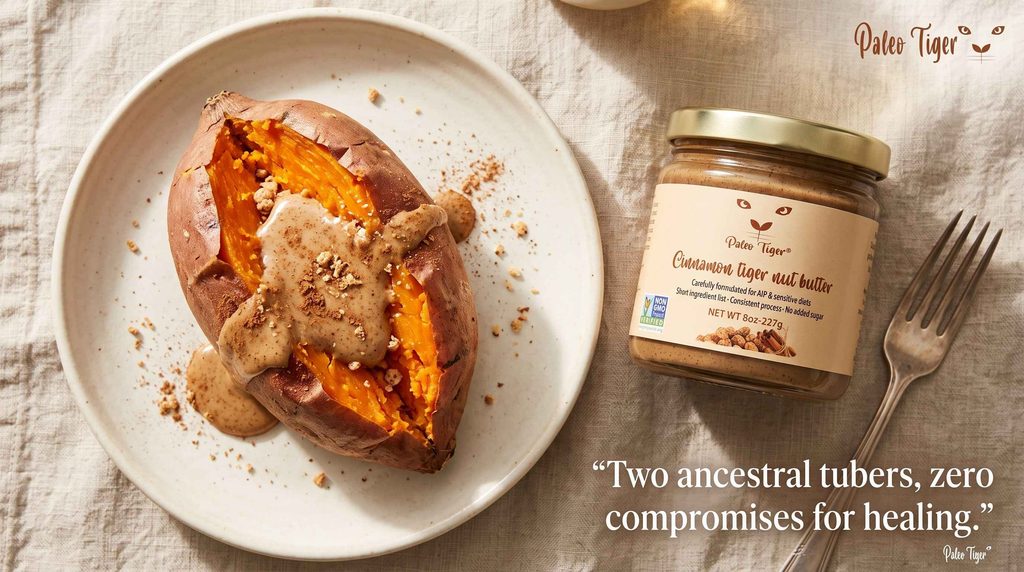
Micro-answer: Roast an AIP sweet potato in tiger nut oil, mash it with cinnamon or original tiger nut butter, bake with tiger nut flour, or crunch it up with tiger nut granola.
Every pairing below is a real PaleoTiger product, linked to its live page, with ingredients verified on September 30, 2026. No nuts. No seeds. Each match is chosen for a specific culinary job.
1. Roast it in cold-pressed tiger nut oil
Why use: Seed oils are out on AIP and paleo, butter is dairy, and coconut oil brings a strong flavor. This is the compliant roasting fat that actually tastes as it belongs with sweet potatoes.
Pricing: $12.99 for 8 oz, one ingredient: cold-pressed tiger nuts.
Toss the cubed sweet potato in a tablespoon before roasting at 400°F for caramelized edges, a compliant fat for beta-carotene absorption, and vitamin E from the oil itself. We reach for Tiger Nuts Oil whenever a recipe says “high-heat oil” because it removes the guesswork. Honest limitation: the bottle is small for the price if you roast sheet pans weekly, measure, don’t free-pour.
Verdict: the everyday roasting oil for anyone doing AIP seriously. Skip if you only ever boil or steam.
2. Mash it with cinnamon tiger nut butter
Why use: This is the headline pairing, the closest thing the AIP diet has to dessert for dinner.
Pricing: $14.99 for 8 oz. Ingredients: tiger nuts, avocado oil, coconut oil, cinnamon. No added sugar.
A hot baked sweet potato split open with a spoonful of Tiger Nut Butter (Cinnamon) melting into it replaces the butter, brown sugar, and marshmallows of the standard playbook with four compliant ingredients. The cinnamon echoes the potato’s own warmth, the fats blunt the glycemic response discussed above, and tiger-nut fiber feeds the gut bacteria AIP eaters work hard to nourish. Honest limitation: cinnamon is a strong personality; if the meal leans savory, it will fight the garlic.
Verdict: buy this first if your sweet potatoes skew sweet. The single most versatile jar in the lineup.
3. Keep the original butter for savory mashes
Why use: When the meal leans savory, cinnamon is wrong, and you need a neutral creamy base.
Pricing: $14.99 for 8 oz. Ingredients: tiger nuts, avocado oil, coconut oil, nothing else.
Stirred into mashed sweet potato with sea salt and a splash of coconut milk, Tiger Nut Butter (Original) produces a creamy, dairy-free mash that stands next to any restaurant version. Honest flag: the shop listing showed this butter as sold out when we checked on September 30, 2026, confirming availability on the live page before planning around it; the cinnamon version is the reliable substitute.
Verdict: the savory cook’s jar. Check stock before you menu-plan.
4. Bake with extra-fine tiger nut flour
Why use: Sweet potato puree boosts moisture and sweetness in grain-free baking, but it needs a flour that is also AIP-compliant.
Pricing: $12.99 for 1 lb. Single ingredient: tiger nuts, milled extra fine.
Almond flour breaks AIP and coconut flour wrecks texture. Tiger Nuts Flour covers grain-free, nut-free, and AIP in one bag, sweet potato muffins sweetened only by the potato itself. Honest limitation: it behaves nothing like wheat flour, so use recipes formulated for it rather than swapping 1:1 into conventional ones.
Verdict: essential if you bake on AIP; unnecessary if your sweet potatoes never leave the roasting pan.
5. Build breakfast bowls with tiger nut granola
Why use: Crunch, cinnamon, and prebiotic fiber in one scoop, the topping a breakfast bowl actually needs.
Cube and roast an AIP sweet potato, then serve it warm under Tiger Nuts Granola with coconut yogurt for a bowl that eats like dessert. The live ingredient list is tiger nuts, avocado oil, and cinnamon, with no added sugar, formulated for the Autoimmune Protocol.
Two store notes from our audit: the title says 1Lb while capacity lists 8oz, and the product page shows $12.99 against $13.99 on the shop listing, so we make no pack-size or price claims here.
Verdict: the fastest way to make sweet potatoes for breakfast. Just verify the listing details at checkout.
| Job | Product | Price (verified 2026-09-30) |
| Roasting fat | Tiger Nuts Oil, 8 oz | $12.99 |
| Sweetmash/toppingg | Cinnamon Tiger Nut Butter, 8 oz | $14.99 |
| Savory mash | Original Tiger Nut Butter, 8 oz | $14.99 (check availability) |
| Grain-free baking | Tiger Nuts Flour, 1 lb | $12.99 |
| Breakfast crunch | Tiger Nuts Granola | See live listing |
Takeaway: five products, five jobs, zero compliance risk; the article’s advice made purchasable at every step.
Shop the tiger-nut pantry → Start with the cinnamon butter if you only buy one jar.
Quick Summary: So the bottom line is, every classic sweet potato preparation has a tiger-nut equivalent: oil for roasting, cinnamon butter for sweet, original butter for savory, flour for baking, granola for crunch.
Five products solve the toppings. Now the workflow question: what should you make versus buy?
Homemade vs. Store-Bought, Building Your AIP Sweet Potato Routine
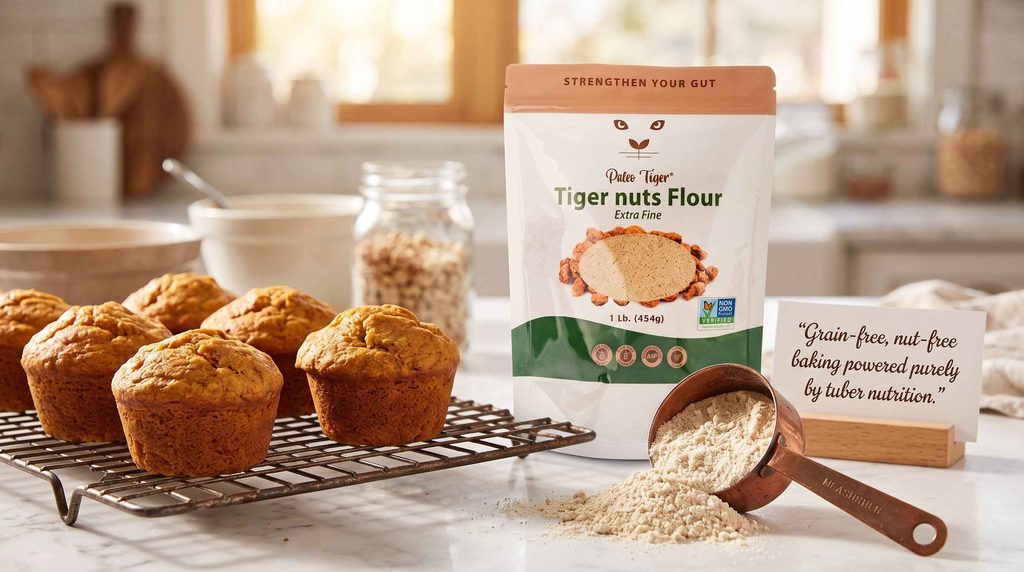
Make the potato yourself; buy the butter, oil, flour, and granola; the equipment matters more than the recipe.
The homemade instinct runs strong in the AIP community, and for the sweet potato itself, it is correct: nobody needs a packaged baked sweet potato. Roast it, boil it, mash it yourself. The math changes with everything around it.
| Task | Homemade | Store-bought |
| Baked / roasted potato | Easy, cheap, better fresh | No reason to buy |
| Tiger nut butter | Needs soaked nuts + strong blender; texture rarely matches stone-ground | Verified 3–4 ingredients, $14.99 |
| Tiger nut oil | Unrealistic, cold-pressing is industrial | Single ingredient, $12.99 |
| Tiger nut flour | Home mills can’t hit “extra fine” evenly | $12.99/lb, consistent grind |
| Granola | Doable but slow; AIP binders are finicky | No-added-sugar, AIP-formulated |
Takeaway: homemade where it is easy (the potato), store-bought where the equipment matters (everything around it).
The practical routine is therefore hybrid, and that division protects compliance. Every finished product you buy is a verified ingredient list instead of a gamble on a bulk-bin oil or a “natural flavors” seasoning blend. On an elimination protocol, where one off-plan ingredient can muddy weeks of careful reintroduction testing, that certainty has real value.
Quick Summary: In short, roast and mash the AIP sweet potato yourself, and let the store handle the butter, oil, flour, and granola. Freshness where it counts, label certainty where it matters.
The Bottom Line
The AIP sweet potato is that rare food that survives every level of scrutiny: botanically distinct from nightshades, compliant on the Paleo diet and the stricter AIP diet, genuinely nutritious, and versatile enough to carry breakfast, dinner, and baking. The only thing standing between you and a great sweet potato meal was never the potato; it was the topping, the oil, and the flour. Now those decisions are made: roast in tiger nut oil, mash with cinnamon tiger nut butter, bake with tiger nut flour, and crunch it up with granola. Two tubers, zero compromises.
Shop tiger-nut pantry staples → Every ingredient list verified September 30, 2026.
Medical disclaimer: This article is for informational purposes only and is not medical advice. The AIP diet is a therapeutic elimination protocol; consult a qualified healthcare practitioner before starting it, especially if you manage an autoimmune condition.
Frequently Asked Questions
Is sweet potato allowed on the AIP diet?
Yes. The AIP sweet potato is compliant during the elimination phase: sweet potatoes are non-nightshade tubers with no grains, legumes, dairy, nuts, seeds, or eggs. Compliance depends on preparation: roast in a compliant fat like tiger nut oil and skip dairy, refined sugar, and nut-based toppings.
Is sweet potato a nightshade?
No. An AIP sweet potato is in the morning glory family (Convolvulaceae), unrelated to the nightshade family (Solanaceae) that holds white potatoes, tomatoes, and peppers. They contain none of the glycoalkaloids that put white potatoes on the AIP elimination list.
Are sweet potatoes paleo?
Yes. Sweet potatoes are a widely accepted paleo carbohydrate source, a whole, unprocessed tuber, not a grain or legume. They appear on virtually every standard paleo food list as the recommended starch for replacing grains.
I keep seeing “yams” and “sweet potatoes” as totally different things at the store; does it actually matter for AIP?
Not for compliance. Most US products labeled “yams” are just orange-fleshed sweet potatoes, and true yams are a different species that is also generally AIP-friendly. It only matters for cooking: orange “yams” mash sweet and moist; true yams cook up dry and starchy.
Can I eat sweet potato fries on AIP, or will the oil mess it up?
You can, with the right oil. Cut into wedges, toss in cold-pressed tiger nut oil with sea salt, and roast or air-fry. Avoid seed oils, spice blends with undisclosed ingredients, and grain-based breading; the fry is compliant; the coating is where people slip.
Is PaleoTiger tiger nut butter actually AIP-friendly? What’s in it?
Yes. The cinnamon version contains four ingredients: tiger nuts, avocado oil, coconut oil, cinnamon, and the original contains three (no cinnamon). No added sugar, no preservatives, no nuts despite the name: tiger nuts are tubers. We verified both labels against live product pages on September 30, 2026.
Which PaleoTiger product should I buy first for sweet potato meals?
The cinnamon tiger nut butter. At 14.99for8oz,itcoversthemostcommonjob, a sweet dessert, like a topping that melts into a baked potato, with four compliant ingredients.Addthecold-pressedoil(12.99) next if you roast often.