

Summery
- Lab testing before AIP Foods gives you a measurable health baseline.
- Thyroid panels and inflammation markers are the two most critical starting points.
- CRP and ESR reveal hidden systemic inflammation.
- A full thyroid panel (TSH, Free T3, Free T4, TPO antibodies) detects autoimmune activity.
- Supporting your gut and reducing inflammatory load improves retesting outcomes.
What Lab Tests Should You Do Before Starting AIP?
Short answer: Before starting the Autoimmune Protocol (AIP Foods), you should test your thyroid function, inflammation markers, gut health, vitamin levels, and blood sugar. These tests create a baseline so you can measure whether AIP foods are actually reducing inflammation and improving autoimmune markers.
If you’re starting AIP without lab work, you’re guessing instead of measuring. Many people remove grains, legumes, and seed oils but never confirm whether inflammation, thyroid antibodies, or nutrient deficiencies were present to begin with.
Before changing your diet dramatically, establish objective data.
Why Lab Testing Matters Before the AIP Diet?
The Autoimmune Protocol (AIP Foods) is an elimination diet designed to reduce immune triggers and systemic inflammation. But without testing:
- You won’t know if CRP was elevated.
- You won’t know if thyroid antibodies were active.
- You won’t know if vitamin D deficiency was worsening symptoms.
- You won’t know if blood sugar instability is driving inflammation.
Baseline labs allow comparison after 8–12 weeks on AIP foods. In short, testing turns AIP from a “trial diet” into a measurable intervention.
Lab Test #1: Comprehensive Thyroid Panel
Should You Test Thyroid Levels Before Going AIP?
Yes. A full thyroid panel is essential before starting AIP, especially if you suspect Hashimoto’s, Graves’, fatigue, hair loss, or cold intolerance. Many autoimmune cases are thyroid-related.
What to Include in a Thyroid Panel?
- TSH
- Free T3
- Free T4
- TPO antibodies
- Thyroglobulin antibodies
TSH alone is not enough. Thyroid antibodies (TPO) detect autoimmune activity even when TSH appears normal.
Why This Matters for AIP
AIP removes gluten, grains, legumes, and inflammatory oils, all potential immune triggers. If thyroid antibodies are elevated before starting, you can retest after 8–12 weeks to track improvement.
Reducing inflammatory food exposure and replacing refined oils with stable fats like 100% Cold-Pressed Tiger-Nuts Oil can support an anti-inflammatory dietary transition. This oil is rich in monounsaturated fats, which are associated with lower inflammatory markers compared to processed seed oils. Test thyroid antibodies before AIP. Without antibody testing, you can’t measure autoimmune improvement.
Lab Test #2: Inflammation Markers (CRP & ESR)
What Inflammation Markers Should Be Tested Before AIP?
At minimum, test high-sensitivity C-reactive protein (hs-CRP) and ESR (erythrocyte sedimentation rate). These reveal systemic inflammation levels.
CRP is produced by the liver when inflammation is present. Elevated CRP is linked to autoimmune flare-ups, metabolic stress, and gut dysfunction.
Ideal Markers
- hs-CRP: under 1.0 mg/L (optimal range)
- ESR: within lab reference range (varies by age & gender)
If CRP is elevated before starting AIP, you have measurable proof of inflammation. After eliminating inflammatory foods and introducing gut-supportive fibers, you can retest.
For example, incorporating resistant starch from whole-food sources like Whole Tiger Nuts may support beneficial gut bacteria. A balanced microbiome can indirectly influence inflammatory pathways.
Similarly, replacing traditional oat cereals with grain-free options likeTiger-Nuts Granola helps reduce gluten exposure and blood sugar spikes, both of which can contribute to systemic inflammation in sensitive individuals. CRP measures inflammation. ESR confirms inflammatory activity. Both are baseline markers before AIP Foods.
Why Inflammation Testing Changes Your AIP Foods Strategy?
If CRP is high:
- Focus on anti-inflammatory fats
- Prioritize gut healing foods
- Reduce refined sugar
- Improve sleep and stress management
If CRP is normal:
- Focus more on gut repair and micronutrient balance
- Monitor thyroid antibodies instead
Adding fiber-rich, elimination-friendly options like Tiger-Nut Smoothie Mix can support digestive stability during the transition phase. Stable digestion helps reduce stress on the immune system, especially when inflammatory foods are removed.

Lab Test #3: Gut Health & Microbiome Testing
Do You Need a Gut Test Before Starting the AIP Diet?
Yes, especially if you experience bloating, constipation, diarrhea, food sensitivities, or autoimmune flare-ups. Many autoimmune conditions are linked to gut permeability (“leaky gut”), dysbiosis, and low microbial diversity. The AIP diet focuses heavily on gut repair. But without testing, you won’t know:
- If you have bacterial imbalance
- If yeast overgrowth is present
- If inflammation exists in the intestinal lining
- If digestive enzyme output is low
What to Include in a Gut Health Panel?
- Comprehensive stool analysis
- Zonulin (gut permeability marker)
- Calprotectin (intestinal inflammation)
- H. pylori screening
- SIBO breath test (if symptomatic)
Gut testing identifies inflammation, permeability, and bacterial imbalance before dietary elimination begins.
Why Does This Matters for AIP?
AIP Foods removes grains, legumes, seed oils, dairy, and processed foods to reduce immune triggers. But gut healing also requires:
- Prebiotic fiber
- Stable blood sugar
- Reduced inflammatory fats
Incorporating elimination-friendly fiber sources like Whole Tiger Nuts provides natural resistant starch. Resistant starch acts as a prebiotic, feeding beneficial bacteria that produce short-chain fatty acids (SCFAs) like butyrate important for gut lining integrity.
For an easier daily option, Tiger-Nut Smoothie Mix can be used as a gut-supportive breakfast. Its fiber profile helps maintain microbiome balance during elimination.
Gut testing reveals whether dysbiosis or leaky gut is contributing to autoimmune symptoms before starting AIP.
Lab Test #4: Vitamin & Mineral Deficiency Panel
What Nutrient Deficiencies Should Be Checked Before AIP?
Autoimmune conditions are often linked to micronutrient deficiencies. Before starting AIP Foods, test:
- Vitamin D (25-OH D)
- Vitamin B12
- Ferritin (iron storage)
- Magnesium
- Zinc
Vitamin D, iron, and B12 deficiencies are common in autoimmune patients and should be tested before elimination diets.
Why Testing Nutrients Matters?
If you’re deficient before starting AIP:
- Fatigue may persist despite dietary changes
- Thyroid conversion (T4 → T3) may remain impaired
- Immune regulation may stay dysfunctional
For example:
- Low vitamin D is associated with increased autoimmune activity
- Low ferritin can worsen hair loss and fatigue
- Low B12 can cause neurological symptoms
Replacing processed snacks with nutrient-dense, elimination-friendly options like Original Tiger-Nut Butter or Cinnamon Tiger-Nut Butter helps stabilize energy and blood sugar without inflammatory additives. Additionally, baking with Tiger-Nuts Flour Extra Fine instead of refined wheat flour removes gluten exposure, a known trigger for many autoimmune individuals while maintaining fiber intake.
Correct nutrient deficiencies before and during AIP Foods. Diet alone may not resolve symptoms if baseline deficiencies are unaddressed.
Lab Test #5: Blood Sugar & Insulin Markers
Should You Test Blood Sugar Before Going on AIP?
Absolutely. Blood sugar instability drives inflammation and immune dysfunction. Even if you’re not diabetic, insulin resistance can contribute to:
- Chronic inflammation
- Thyroid imbalance
- Fatigue
- Hormonal disruption
What to Test?
- Fasting glucose
- Fasting insulin
- HbA1c
- HOMA-IR (calculated from glucose + insulin)
Stable blood sugar lowers inflammatory stress and supports immune regulation during AIP.
Why Blood Sugar Impacts Autoimmunity?
Spikes in glucose increase oxidative stress and inflammatory cytokines. If insulin is elevated before AIP, dietary changes must prioritize:
- Balanced macronutrients
- Fiber intake
- Anti-inflammatory fats
Replacing conventional sugary cereals with Tiger-Nuts Granola provides a grain-free alternative that may support more stable glucose patterns compared to high-glycemic breakfasts.
Cooking with 100% Cold-Pressed Tiger-Nuts Oil instead of refined vegetable oils also reduces oxidative stress exposure, supporting metabolic stability. For controlled, elimination-friendly treats, options like Carob Tiger-Nut Butter or Crunchy Tiger-Nuts Butter can provide healthy fats without inflammatory seed oils.
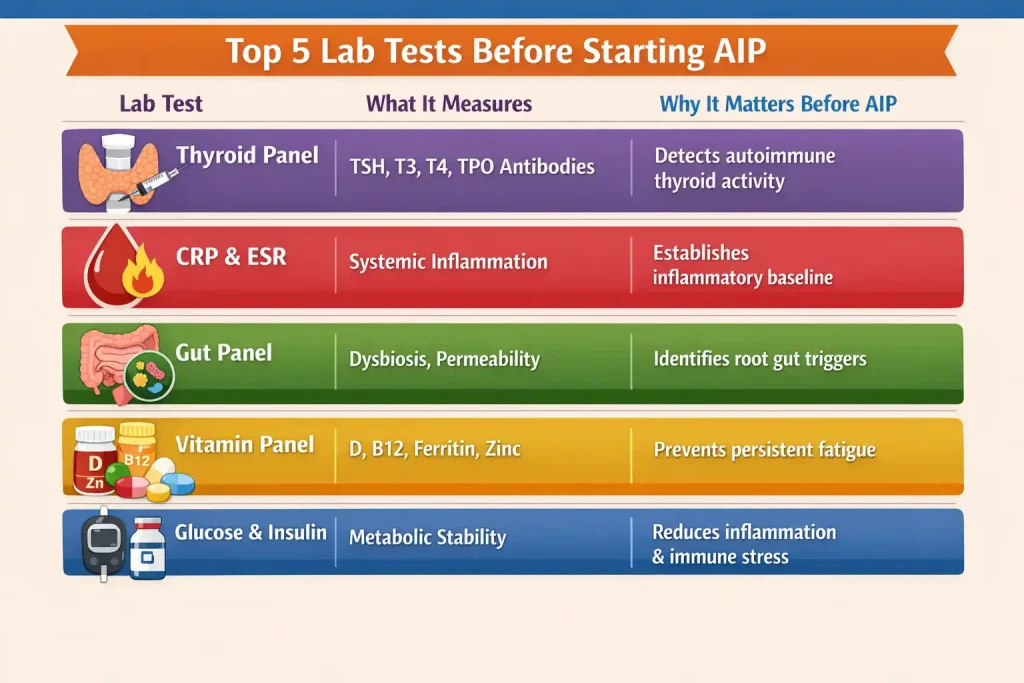
Top 5 Lab Tests Before Starting AIP
| Lab Test | What It Measures | Why It Matters Before AIP |
| Thyroid Panel | TSH, T3, T4, TPO antibodies | Detects autoimmune thyroid activity |
| CRP & ESR | Systemic inflammation | Establishes inflammatory baseline |
| Gut Panel | Dysbiosis, permeability | Identifies root gut triggers |
| Vitamin Panel | D, B12, Ferritin, Zinc | Prevents persistent fatigue |
| Glucose & Insulin | Metabolic stability | Reduces inflammation & immune stress |
How Do You Know If AIP Foods Is Working?
Short answer: AIP is working if inflammatory markers decrease, thyroid antibodies improve, gut markers normalize, nutrient deficiencies correct, and blood sugar stabilizes. Dietary changes should produce measurable improvements within 8–12 weeks.
What Improvement Looks Like?
- CRP decreases toward <1.0 mg/L
- TPO antibodies trend downward
- Vitamin D moves into optimal range (40–60 ng/mL)
- Fasting insulin drops below 8 µIU/mL
- Digestive symptoms improve
If numbers do not improve, reassessment is necessary, not blind continuation. Improvement is measured by objective lab trends, not just symptom relief.
When Should You Retest After Starting AIP?
Most practitioners recommend retesting after 8–12 weeks of strict AIP elimination. Why?
- The immune system needs time to calm.
- Antibodies take weeks to shift.
- Inflammation markers fluctuate gradually.
- Gut microbiome remodeling requires consistent dietary adherence.
Retest at 8–12 weeks to compare against your baseline.
Where Can You Get These Tests?
United States
- LabCorp
- Quest Diagnostics
- Functional medicine practitioners
Cost varies from $50–$400 per panel depending on insurance.
United Kingdom
- NHS (limited testing availability)
- Private labs like Medichecks
Prices range £40–£250.
Canada
- Provincial health coverage (basic panels)
- Private functional labs for advanced stool tests
Costs CAD $75–$350.
Basic labs are widely accessible; advanced gut panels may require private testing.
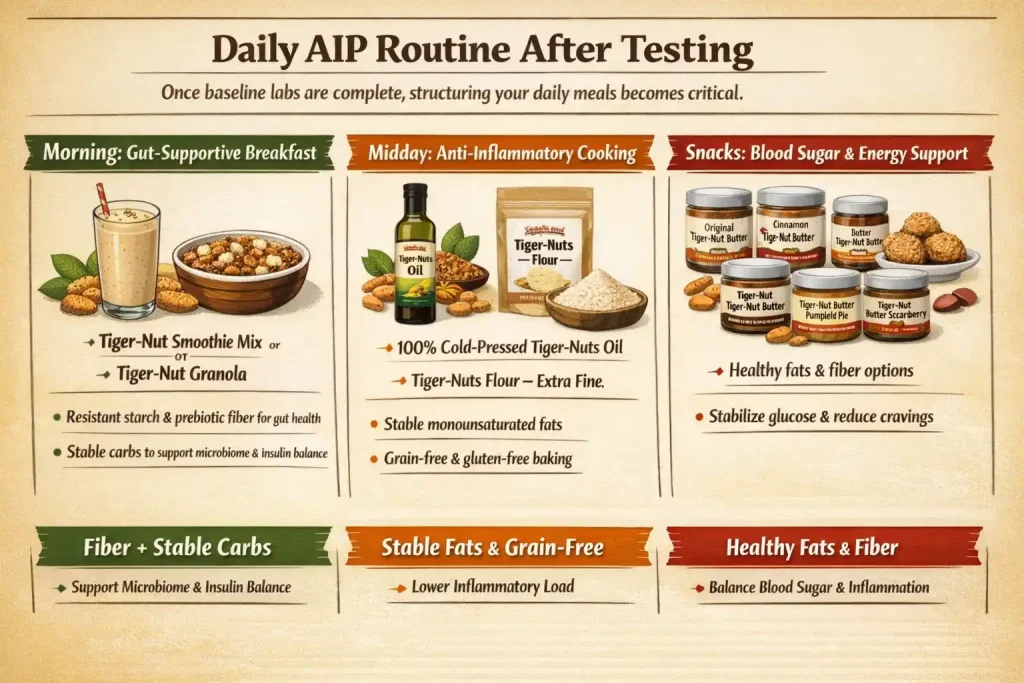
Daily AIP Foods Routine After Testing
Once baseline labs are complete, structuring your daily meals becomes critical. Here’s how supportive AIP-friendly options fit in,
Morning: Gut-Supportive Breakfast
Using Tiger-Nut Smoothie Mix provides resistant starch and prebiotic fiber, which help nourish beneficial gut bacteria, important if stool tests show dysbiosis. Alternatively, Tiger-Nuts Granola offers a grain-free breakfast option that may help reduce glucose spikes compared to traditional oat cereals.
Start the day with fiber + stable carbs to support microbiome and insulin balance.
Midday, Anti-Inflammatory Cooking
Replace refined seed oils with 100% Cold-Pressed Tiger-Nuts Oil.
This oil contains stable monounsaturated fats, which may reduce oxidative stress compared to processed vegetable oils, helpful when CRP is elevated.
For grain-free baking or thickening, Tiger-Nuts Flour – Extra Fine can substitute wheat flour, supporting gluten elimination if thyroid antibodies are present.
Stable fats and grain removal support lower inflammatory load.
Snacks: Blood Sugar & Energy Support
Instead of processed snacks:
- Original Tiger-Nut Butter
- Cinnamon Tiger-Nut Butter
- Carob Tiger-Nut Butter
- Crunchy Tiger-Nuts Butter
- Tiger-Nut Butter Pumpkin Pie
- Tiger-Nut Butter Strawberry – AIP Friendly Limited Edition (8oz)
These options provide healthy fats and fiber, which help stabilize glucose levels, especially important if fasting insulin was elevated before AIP. For occasional elimination-friendly treats, Tiger-Nut Macaroon offers a compliant alternative that helps prevent dietary burnout.
Healthy fats + fiber reduce blood sugar spikes and support inflammatory regulation.
Final Takeaway
The AIP diet is not just about removing foods, it’s about measuring immune change. Before starting:
- Test thyroid function.
- Measure inflammation.
- Evaluate gut health.
- Check nutrient status.
- Assess blood sugar stability.
After 8–12 weeks, retest. In short, data creates direction. Without lab work, AIP is guesswork. With lab work, it becomes a structured healing protocol. For elimination-friendly, gut-supportive options, explore the full Paleo Tiger Shop to support your AIP journey with compliant, grain-free alternatives.
FAQs
What lab tests should I do before starting AIP?
Test thyroid panel, CRP, ESR, gut health markers, vitamin levels, and fasting glucose/insulin.
Do I need blood work before the AIP diet?
It’s highly recommended. Baseline labs allow measurable comparison after 8–12 weeks.
How do I know if AIP is reducing inflammation?
CRP and ESR should decrease, and autoimmune antibodies may trend downward.
Can AIP improve thyroid antibodies?
Some individuals see reductions in TPO antibodies after eliminating inflammatory foods and supporting gut health.
Is fiber important during AIP?
Yes. Prebiotic fiber supports microbiome balance, which influences immune regulation.