

Most conventional skincare products hide a long list of ingredients that can trigger inflammation, synthetic fragrances, seed-derived oils, chemical preservatives, and emulsifiers that do more harm than good for people managing autoimmune conditions. If you are following the Autoimmune Protocol, the same caution you bring to food deserves a place in your daily skincare routine.
Tiger nut oil for skin fills that gap cleanly. It is cold-pressed from the tiger nut tuber, not a seed, not a nut, not a legume, which means it sidesteps the ingredient concerns that make most beauty oils a problem on AIP. At Paleo Tiger, we have built our product line around exactly this kind of thoughtful substitution: ingredients that work just as well as the conventional option, without the compromise.
This guide walks through everything worth knowing about using tiger nut oil for skin: what it does, why it works, how it compares to other options, and how to use it practically in a daily routine. All without anything that conflicts with AIP elimination-phase boundaries.
What Is Tiger Nut Oil and Why Does It Matter for Skin?
Tiger nut oil is a cold-pressed oil extracted from Cyperus esculentus, a small root vegetable also called earth almond or chufa. It has been used in Mediterranean and West African traditions for centuries, both as a food and as a topical treatment for dry skin and hair.
What makes it stand out in a skincare context is its fat profile. It is rich in oleic acid, the same monounsaturated fatty acid that gives olive oil its reputation for skin softening, and it absorbs quickly without leaving a heavy, greasy residue. For people with sensitive or reactive skin, that combination is genuinely useful.
From an AIP perspective, its origin matters just as much as its composition. Because the tiger nut is a tuber, tiger nut oil for skin is fully compliant. There are no seeds, no grains, no legumes, and no synthetic additives involved in cold pressing. What you apply is the oil and nothing else.
For a deeper look at what tiger nuts are at their core, our guide at What Are Tiger Nuts covers the full picture from origin to nutritional makeup.
Tiger Nut Oil Fatty Acid Profile
| Fatty Acid | Type | Approximate % in Tiger Nut Oil | Skin Benefit |
| Oleic Acid (Omega-9) | Monounsaturated | ~65–73% | Deep moisturizing, barrier repair |
| Palmitic Acid | Saturated | ~10–15% | Skin softening, emollient |
| Linoleic Acid (Omega-6) | Polyunsaturated | ~8–12% | Anti-inflammatory support |
| Stearic Acid | Saturated | ~3–6% | Nourishing, protective |
| Vitamin E (Tocopherol) | Antioxidant | Naturally present | Protects against oxidative stress |
This fat profile explains why tiger nut oil performs so well on dry, irritated, or inflammation-prone skin. High oleic acid content means the oil penetrates the skin barrier rather than sitting on top of it, which is the key difference between an oil that genuinely moisturizes and one that just coats the surface temporarily.
Key Skin Benefits of Tiger Nut Oil

Using tiger nut oil for skin delivers several benefits that are especially relevant for anyone on AIP or managing a reactive skin condition. Here is what the research and practical use support:
1. Deep Moisturizing Without Greasiness
The high oleic acid content allows tiger nut oil to penetrate quickly through the outer layers of skin. It does not sit on the surface the way heavier oils (like castor oil) do. This makes it suitable for daily face and body use, even for combination or oily skin types.
2. Skin Barrier Support
A compromised skin barrier is common in autoimmune conditions including psoriasis, eczema, and lupus. Oleic acid helps reinforce the lipid barrier, reducing transepidermal water loss (TEWL), the invisible moisture leak that makes skin feel perpetually dry despite regular moisturizing.
3. Natural Vitamin E Delivery
Tiger nut oil for skin contains naturally occurring vitamin E (tocopherol). Vitamin E is an antioxidant that helps protect skin cells from UV-related oxidative stress. People on AIP often get less vitamin E than usual because many common dietary sources (almonds, sunflower seeds) are excluded during elimination, so topical delivery through an oil used daily is a genuinely useful secondary source.
4. Anti-Inflammatory Support
The linoleic acid content in tiger nut oil plays a role in reducing inflammatory signaling in skin tissue. For people with autoimmune-related skin symptoms, redness, flaking, reactive patches, this is directly relevant. The oil does not replace medical treatment, but it supports a calmer skin environment.
5. Suitable for Sensitive Skin
Cold-pressed tiger nut oil is non-comedogenic (does not clog pores) and has a relatively neutral profile with no known allergens tied to its tuber origin. It does not contain proteins that trigger the immune response tree-nut oils can cause, which makes it a genuinely safe option for households managing multiple dietary and topical sensitivities.
| Skin Benefit | Evidence Level | Best Application |
| Moisturizing / hydration | Strong (high oleic acid) | Face, hands, body after bathing |
| Barrier repair | Moderate–Strong | Dry patches, eczema-prone areas |
| Anti-inflammatory | Moderate (linoleic acid) | Reactive or red areas |
| Antioxidant protection | Moderate (Vitamin E) | Daily face and sun-exposed areas |
| Non-comedogenic use | Practical / low risk | Acne-prone or combination skin |
Tiger Nut Oil vs Other AIP-Friendly Oils for Skin
AIP allows several oils for topical use, but they are not all equally suited to everyday skincare. Here is how tiger nut oil for skin compares honestly to the most common alternatives.
| Oil | Skin Feel | Absorbs Quickly? | AIP Compliant? | Best For |
| Tiger Nut Oil | Light, silky | Yes | Yes (tuber) | Daily face + body, barrier repair |
| Coconut Oil | Heavy, occlusive | No, stays on surface | Yes | Overnight mask, hair, very dry areas |
| Olive Oil | Medium, can feel sticky | Moderate | Yes | Body, not ideal for face |
| Avocado Oil | Rich, heavier | Moderate | Yes | Dry or mature skin, body |
| Castor Oil | Very thick, heavy | No | Yes | Targeted spots, not daily face |
The practical advantage tiger nut oil holds over the other AIP-compliant options is that it behaves more like a cosmetically elegant serum oil than a traditional cooking fat repurposed for skin. Coconut oil is effective but can block pores for some people. Olive oil leaves a residue that feels heavy in warmer weather. Tiger nut oil for skin absorbs without any of that, which makes it easy to build into a morning routine without feeling like you need to wipe your face afterward.
If you are exploring other AIP-friendly oils for both cooking and skincare, our detailed breakdown at AIP-Friendly Oils Explained covers compliance and use cases across the full range.
How to Use Tiger Nut Oil for Skin in a Daily Routine?

Tiger nut oil for skin is flexible enough to slot into several points of a daily routine. Here are the most practical ways to use it:
As a Daily Facial Moisturizer
Apply two to three drops of tiger nut oil to clean, slightly damp skin in the morning or evening. Press it gently into the skin rather than rubbing to help it absorb. It layers well under a physical SPF if needed and does not pill under makeup.
As a Body Oil After Bathing
Apply tiger nut oil while skin is still slightly damp, immediately after a shower or bath. This locks in moisture more effectively than applying to completely dry skin, since the oil helps seal water already present in the outer skin layers.
For Targeted Dry or Irritated Areas
For specific patches of dryness, redness, or irritation, elbows, cuticles, the skin around the nose in winter, apply a small amount of tiger nut oil directly to the area two to three times daily. The barrier-supporting properties work best with consistent application.
As a Gentle Eye Area Oil
The eye area is often the first place visible dryness shows up, and it is one of the most sensitive patches of skin on the face. Tiger nut oil is light enough to use here without milia risk (the small whiteheads that heavy oils can cause around the eye area). Use a very small amount on the fingertip and pat gently, no rubbing.
As a Hair and Scalp Treatment
Apply a small amount of tiger nut oil to the scalp and hair ends before washing as a pre-shampoo treatment. Leave it on for 20 to 30 minutes, then wash out. It conditions without the heavy coating that coconut oil can leave, especially on finer hair.
| Time of Day | Application | Amount | Tip |
| Morning | Face moisturizer | 2–3 drops | Apply to damp skin for best absorption |
| After shower (AM or PM) | Body oil | 5–8 drops | Apply before fully drying off |
| Evening | Facial treatment / eye area | 2–4 drops | Layer after water-based serums if using any |
| Weekly | Hair and scalp treatment | Enough to coat roots and ends | Leave 20–30 min before shampooing |
| As needed | Targeted dry patches | Small amount, direct application | Reapply 2–3x daily for best results |
Tiger Nut Oil for Skin: Pros and Cons Compared to Conventional Options
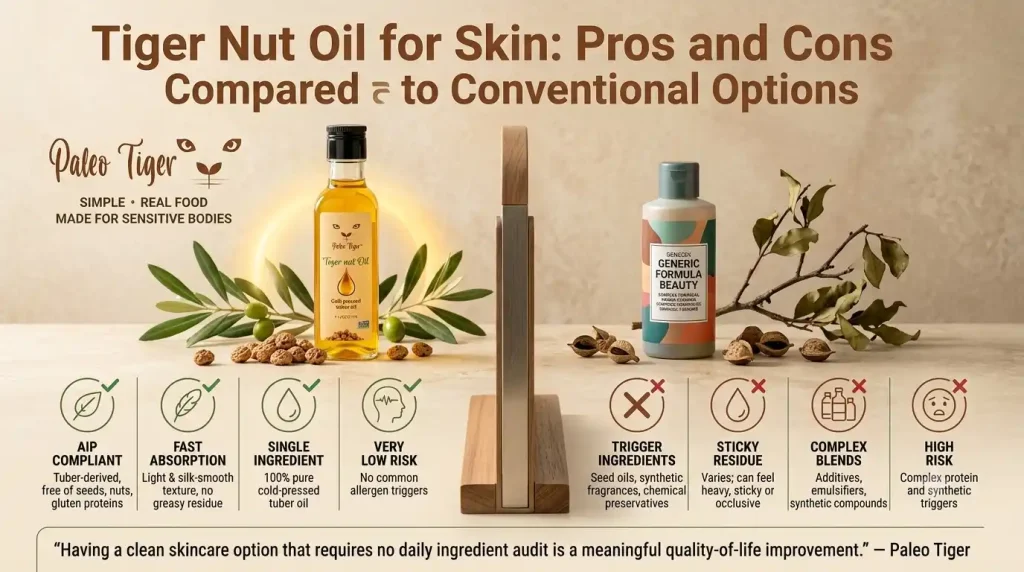
It is worth being honest about where tiger nut oil for skin excels and where it has limitations, especially when compared to conventional (non-AIP) skincare products.
| Tiger Nut Oil | Conventional Seed-Based Beauty Oils | Synthetic Moisturizers | |
| AIP Compliant | Yes | Often No (seed-derived) | Often No (additives) |
| Absorption Speed | Fast | Varies widely | Fast (water-based) |
| Ingredient Simplicity | Single ingredient | Often blended with additives | Complex formulas |
| Allergy Risk | Very low (tuber) | Moderate–High (nut/seed proteins) | Variable |
| Vitamin E Content | Natural, present | Sometimes added synthetically | Sometimes added |
| Shelf Life | ~12–18 months | Varies | Longer (preservatives added) |
| Scent | Mild, faintly nutty | Varies (often fragranced) | Often synthetic fragrance |
| Cost per Use | Economical (few drops) | Varies | Varies |
The case for tiger nut oil in an AIP skincare context is not that it outperforms every conventional product in every category. It is that it removes the ingredient risk entirely, without requiring you to sacrifice performance. For someone already reading food labels carefully every day, having a skincare option that requires no ingredient audit is a genuine quality-of-life improvement.
Browse our full product range, including our 100% Cold-Pressed Tiger Nut Oil, to see exactly what goes into the bottle. No additives, no blending agents, no fillers.
The AIP Skin Connection: Why What You Eat Affects What You Apply
One of the more overlooked aspects of the Autoimmune Protocol is that skin symptoms, rashes, dryness, psoriatic flares, eczema, often respond to dietary changes alongside topical care. The elimination protocol is designed to reduce inflammatory triggers systemically, which means improvements can show up in the skin even when the primary goal was gut or joint health.
Using tiger nut oil for skin while following the AIP diet creates a consistent approach: reducing inflammatory inputs both internally and externally. Seed-based oils in skincare products often contain linoleic acid in ratios that, applied repeatedly to inflamed skin, can disrupt rather than support the skin barrier. Cold-pressed tiger nut oil avoids that imbalance.
If you are new to the protocol and want to understand the full elimination framework, our overview at What Is the AIP Diet is the right starting point before layering in skin-specific adjustments.
The skin is also one of the most visible indicators of whether the AIP diet is working. Our breakdown at Top 10 Signs the AIP Diet Is Working lists skin changes as one of the key early signals, something worth tracking alongside topical interventions.
Tiger Nut Oil for Skin in an AIP Household: The Allergy Angle
Households managing a tree-nut allergy alongside an autoimmune protocol often end up with two versions of everything. Tiger nut oil sidesteps that entirely. Because the tiger nut is a root vegetable, not a nut at all, it carries none of the proteins that trigger IgE-mediated nut allergy responses. This matters for topical use just as much as dietary use.
For families where one member has AIP restrictions and another has a tree-nut allergy, a single bottle of tiger nut oil for skin covers everyone at the table, and everyone at the bathroom counter. That is a practical win that does not get talked about enough.
The same logic applies to parents looking for simple, single-ingredient options for children with sensitive skin. Our post on AIP Snacks for Kids and Family Meals covers the family AIP angle more broadly, including how to manage mixed-need households day to day.
How Paleo Tiger Sources and Cold-Presses Tiger Nut Oil?

At Paleo Tiger, every product starts with a question: does this ingredient do what it claims, and can we source it without compromising the principles the brand was built on? Our cold-pressed tiger nut oil is no exception.
Cold pressing preserves the full fatty acid profile and natural vitamin E content that make tiger nut oil for skin valuable in the first place. Heat extraction, used in most commercial oils, drives down cost but also drives out the compounds that matter most for skin health. We choose cold pressing deliberately, not as a marketing claim but because the resulting oil actually performs better.
What goes into the bottle is one ingredient: tiger nut oil. No carrier oils, no vitamin E added back in synthetically, no fragrance to mask a processing smell. If you are the kind of person who turns products over to read the back label, you will appreciate having nothing to decode.
Our full pantry lineup, including Whole Tiger Nuts, Tiger Nut Flour, and Tiger Nut Butter, is built on the same sourcing principle. One ingredient, done well.
Statistics and Evidence: Why Tiger Nut Oil Stands Out
| Stat / Data Point | Detail | Source / Context |
| Oleic acid content | ~65–73% of total fatty acids | Comparable to olive oil’s oleic acid range of 55–83% |
| Vitamin E (tocopherol) | Naturally present without fortification | Many seed oils require synthetic Vitamin E addition |
| Absorption rate | Classified as a ‘dry’ oil, absorbs without residue | Relevant for daily face use without a greasy finish |
| Allergen risk | No known cross-reactivity with tree nut allergies | Critical for AIP households managing multiple restrictions |
| AIP compliance | 100% elimination-phase compliant | Tuber origin, no seeds, grains, or legumes |
| Non-comedogenic rating | Low comedogenic score (comparable to argan oil) | Safe for oily/combination and acne-prone skin types |
Common Mistakes When Using Tiger Nut Oil for Skin
A few missteps come up often enough with natural oil skincare that they are worth flagging before you start:
• Using too much. A few drops go a long way. Using too much, especially on the face, leads to that greasy feel that puts people off oil-based moisturizers. Start with two drops and work up if needed.
• Applying to completely dry skin. Natural oils seal in moisture rather than adding it. Apply tiger nut oil to slightly damp skin to lock hydration in rather than just coating the surface.
• Expecting overnight transformation. Consistent daily use over several weeks is where the barrier-repair and moisturizing benefits become visible. It is not a quick-fix product.
• Skipping a patch test. Even a well-tolerated oil like tiger nut oil for skin is worth patch-testing on the inner arm for 24 hours before applying it to the face, especially if your skin is currently in a reactive state.
• Storing in a warm or sunny spot. Cold-pressed oils keep their fatty acid integrity best when stored away from direct heat and light. A cool, dark cabinet extends shelf life to 12–18 months without refrigeration.
Pairing Tiger Nut Oil Skincare with an AIP-Compliant Internal Routine
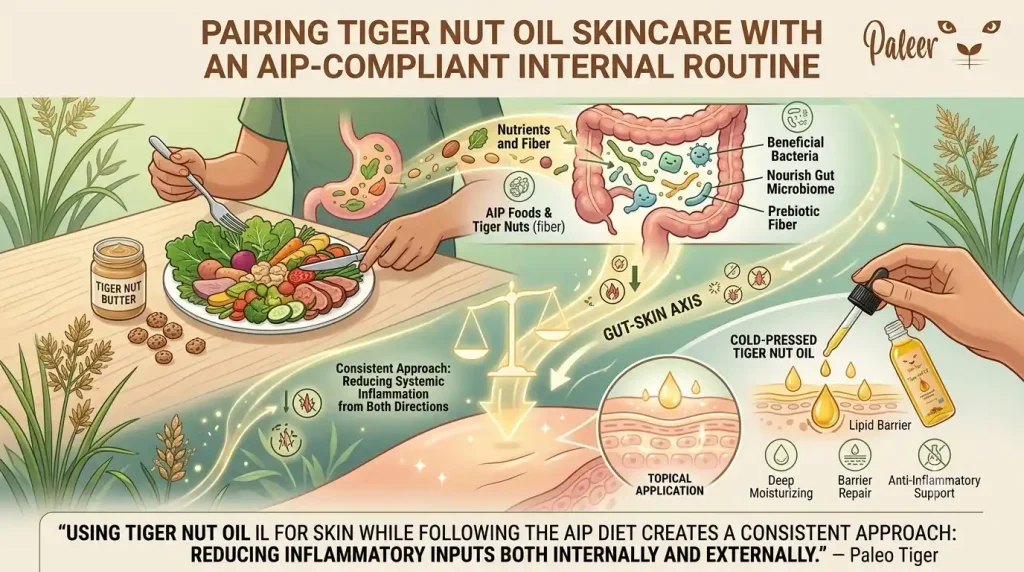
Topical tiger nut oil works best as part of a broader approach, one that addresses inflammation from the inside as well as the outside. That means the AIP diet remains the foundation, with skincare serving as a complementary layer rather than a standalone solution.
Internally, tiger nuts are a prebiotic food, they feed the beneficial bacteria in the gut that play a role in systemic inflammation management. Our Tiger Nut Prebiotic overview explains how the fiber content of tiger nuts supports the gut-skin axis, a well-established connection between gut health and skin condition.
Eating whole tiger nuts, using tiger nut butter, and applying tiger nut oil for skin creates a consistent approach from multiple directions, dietary, microbiome, and topical — without ever stepping outside AIP guidelines. That is the kind of coherent, brand-wide support that Paleo Tiger was designed to provide.
Our Tiger Nut Butter Original and Cinnamon Tiger Nut Butter are the easiest starting points for adding tiger nuts to the diet alongside a topical routine.
Final Thoughts
Skincare is often the last thing people adjust on AIP, understandably, because the dietary changes ask enough of you already. But the logic is the same: tiger nut oil for skin removes one more source of inflammatory ingredients from daily life without requiring you to sacrifice effectiveness or add complexity to your routine.
A bottle of cold-pressed tiger nut oil does the work of a facial moisturizer, body oil, eye treatment, and hair conditioner in a single AIP-compliant, allergy-safe, single-ingredient product. That is a meaningful simplification, not a compromise.
Start with the face, build from there, and give it a few consistent weeks before judging the results. The difference between an oil that coats skin and one that genuinely supports it becomes clear fairly quickly.
Browse the full Paleo Tiger range at our shop, including tiger nut oil, whole tiger nuts, flours, and butters, all built around the same one-ingredient standard.
Frequently Asked Questions
1. Is tiger nut oil for skin safe during the AIP elimination phase?
Yes. Tiger nut oil is cold-pressed from a root vegetable, not a seed, nut, or legume. It is fully compliant with AIP elimination-phase guidelines for both internal and topical use.
2. Can I use tiger nut oil on my face every day?
Yes. Tiger nut oil for skin absorbs quickly and has a low comedogenic rating. Two to three drops daily on slightly damp skin is a practical starting point for most skin types.
3. Is tiger nut oil safe for people with tree-nut allergies?
Yes. Despite the name, tiger nuts are tubers with no cross-reactivity to tree-nut allergens. Tiger nut oil is safe for households managing tree-nut allergies alongside AIP.
4. How does tiger nut oil compare to coconut oil for skin?
Tiger nut oil for skin absorbs faster and does not block pores the way coconut oil can for some users. It is better suited for daily face use, while coconut oil works well for overnight treatments on very dry areas.
5. How long does a bottle of tiger nut oil last for skincare use?
With daily use of two to four drops on the face, a standard bottle lasts several weeks. Tiger nut oil keeps for 12–18 months stored in a cool, dark place away from direct heat or sunlight.