
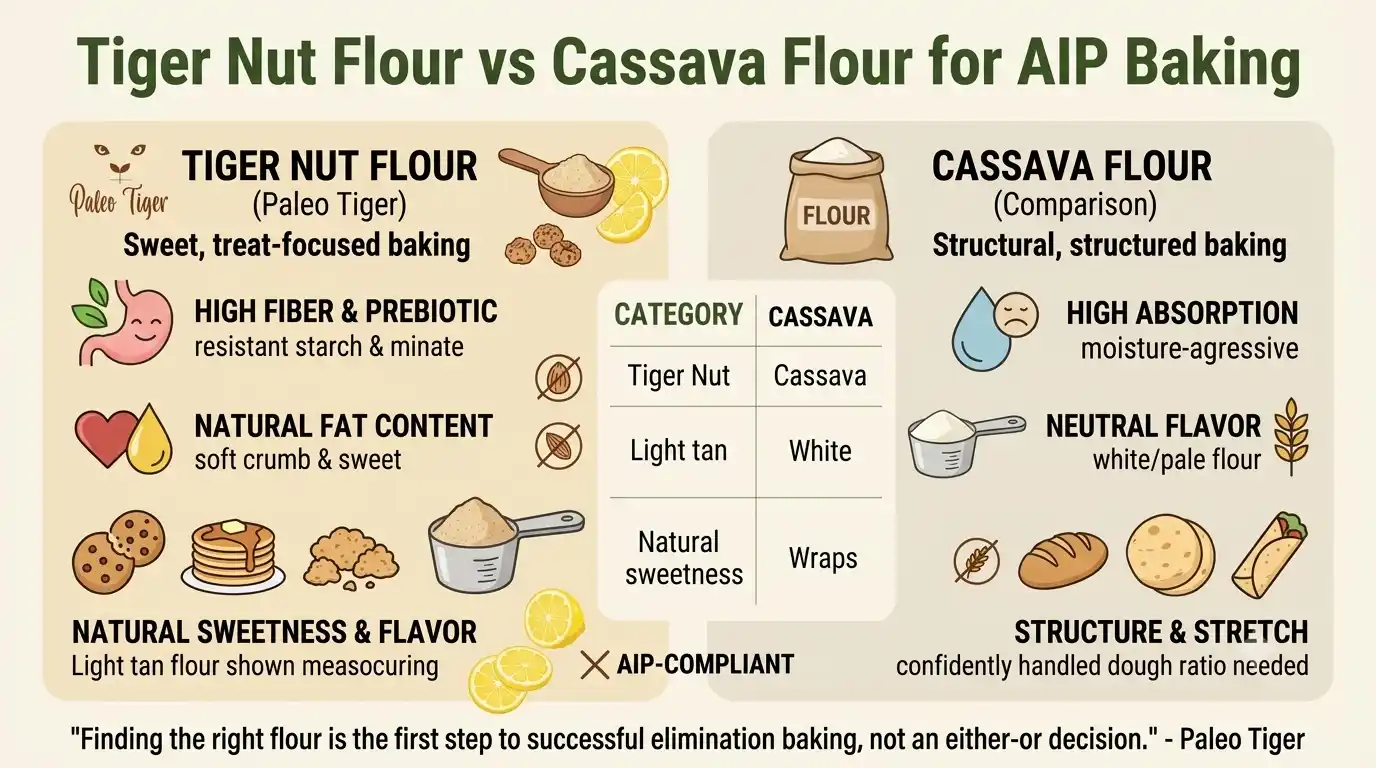
Anyone who has stood in a kitchen holding two bags of AIP-compliant flour, unsure which one actually belongs in the recipe, knows the problem isn’t a lack of options. It’s that Tiger Nut Flour vs Cassava Flour gets framed as an either-or choice when the honest answer depends on what’s being baked, and almost nobody explains that clearly.
Both flours show up constantly in AIP baking discussions, and both are genuinely compliant during elimination. But they behave nothing alike once they hit a mixing bowl. One browns and tastes faintly sweet. The other stays pale and works more like a thickener than a flour. Mixing them up in a recipe is the fastest way to end up with a dense, gummy loaf instead of something worth eating again.
This guide breaks down Tiger Nut Flour vs Cassava Flour across texture, taste, nutrition, and real baking performance, so the decision stops being a guess. For a wider look at where tiger nut products fit into the bigger picture, the All Things Tiger Nuts guide collection covers that in more depth.
Why This Comparison Trips Up So Many AIP Bakers?
Most people land on AIP after cutting out grains, and the instinct is to reach for whatever gluten-free flour is already in the pantry. The problem is that almond flour, oat flour, and most gluten-free blends are seed- or grain-based, which knocks them straight out of AIP elimination. That leaves a short list of compliant starches and flours, and Tiger Nut Flour and Cassava Flour are the two that show up most often.
The confusion usually starts because recipe blogs use the terms loosely, calling for “a grain-free flour” without specifying which one, or swapping them 1:1 in a recipe that was never tested that way. Cassava Flour absorbs liquid aggressively and behaves close to wheat flour in structure. Tiger Nut Flour is denser, slightly sweet, and doesn’t bind the same way on its own. Treating them as interchangeable is where most AIP baking failures actually start.
Understanding the difference up front saves a lot of wasted ingredients, and it’s exactly the kind of practical clarity Paleo Tiger was built to provide for people navigating elimination-phase cooking.
What Tiger Nut Flour Actually Is?
Tiger Nut Flour is ground from tiger nuts, which despite the name are a small root tuber, not a tree nut, seed, or legume. That makes it fully compliant during AIP elimination, and safe for households managing tree-nut allergies alongside autoimmune dietary needs.
The flavor is mild, faintly sweet, and a little earthy, closer to a toasted oat than anything nut-like. It carries a natural fat content most other AIP flours don’t have, which gives baked goods a softer crumb and a flavor that doesn’t need much dressing up. The tiger nut flour benefits extend well beyond baking, but texture and taste are where it earns its place in a mixing bowl specifically.
It also brings fiber and a small amount of resistant starch to the table, something cassava flour doesn’t offer nearly as much of. That’s a meaningful difference for anyone paying attention to digestion during elimination, not just flavor.
What Cassava Flour Actually Is?
Cassava Flour is made from the whole cassava root, peeled, dried, and ground fine. It’s neutral in flavor, pale in color, and absorbs moisture the way wheat flour does, which is why it shows up in so many AIP bread and tortilla recipes that need a stretchy, structured dough.
That neutral flavor is both its strength and its limitation. It won’t fight with other ingredients, but it also won’t add anything on its own. Baked goods made entirely from Cassava Flour can turn gummy or dense if the liquid ratio is even slightly off, since it keeps absorbing moisture well after mixing. Anyone who has worked with yuca in cooking will recognize the same starchy, absorbent quality showing up here in flour form.
Tiger Nut Flour vs Cassava Flour: Side-by-Side Comparison
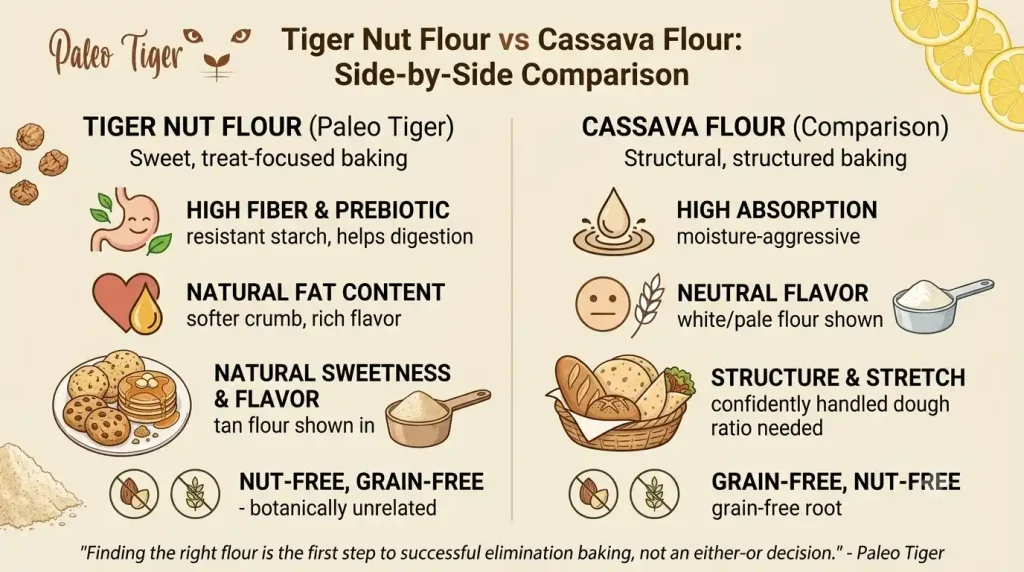
Here’s how Tiger Nut Flour vs Cassava Flour actually stack up once the marketing language is stripped away.
| Category | Tiger Nut Flour | Cassava Flour |
| Source | Root tuber (not a nut) | Cassava root |
| Flavor | Mild, sweet, nutty | Neutral, starchy |
| Color | Light tan | White/pale |
| Best for | Cookies, pancakes, crumbles | Bread, tortillas, wraps |
| Moisture absorption | Moderate | High, absorbs aggressively |
| Fiber content | Higher | Lower |
| Binds without eggs | Sometimes, depends on recipe | Rarely, needs a binder |
| Allergy profile | Tree-nut-free | Grain- and nut-free |
Neither flour wins outright. Tiger Nut Flour earns its place in anything meant to taste like a treat, while Cassava Flour earns its place in anything meant to hold a shape. The strongest AIP baking results we’ve seen actually use both, in the same recipe, rather than picking a single winner.
Texture and Taste in Real Baking
On its own, Tiger Nut Flour lends a tender, slightly crumbly texture, similar to a flour made from toasted oats. It performs best in recipes that are supposed to be a little dense, cookies, crumbles, pancakes, where its natural sweetness means less added sweetener is needed overall.
Cassava Flour, by contrast, produces a smoother, more elastic dough once hydrated, which is exactly why it dominates AIP bread and tortilla recipes. The trade-off is that it needs a confident hand with liquid ratios. Too much liquid and the result turns gummy; too little and it crumbles apart.
Blended together, the two flours balance each other out. Cassava Flour provides the structure, Tiger Nut Flour softens the crumb and rounds out the flavor. A rough starting ratio of two parts cassava to one part tiger nut flour is a reasonable template for adapting an existing AIP bread recipe, though it’s worth testing in small batches before committing to a full loaf.
Nutrition Side by Side
Beyond texture, the nutrition profile is where Tiger Nut Flour pulls ahead in a few specific areas. It carries more dietary fiber per serving than Cassava Flour, along with a modest amount of resistant starch, a type of fiber that feeds beneficial gut bacteria rather than spiking blood sugar the way refined starches do.
Cassava Flour is mostly carbohydrate with very little fiber or fat, which makes it lighter and easier to digest in small amounts but less satisfying on its own. Anyone trying to manage blood sugar response or get more fiber during elimination will generally get more nutritional value from leaning on tiger nut flour where the recipe allows it. For more on how fiber and starch choices interact with gut health on AIP, the health and wellness section covers that ground in detail.
Which Recipes Favor Which Flour?
• Cookies and bars: Tiger Nut Flour, for natural sweetness and a tender bite without extra sugar.
• Pancakes and waffles: Tiger Nut Flour, since the flavor stands on its own with minimal toppings.
• Bread and rolls: Cassava Flour, for the structure needed to hold a rise and a crust.
• Tortillas and wraps: Cassava Flour, for its stretch and pliability once cooked.
• Crumbles and toppings: Tiger Nut Flour, for a toasty, slightly sweet finish.
• Thickening sauces or gravies: Cassava Flour, used the same way arrowroot is used.
If a recipe calls for a flour that needs to brown nicely under heat, like a streusel topping or a cookie edge, Tiger Nut Flour usually wins on appearance and flavor. If the recipe needs to fold, roll, or hold air, Cassava Flour is doing the heavier lifting. This is the same logic behind why arrowroot often shows up alongside cassava flour in AIP baking, since both help manage structure rather than flavor.
Pros and Cons at a Glance
| Tiger Nut Flour | Cassava Flour |
| + Naturally sweet, less added sugar needed | + Neutral flavor fits savory and sweet recipes |
| + Higher fiber and resistant starch | + Stretchy, dough-like texture when hydrated |
| + Tree-nut-free, allergy-friendly | + Works as a 1:1 wheat flour substitute in many recipes |
| − Doesn’t bind well alone in bread | − Easy to overhydrate into a gummy texture |
| − Denser, less stretch for wraps | − Lower fiber and fat than tiger nut flour |
Reading this table side by side makes the decision less about which flour is “better” and more about which job needs doing. That’s a more useful framework than most comparison guides offer, and it’s the framework Paleo Tiger leans on across every product recommendation.
Common Mistakes When Substituting Between the Two
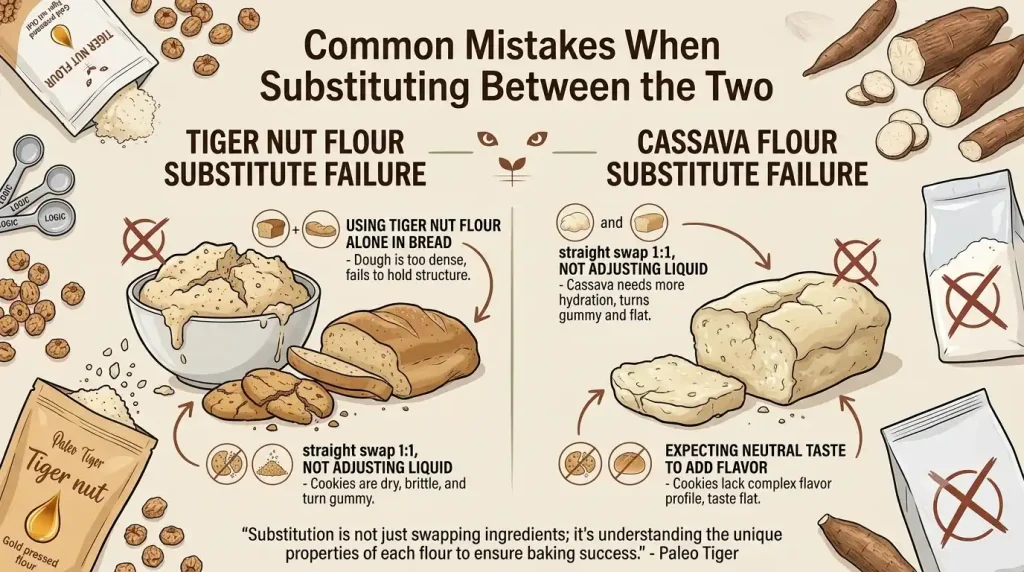
A handful of mistakes show up repeatedly when people try to swap one flour for the other without adjusting anything else.
• Swapping 1:1 without adjusting liquid. Cassava Flour needs noticeably more liquid than Tiger Nut Flour. A straight swap usually produces a dry, crumbly result.
• Expecting cassava flour to taste like something. Its neutral flavor means recipes built around it need more seasoning, sweetener, or spice than a tiger-nut-based version.
• Using tiger nut flour alone in bread. It doesn’t have the gluten-like structure cassava flour can mimic, so bread made entirely from tiger nut flour tends to fall flat.
• Overmixing cassava-flour dough. It can turn gummy fast. A light hand and a short mixing time go further than working it longer.
• Storing either flour somewhere warm. Both keep best in a cool, dry pantry or the fridge, away from direct heat that can affect texture over time.
Pairing Tiger Nut Flour With the Rest of an AIP Pantry
Tiger Nut Flour rarely works in isolation. The recipes that turn out best usually pair it with a complementary fat, like tiger nut oil, which keeps the same mild, slightly sweet flavor profile going through the whole dish rather than introducing a competing taste from olive or coconut oil.
For anyone building a full AIP baking pantry, keeping a bag of tiger nut flour stocked alongside cassava flour means almost any baked good on the elimination-phase list is within reach without a special grocery run. That kind of stocked-and-ready pantry is the entire idea behind how Paleo Tiger built out its flour and oil lineup in the first place, so the decision fatigue of figuring out which flour does what disappears before it even starts.
A spoonful of tiger nut butter stirred into a tiger-nut-flour batter also adds moisture and a deeper flavor without introducing anything outside AIP boundaries, which is a small trick worth keeping in the back pocket for cookie and muffin recipes specifically.
Why Quality Matters More Than the Label?
Not every bag labeled “Tiger Nut Flour” or “Cassava Flour” performs the same way. Coarser grinds behave differently in a recipe than extra-fine grinds, and inconsistent sourcing can change moisture content from bag to bag, which throws off even a well-tested recipe.
This is one of the clearer cases where it pays to buy from a source that’s actually paying attention to grind consistency and sourcing, rather than whatever’s cheapest on a shelf. Paleo Tiger’s extra-fine tiger nut flour is milled specifically with baking performance in mind, which removes one more variable from a process that already has enough of them during strict elimination. Anyone wanting the full picture on sourcing and quality can browse the shop page directly.
Cost, Shelf Life, and Everyday Practicality
Price and shelf life matter just as much as taste once a flour becomes a weekly staple rather than a one-time experiment. Cassava Flour is generally the more affordable option per pound, partly because cassava root is a high-yield crop grown at scale in several regions. Tiger Nut Flour tends to run a little higher, reflecting the more involved process of growing, drying, and milling tiger nut tubers into a fine, baking-ready powder.
Shelf life is close between the two when stored properly. Both keep well for several months in a sealed container in a cool pantry, and longer in the fridge or freezer. The bigger practical difference shows up in how each flour behaves once opened: cassava flour can clump if it picks up any humidity, while tiger nut flour’s natural fat content means it benefits from cooler storage to avoid the oils inside it turning slightly stale over time.
None of this should be a dealbreaker either way. The modest price difference between Tiger Nut Flour and Cassava Flour is easy to justify once the nutritional and textural upsides are factored in, and buying both in reasonable quantities means neither one runs out mid-recipe.
Digestive Considerations Worth Knowing
AIP exists largely because of how certain foods interact with gut lining and digestion, so it’s worth looking at how each flour actually behaves once it’s eaten, not just baked.
Tiger Nut Flour’s resistant starch and fiber content mean it digests more slowly, which can help with steadier energy and a feeling of fullness after a baked good rather than a quick spike and crash. That same fiber, though, means some people introduce it gradually rather than eating a large serving on day one, simply because any new source of fiber can take a little adjustment.
Cassava Flour digests faster, with very little fiber to slow it down. That makes it gentler for anyone whose gut is more sensitive during the early weeks of elimination, but it also means baked goods made entirely from cassava flour won’t carry the same staying power. Pairing a cassava-based bread with a protein or healthy fat, rather than eating it on its own, helps balance that out. The AIP diet overview covers more on how fiber, fat, and protein work together during elimination if this is new territory.
Which Flour Should You Start With?
For anyone brand new to AIP baking and trying to decide between Tiger Nut Flour and Cassava Flour without buying both immediately, the answer usually comes down to what’s already on the weekly meal plan.
• If breakfast is the priority: start with Tiger Nut Flour for pancakes, muffins, or a simple crumble topping.
• If bread or wraps are the priority: start with Cassava Flour, since it covers the widest range of bread-style recipes.
• If cookies or treats are the priority: Tiger Nut Flour’s natural sweetness does more of the work without added sugar.
• If thickening sauces or gravies matters: Cassava Flour functions well as a 1:1 stand-in for cornstarch or arrowroot.
Most people end up buying both within the first month of serious AIP baking anyway, simply because the recipes that come up week to week rarely fall into only one category. Starting with whichever matches this week’s meal plan is a perfectly reasonable way to ease into the Tiger Nut Flour vs Cassava Flour decision without overthinking it.
How Paleo Tiger Thinks About Flour Quality?
A comparison like Tiger Nut Flour vs Cassava Flour is only as useful as the quality of the flour actually sitting in the bag. Inconsistent milling, uneven moisture content, and poor sourcing can make even a well-written recipe fail for reasons that have nothing to do with the recipe itself.
That’s the gap Paleo Tiger set out to close. Every batch of tiger nut flour is milled extra-fine specifically with baking performance in mind, not just snacking, which means the texture stays consistent from bag to bag instead of varying the way many imported, loosely regulated tiger nut products do. Anyone who has had a recipe fail for no obvious reason has likely run into that kind of inconsistency before, and it’s a frustrating problem that has nothing to do with skill in the kitchen.
The same attention to detail carries across the rest of the lineup, from tiger nut butter to whole tiger nuts to cold-pressed oil, all built around the idea that AIP and Paleo baking shouldn’t require a chemistry degree to get right. That consistency is exactly why so many people researching Tiger Nut Flour vs Cassava Flour end up settling on Paleo Tiger’s flour specifically once they’ve tried a few less consistent alternatives.
A Simple Framework for Blending the Two
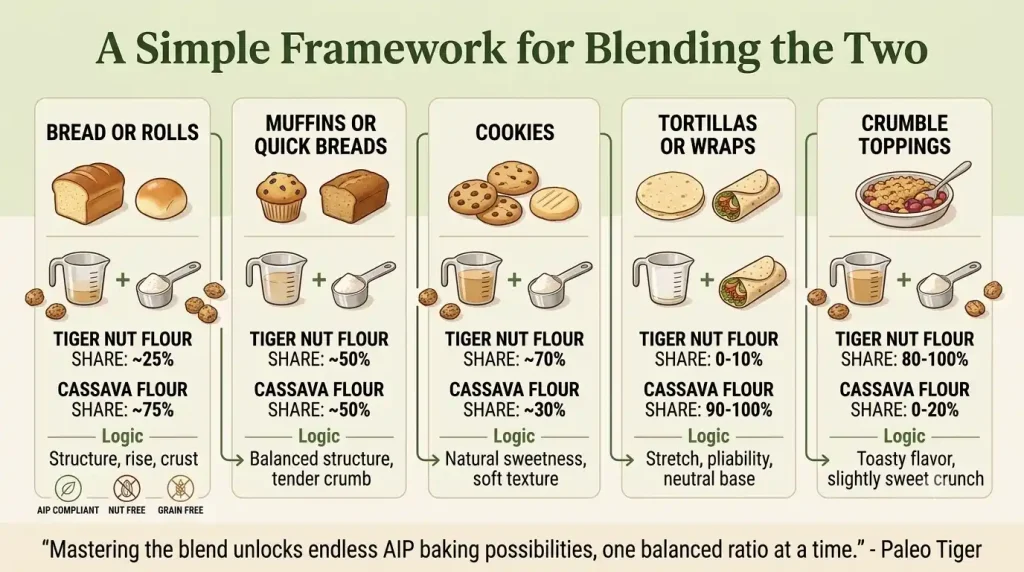
Rather than treating Tiger Nut Flour vs Cassava Flour as a binary choice, it helps to have a basic ratio framework to start from when adapting any existing AIP recipe.
| Recipe type | Tiger Nut Flour share | Cassava Flour share |
| Bread or rolls | 25% | 75% |
| Muffins or quick breads | 50% | 50% |
| Cookies | 70% | 30% |
| Tortillas or wraps | 0–10% | 90–100% |
| Crumble toppings | 80–100% | 0–20% |
These ratios aren’t rigid rules, they’re a reasonable starting point based on how each flour behaves. Once the basic logic behind Tiger Nut Flour vs Cassava Flour makes sense, adjusting the ratio for a specific recipe becomes a lot less intimidating than it sounds.
A Note for Allergy-Conscious Households
Families managing food allergies alongside AIP often have it harder than most, since a single dinner sometimes needs three or four versions to satisfy everyone’s restrictions. This is one of the clearest places where the Tiger Nut Flour vs Cassava Flour comparison stops being academic and starts being genuinely useful day to day.
Both flours are free of gluten, grains, nuts, legumes, and dairy, which means a single batch of cookies or bread made with either one, or a blend of both, can usually be served to the whole table without separate accommodations. That’s a meaningful relief for anyone who has spent years cooking two or three versions of the same meal. Households dealing with tree-nut allergies specifically benefit from knowing tiger nuts are botanically unrelated to almonds, cashews, or walnuts, a distinction covered in more depth in the nut-free butter alternatives guide.
Cassava Flour carries its own appeal here too, since its neutral flavor and texture mean it doesn’t taste “adapted” the way some allergy-friendly substitutes can. Combined, the two flours make it realistic to cook one meal for an entire household instead of negotiating separate dishes around each person’s restrictions.
What Pairs Well With Each Flour?
Because Tiger Nut Flour carries its own mild sweetness, it pairs naturally with warm spices like cinnamon, ginger, and vanilla, and with fruit like banana, apple, or pear folded into a batter. It also plays well with a drizzle of tiger nut oil in the batter itself, since the flavors echo each other rather than competing.
Cassava Flour, being neutral, takes direction from whatever it’s paired with. Savory herbs, garlic, and a splash of coconut aminos work well in a cassava-based flatbread, while a touch of honey or maple syrup can round out a cassava-based muffin that would otherwise taste a little flat. Because it doesn’t bring its own flavor to the table, it tends to need slightly more seasoning overall than recipes built around tiger nut flour.
Thinking about flavor pairing this way, rather than treating both flours as interchangeable blank slates, makes the Tiger Nut Flour vs Cassava Flour decision a lot more intuitive the second or third time around.
A Quick Example: AIP Drop Biscuits
A simple recipe makes the difference between these two flours obvious faster than any chart can. These drop biscuits use a blend of both, leaning on cassava flour for structure and tiger nut flour for flavor and a tender crumb.
• 1 cup cassava flour
• 1/2 cup tiger nut flour
• 1/3 cup tiger nut oil, cold
• 3/4 cup full-fat coconut milk
• 1 tsp baking soda
• 1/2 tsp sea salt
Combine the dry ingredients first, cut in the cold tiger nut oil until the mixture turns slightly crumbly, then fold in the coconut milk just until a shaggy dough forms. Drop spoonfuls onto a baking sheet and bake at 400°F for roughly 15 to 18 minutes, until the tops turn lightly golden.
The result holds together the way a cassava-flour-only biscuit struggles to, while the tiger nut flour keeps the crumb from turning dense or gummy. It’s a small recipe, but it demonstrates the core logic behind Tiger Nut Flour vs Cassava Flour better than any side-by-side description could on its own. For more elimination-phase baking ideas built around the same logic, the AIP recipes section has several worth trying next.
Why Sourcing Quality Flour Actually Matters?
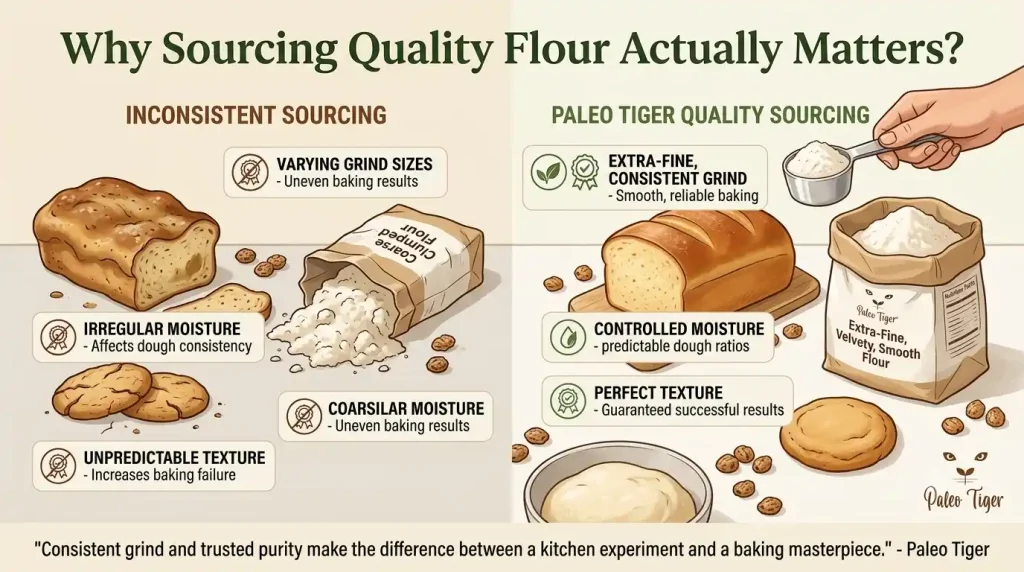
It’s worth repeating, because it gets overlooked constantly: the entire Tiger Nut Flour vs Cassava Flour conversation assumes a reasonably consistent product on both sides. That assumption doesn’t always hold. Tiger nut flour in particular can vary widely in grind size and moisture content depending on where it’s sourced, and a coarser grind behaves nothing like an extra-fine one in a delicate batter.
Paleo Tiger’s approach has always been to treat the milling process as seriously as the sourcing itself, since a perfectly grown tiger nut milled inconsistently still produces an inconsistent flour. That attention to detail is a large part of why bakers who’ve struggled with gummy or unpredictable results from other brands tend to notice an immediate difference once they switch. It’s a small thing on paper, grind consistency, but it’s the difference between a recipe that works every time and one that’s a gamble.
Key Takeaways Before You Buy
A few points are worth holding onto from everything above, especially for anyone skimming before a grocery run.
• Both Tiger Nut Flour and Cassava Flour are fully AIP-compliant, free of grains, nuts, seeds, legumes, and dairy.
• Tiger Nut Flour brings sweetness, fiber, and resistant starch, making it the better choice for cookies, pancakes, and crumbles.
• Cassava Flour brings structure and stretch, making it the better choice for bread, tortillas, and anything that needs to hold a shape.
• Blending the two, roughly two parts cassava to one part tiger nut flour as a starting point, often produces the most balanced results in baked goods that need both flavor and structure.
• Grind consistency and sourcing quality matter as much as the flour type itself, which is where a dedicated supplier like Paleo Tiger makes a measurable difference in everyday baking results.
Keeping both flours stocked, rather than picking one and hoping it covers every recipe, removes the guesswork from week-to-week AIP baking and turns the Tiger Nut Flour vs Cassava Flour decision into a simple matter of reaching for the right bag at the right time.
Final Thoughts
The Tiger Nut Flour vs Cassava Flour question isn’t really a competition, it’s a matter of matching the flour to the job. Tiger Nut Flour brings flavor, fiber, and a tender crumb to anything sweet. Cassava Flour brings structure and stretch to anything that needs to hold together. Most AIP kitchens end up keeping both on the shelf rather than choosing a single winner, and that’s the right call.
Starting with a small batch of each, a simple cookie with tiger nut flour and a basic tortilla with cassava flour, is the fastest way to understand how each one behaves before committing to a more ambitious recipe. From there, blending the two becomes much easier to get right. The full Paleo Tiger pantry lineup is built to make that kind of experimentation simple rather than stressful, one stocked ingredient at a time.
Frequently Asked Questions
Can Tiger Nut Flour and Cassava Flour be used together in one recipe?
Yes. Many AIP bakers blend both, using cassava flour for structure and tiger nut flour for flavor and a softer crumb, especially in breads and muffins.
Which flour is better for someone with a tree-nut allergy?
Both are tree-nut-free. Tiger nuts are a root tuber, not a nut, so Tiger Nut Flour is safe alongside Cassava Flour for nut-allergy households.
Does Cassava Flour taste like anything on its own?
Not much. Cassava Flour is neutral, which makes it flexible but means recipes need extra seasoning or sweetener compared to Tiger Nut Flour.
Why does my cassava flour bread turn out gummy?
Usually too much liquid or overmixing. Cassava Flour absorbs moisture aggressively, so smaller liquid amounts and a light mixing hand help.
Is Tiger Nut Flour from Paleo Tiger fine enough for baking?
Yes. Paleo Tiger mills its tiger nut flour extra-fine specifically for baking, giving more consistent texture than coarser, inconsistently milled versions.